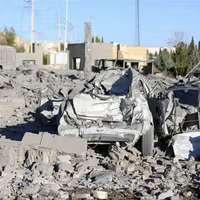
New US intelligence indicates Israel is actively preparing for possible strikes on Iranian nuclear facilities, CNN reported Tuesday, citing multiple officials familiar with the intelligence.
“It has gone up significantly in recent months,” one source told CNN, referring to the likelihood of Israeli action. The same source said chances of a strike would increase if the US reached a nuclear deal that left Iran’s uranium stockpile intact.
The report, based on intercepted Israeli communications, observations of military movements and internal Israeli deliberations, said the preparations included air munitions transfers and completed air drills. CNN noted divisions within the US government over whether Israel will ultimately proceed.
The White House and Israeli officials declined immediate comment, according to Reuters.
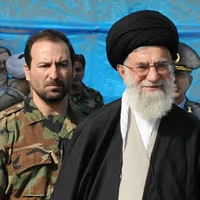
Earlier Tuesday, Iran’s Supreme Leader Ali Khamenei dismissed US demands to halt uranium enrichment as “excessive and outrageous,” casting doubt on prospects for a negotiated settlement under President Donald Trump’s administration.

A US congresswoman of Iranian descent has introduced legislation named after an Iranian Christian covert to block expedited deportations to countries where they may face persecution.
The 'Artemis Act' unveiled on Tuesday honors Artemis Ghasemzadeh, a 27-year-old asylum seeker who was expelled to Panama by the Trump administration after entering the US via its southern border.
She was denied a legally mandated interview and placed on a military flight without notice, her attorney said.
“Artemis Ghasemzadeh was denied the due process afforded to asylum seekers by law, plain and simple,” Arizona Democratic Representative Yassamin Ansari. “Returning to the Islamic Republic of Iran would mean immediate—potentially deadly—danger for her, both as a woman and a Christian convert.”
“People like Artemis who are fleeing religious persecution should not be subject to expedited removal. They deserve a chance to plead their case–that's what my bill will guarantee,” she wrote on X.
Ghasemzadeh fled Iran after members of her underground bible study group were arrested. She told Iran International she was misled about her transfer, held in a jungle detention camp in Panama, and forced to subsist on contaminated water and stale bread.
“The food just helps us stay full and not die,” she said at the time, using a shared phone before being cut off.
The proposed Artemis Act would prohibit deportations to any country listed by the US government as committing “particularly severe violations of religious freedom,” aiming to prevent removals like Ghasemzadeh’s.
Her lawyer has filed a complaint with the Inter-American Court of Human Rights against both US and Panamanian authorities.

Iran's Supreme National Security Council issued a directive on Tuesday banning domestic media from translating or republishing foreign reports on the country’s negotiations with the United States or offering any analysis on the talks.
The SNSC directive, a copy of which was obtained by Iran International, warned that failure to comply would be considered an act of threatening national interests and security.
It instructed media outlets and editors to only rely on official statements from the Iranian Foreign Ministry—namely, the foreign minister and the ministry’s spokesperson—for any coverage related to the ongoing talks.
The directive was published hours after Iran's Supreme Leader Ali Khamenei said that the current indirect nuclear talks with the United States are unlikely to succeed.
"Translating or republishing negotiation-related news from foreign sources including foreign state or non-state media, social networks, online activists, or any other sources is strictly prohibited and considered contrary to national interests and security," the notice said.
The council also warned against publishing any analysis, interpretation or speculation—whether supportive or critical—about the content or outcome of the negotiations.
"Media outlets are also expected, in order to maintain national unity, preserve public psychological calm, support the negotiating team, and convey a unified message to both domestic and international audiences," it continued.
Outlets must "refrain entirely from publishing any analysis, prediction, interpretation, or independent commentary regarding the details of the negotiations, the positions of the opposing parties, or conclusions based on unofficial reports," it added.
The directive emphasized that the restrictions are aimed at preventing the spread of misinformation and ensuring consistency in the country’s foreign policy messaging.
The 2024 Reporters Without Borders (RSF) World Press Freedom Index ranked Iran 176th out of 180 countries assessed, citing state control of the media landscape and the arbitrary arrest and prosecution of journalists before revolutionary courts.
Optimism in Tehran about nuclear talks with Washington has waned after a stern public rebuke from Iran's Supreme Leader Ali Khamenei on Tuesday to US demand that Iran totally halt uranium enrichment.
Some supporters of a hard Iranian line said a US moratorium on Iranian enrichment, which Tehran maintains is its national right, would scupper the talks.
“The Leader stood up to America's excesses. The US will be directly responsible if the negotiations bear no result. They have no right not to recognize (Iran's) right to enrichment,” hardline cleric Ehsan Ebadi posted on X.
But the sharp speech also raised alarm about the stakes of the talks' collapse.
“The failure of the negotiations is definitely a loss for Iran, not the US. Iran should not let the negotiations fail,” Iranian teacher Ali Ghiasi-Farahani posted on X.

As nuclear diplomacy draws global attention, Iran’s domestic politics remain consumed by petty administrative debates, leaving little space to address the country’s deeper economic and institutional challenges.
Iran’s currency the rial dropped as much as 4% on Tuesday after Supreme Leader Ali Khamenei appeared to question the outcome of ongoing negotiations with the United States, highlighting once more the instability of an economy badly in need of reform.
And yet, the most hotly debated issue in the past few weeks has been whether to change office hours instead of simply adjusting the clocks—a standard move in many countries to maximize daylight during warmer months.
After extended back-and-forth between officials and media, government spokeswoman Fatemeh Mohajerani confirmed on May 13 that Parliament had rejected the time change proposal.
Public backlash followed swiftly. Both traditional and social media brimmed with frustration over the 6 AM workday start promulgated to avoid peak electricity consumption hours as an energy shortage and blackouts persist.
Parents, in particular, lament the impracticality of getting children ready and fed before leaving home in the early hours.
Meanwhile, the position of economy minister remains vacant two months after the previous minister was dismissed.
The government has offered no official reason for the delay, but reports suggest the shortlisted candidates are no better than the ousted Abdolnasser Hemmati—widely viewed as more experienced and competent than his potential successors.
His removal, many argue, had more to do with political wrangling than poor performance. What remains unsaid, however, is that no economy minister—or even President—can independently steer the economy while real power lies with Supreme Leader Ali Khamenei.
In Parliament, proceedings drag on with little public interest. The row between Speaker Mohammad Bagher Ghalibaf and hardline MP Mostafa Mirsalim has barely registered.
Mirsalim has accused the parliamentary presidium of accepting bribes to delay impeachment motions. Ghalibaf, calling the allegations insulting, has filed a legal complaint. Meanwhile the public largely views the Parliament as irrelevant at best.
President Masoud Pezeshkian and his team are also losing the limited public support they had—best illustrated, perhaps, by rising voices of disapproval within the moderate and reformist camp.
In mid-May, Pezeshkian and Vice President Mohammad Reza Aref once again vowed to lift bans on social media, but skepticism runs deep—especially after the government’s announcement of a 75% hike in internet subscription fees.
Government spokeswoman Fatemeh Mohajerani drew fresh criticism during an official visit to the northern province of Gilan, a popular holiday destination. She was reported to have called braving the trip in hot weather “a sacrifice” she was making for the nation—an offhand comment that sparked ridicule.
On social media, satire has flourished at pace with the problems as anxiety over a potential war lingers and military leaders frequently boast of Iran's arsenal.
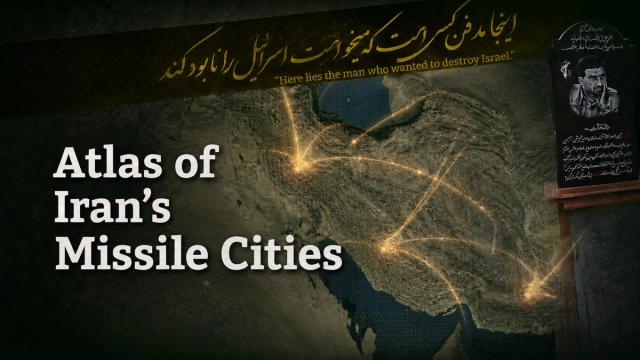
One user quipped that Iran doesn’t have enough electricity to light up its underground missile stockpiles.

Optimism in Tehran about nuclear talks with Washington has waned after a stern public rebuke from Iran's Supreme Leader Ali Khamenei on Tuesday to US demand that Iran totally halt uranium enrichment.
"The American side ... should try not to spout nonsense," Khamenei said in a speech. "Saying things like 'we won’t allow Iran to enrich uranium' is way out of line," he added. "We do not think (the talks) would yield results now."
Within hours of Khamenei's speech, the Iranian rial weakened by over 3 percent, and the main index of the Tehran Stock Exchange dropped by around 2 percent.
Some supporters of a hard Iranian line said a US moratorium on Iranian enrichment, which Tehran maintains is its national right, would scupper the talks.
“The Leader stood up to America's excesses. The US will be directly responsible if the negotiations bear no result. They have no right not to recognize (Iran's) right to enrichment,” hardline cleric Ehsan Ebadi posted on X.
But the sharp speech also raised alarm about the stakes of the talks' collapse.
“The failure of the negotiations is definitely a loss for Iran, not the US. Iran should not let the negotiations fail,” Iranian teacher Ali Ghiasi-Farahani posted on X.
“What benefit has enrichment had for the Iranian people that they insist on continuing it? It has cost over a trillion dollars in direct and indirect costs so far. Be realistic!!”
Door not yet closed?
Observers from the reformist camp sought to project a cautiously hopeful tone, suggesting the door to diplomacy has not yet closed.
“Peace will come, God willing, when the fighting escalates, the uproar increases, and the pressure reaches an unbearable level. Reason: Experience,” senior reformist journalist Mohammad Sahafi posted on X.
Likewise, reformist journalist Ali-Asghar Shafieian who is close to the Pezeshkian administration emphasized that firm statements from Iranian officials did not yet mean negotiations were doomed.
“Relevant officials have given a similar and appropriate response to the other party's claim before the Leader. If required, they will again make the necessary response after him,” Shafieian posted on X. “But these responses do not mean the failure of negotiations or despair in finding innovative solutions to the problem.”
Matin Razavi, a hardline commentator, also dismissed suggestions of a diplomatic breakdown. “Iran's rejection of further talks and saying no to the US is part of Tehran's 'diplomatic performance' toward Washington. We have not yet reached the stage of failure of the talks,” he wrote.
A more nuanced interpretation was offered by a supporter of Parliament Speaker Mohammad-Bagher Ghalibaf posting as @mhmdhsyn who suggested that Khamenei’s rhetoric could be a tactical gambit.
“The Islamic Republic says no through the words of its Leader, shows its frowns through the language of its military men, and says yes by its diplomats," he wrote. “This is the Al Pacino face of Iranian diplomacy—smiling on one side and frowning on the other.”