Tehran would not concede its nuclear rights in ongoing talks with the United States, said Behnam Saeedi, a member of the Iranian parliament’s national security committee on Saturday.
“The Islamic Republic will not back down from its right to enrichment under any circumstances,” he added.
Saeedi said that Washington must end all punitive measures without exception. “The US must lift all sanctions against us in every dimension, and there must be an enforceable guarantee for the lifting of sanctions,” he said.


My sister sent me a satirical video last night: someone joking that instead of adjusting the clocks for daylight saving, Iran's government is dragging 85 million people back and forth. It hit a nerve.
She and her husband both work in the public sector. They now have to work from 6 a.m. to 1 p.m. as the government forces offices to shut down during peak heat hours to curb electricity use.“The people making these decisions think everyone owns a car or can afford rideshare every day,” she said. “Most of us rely on buses. Not everyone lives within 30 minutes of work. For us, the commute is at least an hour. It’s exhausting.”
To be at work by 6, they wake at 4:30. The metro is too far, so they rely on buses, which now begin service only slightly earlier—at 5:30 a.m. Their children’s school hasn’t changed its start time to match, and nurseries don’t open before 7:30, leaving working parents stuck in the dark—literally and figuratively.
From 1991 to 2022, Iran observed daylight saving time. But then the conservative-led parliament repealed the law, claiming it caused confusion and disrupted the economy. The government tried to reverse course with an urgent bill, but parliament blocked it.So we are stuck with fixed clocks—just as we are with the incompetent bunch ruling, and ruining, our country.
Blackouts are now a daily affair. They’ve hit businesses, factories, homes—even as the Supreme Leader declared this the “Year of Investment for Production.”Images of producers burning heaps of spoiled eggs due to outages have gone viral, along with photos of diesel generators lined up outside homes and shops.
“You cry if you don’t laugh,” my sister says. “Most people who post or see these images on social media are raging inside.”
The minor schedule tweaks in cities like Tehran haven’t helped much, and conditions are even worse in smaller towns. Many schools still refuse to shift their hours, creating logistical nightmares for parents juggling long commutes and childcare.
Then there’s the water crisis.We live in a four-story building where water pressure has dropped so much that the upper floors barely receive any.Officials now warn that by summer 2025, apartments above the second floor will face complete water cuts unless they install electric pumps. But with power outages so frequent, even that solution is flawed.
In practice, this means residents on lower floors get by, while those higher up are left dry. Once again, the burden has shifted to the public.
More than 40 cities across Iran are under water stress, according to official figures. Millions are affected—and occasionally insulted by clerics pontificating about the link between drought and sin.
“The government can’t be blamed for lack of rain,” my brother-in-law interjects as he walks past the sofa my sister and I are slumped on.
“To be fair, it can’t be blamed for worn-out infrastructure either, or for sanctions, or the failure to coordinate and communicate basic schedules. It has just one job: to make your lives miserable. And that it’s performed to perfection if your faces lit by your phones’ glow are any measure.”

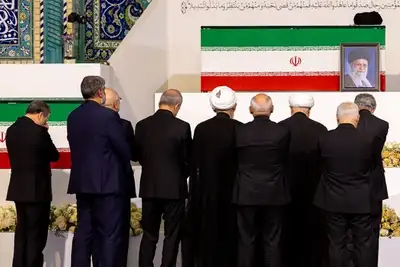
Iran’s Supreme Leader Ali Khamenei on Saturday accused the United States of trying to impose a failed regional order based on Arab dependence on American military support, warning that it would not last.
“This failed model, where Arab states are told they can’t survive ten days without US support, is being imposed again,” Khamenei said. “But it will collapse, and America will leave this region.”
Khamenei said Washington was promoting a security structure that keeps regional countries reliant on foreign protection. “The US wants these countries unable to function without it — that’s the message in their behavior and their proposals,” he said.
He also accused the United States of fueling instability and violence. “The US has used its power to massacre in Gaza, to stoke war wherever possible, and to arm its mercenaries,” he said, describing Israel as “a malignant cancer that must and will be uprooted.”
Khamenei says Trump’s rhetoric ‘shames America’
Khamenei also condemned US President Donald Trump’s remarks during his recent visit to the region.
“Some of what the US president said during this trip doesn’t even merit a reply,” he said in a meeting with teachers in Tehran. “The level of discourse is so low it brings shame to the speaker and to the American nation.”
Trump, during a regional tour that included Saudi Arabia, the United Arab Emirates and Qatar, called for a tougher nuclear agreement with Iran and accused its leadership of spreading instability.
Speaking Tuesday in Riyadh, he said, “The biggest and most destructive of these forces is the regime in Iran, which has caused unthinkable suffering in Syria, Lebanon, Gaza, Iraq, Yemen and beyond.”
Trump also mocked Iran’s economic and environmental problems, contrasting its decline with the development of its Persian Gulf neighbors.
“While you have been constructing the world's tallest skyscrapers in Jeddah and Dubai, Tehran's 1979 landmarks are collapsing into rubble,” he said. “[Iran’s] corrupt water mafia… causes droughts and empty riverbeds. They get rich.”
Iran’s Supreme Leader Ali Khamenei dismissed recent comments by US President Donald Trump during his regional visit as beneath response, describing them as an embarrassment to both the speaker and the American people.
“Some of what the US president said during this trip doesn’t even merit a reply,” Khamenei said in a meeting with teachers and educators in Tehran. “The level of discourse is so low it brings shame to the speaker and to the American nation.”
Khamenei rejected Trump’s argument of using power to promote peace. “He lied,” he said. “The US has used its power to massacre in Gaza, to stoke war wherever possible, and to arm its mercenaries.”
He accused Washington of enabling Israeli attacks on civilians and described Israel as “the Zionist regime” and as “a malignant cancer that must and will be uprooted.”
“This failed model, where Arab states are told they can’t survive ten days without US backing, is being imposed again,” Khamenei said. “But it will collapse, and America will leave this region.”


Iranian President Masoud Pezeshkian said on Saturday that Iran is open to negotiations but will not retreat in the face of threats, while Foreign Minister Abbas Araghchi ruled out any compromise over enriching uranium.
“We are not seeking war. We believe in negotiations and dialogue,” Pezeshkian said at a military ceremony in Tehran. “But we are not afraid of threats and we will never retreat from our legal rights.”
Pezeshkian criticized US President Donald Trump for sending what he called contradictory messages. “He talks of peace while threatening us with advanced weapons. No one but him believes these contradictions,” Pezeshkian said.
The president added that Iran would stand firm. “They assassinate our scientists and accuse us of terrorism. But we are the victims of terror,” he said. “They should not expect us to give up our military and nuclear achievements under pressure.”
Separately, Foreign Minister Abbas Araghchi said Iran remains committed to peaceful nuclear development under the Non-Proliferation Treaty but will not negotiate away its right to enrichment.
“Iran is ready to build trust about the peaceful nature of its program, but cannot compromise on the legal and inalienable right to enrichment,” Araghchi said at a meeting with the Pugwash Conferences on Science and World Affairs. He added that Iran had “paid a heavy price” to preserve this right and would not accept restrictions as a long-standing NPT signatory.
Araghchi also criticized what he called inconsistent messages from US officials, saying they had complicated negotiations and undermined trust. “The Americans change their positions frequently and face pressure from war-driven lobbies,” he said. “This is their internal issue, but Iran will stay focused on its lawful and principled position.”

British counter-terrorism police have charged three Iranian nationals with offences under the National Security Act, alleging they acted on behalf of Iran’s intelligence service and carried out surveillance targeting Iran International journalists.
The men — Mostafa Sepahvand, 39, Farhad Javadi Manesh, 44, and Shapoor Qalehali Khani Noori, 56 — were arrested at their homes in London on May 3 and charged on Friday.
All three are accused of engaging in conduct likely to assist a foreign intelligence service between August 14, 2024 and February 16, 2025, in breach of Section 3 of the National Security Act 2023.
The foreign state involved is Iran, police said.
Surveillance linked to Iran International journalists
According to the Crown Prosecution Service, the men carried out surveillance and reconnaissance targeting journalists associated with Iran International.
"Examination of their phones revealed that from the 14th August 2024 they had been engaged in carrying out surveillance with a view to locating journalists associated with Iran International," read the statement by the Crown Prosecution Service.
Iran International is a Persian-language TV news network that broadcasts 24/7 and has a strong following in Iran, despite government efforts to restrict access to the internet and satellite signals. Tehan has labelled it a terrorist organisation.
Phones seized during the arrests allegedly contained satellite images and mobile phone videos of buildings and streets in London.
Sepahvand faces an additional charge of conducting reconnaissance with the intention of committing acts of serious violence in the UK. Javadi Manesh and Noori are charged with similar conduct intended to facilitate serious violence by others.
“These are extremely serious charges under the National Security Act,” said Commander Dominic Murphy, head of the Metropolitan Police’s Counter Terrorism Command. “Detectives have been working around the clock and we have worked closely with colleagues in the CPS to reach this point.”
All three men have been remanded in custody and appeared at Westminster Magistrates’ Court on Saturday.
Iran International has previously been the subject of threats and attacks. In 2023, a man was convicted under terrorism laws after filming outside its premises, and in 2024, Pouria Zeraati, the television host of the "Last Word" program on Iran International was stabbed in London.
UK Minister: Iran must be held to account for its actions
Home Secretary Yvette Cooper on Saturday confirmed Iran was the foreign state referred to in the charges.
“I want to thank the police and security services for their continuing work on this very serious investigation, and for their immense dedication to protecting our national security and the safety of our communities,” she said in a statement.
“The charges that have been laid must now take their course through the criminal justice system… But we will also take separate action to address the very serious wider issues raised by this case. Iran must be held to account for its actions.”
Cooper said the government would publish next week the findings of a review by Jonathan Hall KC -- the Home Secretary's independent reviewer of terrorism legislation -- into whether existing counter-terrorism frameworks can be adapted to address modern state-based threats, including the design of a proscription mechanism for state-linked entities.
UK raises alarm over Iranian state threats
UK security agencies have warned of increasing threats linked to Tehran. In October, MI5 Director General Ken McCallum said at least 20 plots linked to Iranian state actors had been disrupted since early 2022, including efforts to kidnap or kill individuals seen as dissidents.
A fourth man, aged 31, arrested as part of the investigation was released without charge on May 15.
All three defendants arrived in the UK by irregular means, including via small boats, between 2016 and 2022. Sepahvand claimed asylum in 2016, Javadi Manesh in 2019 on religious grounds, and Noori's asylum application was rejected in 2024. He is currently appealing that decision.
Iran’s government has previously denied involvement in alleged plots on British soil. In earlier comments, Foreign Minister Abbas Araghchi said Iran “categorically rejects” claims of targeting foreign sites and called for due process to be afforded to Iranian nationals abroad.