More Stories

President Trump arrived in Saudi Arabia on May 13 on the first leg of a four-day, three-country trip to the Middle East that included stops in Qatar and the United Arab Emirates.
The choice of Saudi Arabia for the first state visit of Trump’s second term mirrored that of his first, except this time he did not go to Israel, signaling that the administration is doubling down on its Arabian peninsula partners as key supporters of US regional interests.
Iran was naturally not on the itinerary but ever-present in Trump’s public statements, with the president using a characteristic blend of carrot-and-stick which urged Iranian leaders to take a “new and better path” and warned of “massive maximum pressure” if Tehran “rejects this olive branch.”
Trump expressed his desire to reach a deal with Iran on many occasions, even hinting that a deal was almost agreed. For that to happen, however, Tehran "must stop sponsoring terror, halt its bloody proxy wars, and permanently and verifiably cease its pursuit of nuclear weapons,” he added.
Later, aboard Air Force One, Trump told reporters that Iran had to “make the right decision” about its nuclear program because “something’s going to happen one way or the other” and "we’ll either do it friendly or we’ll do it very unfriendly.”
Arab, Iranian audiences
There are various takeaways for leaders in Iran as well as in its neighboring Arab countries, from Trump’s commentary.
For the latter, Trump’s demand that Iran end its sponsorship of terror and involvement in proxy wars will be welcomed as a signal that any agreement with Tehran might not be narrowly confined to its nuclear program alone, as was the case with the Joint Comprehensive Plan of Action in 2015.

For leaders in Riyadh, Doha and Abu Dhabi - not to mention in Tel Aviv -it was Iran’s regional activities that were as much a priority as its nuclear program, and their exclusion from the negotiations for the 2015 nuclear deal caused alarm in the region.
However, any such optimism in regional corridors of power may be tempered by concern that the president’s unconventional approach to deal-making may create openings for an agreement that gives Trump the optics he desires at the expense of nuts-and-bolts details on specific Iranian commitments.
Deals, details and differences
Comments by Steve Witkoff, Trump’s chief negotiator and one of his closest confidants, in podcast and other appearances, have not given the impression of a details-focused approach to diplomacy, whether in terms of Russia and Ukraine or Iran.
Witkoff and other members of the Trump administration have also sent mixed messages about whether Iran would be able to enrich uranium in any agreement, reinforcing concerns by domestic and regional critics of US engagement with Iran that a new deal may be worse than no deal.
For the leadership in Tehran, beset by economic challenges, energy shortages and geopolitical setbacks that left its regional "Axis of Resistance" weakened, the optics of Trump’s regional procession offer glimpses of opportunity.

The fact that Trump met with Syria’s new president, Ahmed al-Sharaa, in Riyadh and declared that sanctions on Syria would be lifted was further illustration that Trump is transactional rather than ideological, and willing to take decisions that break the mold of conventional American policy thinking.
This was underscored in Trump’s remarks in Riyadh on May 13 when he slammed the failures of generations of western interventionists and neocons in the Middle East who “told you how to do it, but they had no idea how to do it themselves” and, he argued, did far more damage than good.
In making these comments and receiving al-Sharaa, Trump has shown himself willing to break free of traditional constraints on US policymaking in the region, at least on the surface, and this may yet extend to Iran.
Unclear outlook
There are nevertheless multiple uncertainties for Iranian officials as they begin to digest the outcomes of Trump’s visit to the Middle East and assess the implications, both short- and long-term, for Tehran.
The plethora of major deals signed in Saudi Arabia, Qatar, and the UAE have cemented these countries’ deep and longstanding ties with the US across the defense and security, economic, and energy spectrum.
Any concerns in the region of US disengagement from the Middle East may be dissipated by the sight of Trump bestowing such significance on the region, in stark contrast to the disdain with which the administration has treated its formal allies in Europe and North America.
And yet, if Trump is to reap the benefits of the hundreds of billions of dollars of planned investments into the US, he will likely return from his trip with a conviction that the pledges, and the returns, require stability and would be jeopardized by any conflict with Iran.
This not only plays into the de-risking and de-escalatory approach that Iran's energy-rich Arab neighbors have taken since 2020 but may also fortify Trump’s desire to burnish his credentials as a peacemaker in the explosive region.
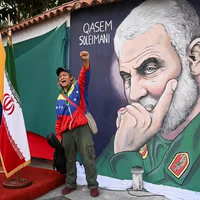
Iran’s Islamic Revolutionary Guard Corps (IRGC) chief said US President Donald Trump is an enemy of the Iranian people, accusing him of blocking access to medicine and ordering the killing of IRGC General Qassem Soleimani in 2020.
“The Iranian people know their friends and enemies well, and you are at the center of their hostility … Trump has sanctioned the Iranian people and is trying to block medicine from reaching the sick in this land,” Hossein Salami said in a speech on Thursday. “The Iranian people consider you the murderer of their most beloved and greatest national hero, Lieutenant General Qassem Soleimani.”
“Mr. President, a few years ago you called the Iranian people terrorists and said Iran was a terrorist nation. How is it now that you portray yourself as a friend of this people?” he added. “Think carefully about what image of yourself exists in the minds of Iranians.”