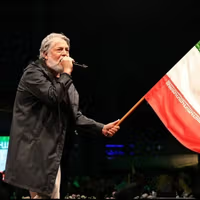
Former Iranian vice president Eshaq Jahangiri said he felt ashamed when US President Donald Trump gave what he described as a false portrayal of Iran during a visit to Saudi Arabia.
“I suffered, I was ashamed when the president of the United States, in Saudi Arabia, gave a false description of Iran, saying that Iran doesn’t have water or electricity,” Jahangiri said in a speech on Thursday.
Speaking before Crown Prince Mohammed bin Salman and other top Saudi and US officials, President Donald Trump spent much of a lengthy speech on Tuesday criticizing Iran while urging a deal over its disputed nuclear program.
The US Treasury Department on Thursday sanctioned two senior Hezbollah officials and two financial facilitators in Iran and Lebanon for coordinating overseas funding for the group.
The individuals, identified as Mu’in Daqiq Al-‘Amili, Jihad Alami, Fadi Nehme and Hasan Abdallah Ni’mah, are accused of helping move large sums of money, including funds from Iran to Gaza following Hamas' October 7 attack.
“These actions underscore Hezbollah’s global financial reach, particularly through Tehran,” said Deputy Treasury Secretary Michael Faulkender.
“As part of our ongoing efforts to address Iran’s support for terrorism, Treasury will continue to intensify economic pressure on the key individuals in the Iranian regime and its proxies who enable these deadly activities,” he added.
Former Iranian vice president Eshaq Jahangiri said he felt ashamed when US President Donald Trump gave what he described as a false portrayal of Iran during a visit to Saudi Arabia.
“I suffered, I was ashamed when the president of the United States, in Saudi Arabia, gave a false description of Iran, saying that Iran doesn’t have water or electricity,” Jahangiri, who served from 2013 until 2021 in Hassan Rouhani's government, said in a speech on Thursday.
Speaking before Crown Prince Mohammed bin Salman and other top Saudi and US officials, President Donald Trump spent much of a lengthy speech on Tuesday criticizing Iran while urging a deal over its disputed nuclear program.

Iran has not received any new proposal from the United States to resolve its nuclear standoff, Reuters reported on Thursday, citing an unnamed senior Iranian official, denying reports of recent written offers.
The official said Tehran would only consider sending enriched uranium abroad if US sanctions are lifted “verifiably and effectively.”
Sending uranium enriched above 5% abroad has always been part of Iran’s nuclear discussions with the United States, the official added.
Earlier in the day, Axios reported that White House envoy Steve Witkoff had delivered a written proposal to Iran during talks in Oman, marking the first such offer since negotiations resumed in April.
Iranian President Masoud Pezeshkian said on Thursday he supports negotiations and peace, but not under coercion.
“We will negotiate with strength and dignity, not under a gun to our head,” he told political activists in Kermanshah, adding that Iran will not compromise on its core beliefs.

Oil prices fell sharply on Thursday following remarks by US President Donald Trump suggesting a nuclear deal with Iran may be near, but analysts say any boost to global oil supply would likely belimited, according to a Bloomberg analysis.
Speaking in Qatar, Trump said “we’re getting close to maybe doing a deal” with Tehran. Brent crude dropped as much as 4% on the news, amid reports that an agreement could ease sanctions and increase Iranian oil exports.
However, analysts quoted by Bloomber said that Iran has limited spare capacity—estimated between 300,000 and 400,000 barrels per day—equivalent to about 0.3%–0.4% of global demand.
“Let’s just assume all sanctions were going to be lifted, the actual volume coming back to the market is not going to be that much,” said Amrita Sen of Energy Aspects.
Iran’s output was 3.4 million barrels a day in April, with capacity capped around 3.8 million, according to the International Energy Agency. The IEA also said that global inventories are set to rise, signaling an oversupplied market regardless of Iranian flows.
While much of Iran’s crude is already reaching markets through shadow fleets, tighter US sanctions could push exports below 1 million barrels per day, Bloomberg added.