Iran has no intention of halting nuclear program, spokesman says
Iran has no intention of halting its nuclear program, the foreign ministry spokesman said on Thursday, according to Iranian media.
Speaking to reporters at Tehran’s book fair, the Esmail Baghaei emphasized that stopping the nuclear program is not on the agenda, adding that Iran has learned from past "bitter experiences" and knows where to take necessary measures.
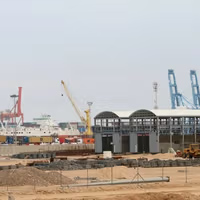
T-shaped oil terminal on Khark Island in southern Iran
Oil prices fell sharply on Thursday as signs of progress in US-Iran nuclear negotiations and an unexpected rise in US crude inventories raised concerns about a potential supply glut.
Brent crude futures dropped as much as 3.7% to $63.68 a barrel in early trade before paring losses to $63.98. US West Texas Intermediate (WTI) crude fell 3.3% to $61.05.
The sell-off followed remarks by US President Donald Trump, who said Washington was in "very serious negotiations with Iran for long-term peace" during his tour of the Persian Gulf, adding that Tehran had "sort of" agreed to US terms for a possible deal.
Traders view a possible agreement as a step toward easing sanctions on Iran, which could pave the way for the return of Iranian oil exports to global markets.
Adding to the downward pressure, data released late Wednesday showed an unexpected build in US crude inventories last week, fueling concerns about oversupply.
"The market is reacting to both the political developments and the inventory surprise," said a trader at a London-based commodities firm. "Any indication that Iranian barrels could re-enter the market weighs on prices."
Earlier this week, markets rallied on a US-China trade truce and a flurry of investment deals unveiled during Trump's visit to the Middle East.
Still, oil markets remain volatile as investors weigh the potential timing and terms of any US-Iran agreement, along with broader macroeconomic risks.
US President Donald Trump on Thursday praised the Emir of Qatar for his role in efforts to avoid military conflict with Iran and encourage a diplomatic solution.
“Iran is very lucky to have the emir because he's actually fighting for them,” Trump told reporters. “He doesn't want us to do a vicious blow to Iran. He says you can make a deal, you can make a deal. He's really fighting, and I really mean this.”
Trump said Emir of Qatar has been urging restraint during sensitive nuclear negotiations. “I think that Iran should say a big thank you to the emir because the emir is fighting very much that we don't,” he said.
“There are many people that want me to go the other route,” Trump added. “They say just knock it out because nobody can beat us. We have the strongest military in the world by far.”
US President Donald Trump on Thursday praised the Emir of Qatar for his role in efforts to avoid military conflict with Iran and encourage a diplomatic solution.
“Iran is very lucky to have the emir because he's actually fighting for them,” Trump told reporters. “He doesn't want us to do a vicious blow to Iran. He says you can make a deal, you can make a deal. He's really fighting, and I really mean this.”
Trump said Emir of Qatar has been urging restraint during sensitive nuclear negotiations. “I think that Iran should say a big thank you to the emir because the emir is fighting very much that we don't,” he said.
“There are many people that want me to go the other route,” Trump added. “They say just knock it out because nobody can beat us. We have the strongest military in the world by far.”
US President Donald Trump speaks next to Qatar's Emir Tamim bin Hamad Al Thani on the day of a state dinner, at Lusail Palace in Lusail, Qatar, May 14, 2025.
US President Donald Trump listens as Qatar's Emir Tamim bin Hamad Al Thani (not pictured) speaks at a state dinner, at Lusail Palace in Lusail, Qatar, May 14, 2025.
US President Donald Trump said on Thursday that Iran had “sort of agreed” to American terms in ongoing nuclear negotiations, suggesting a breakthrough in the long-running standoff may be imminent.
“We’re getting very close to a deal,” Trump told reporters. “You probably read today the story about Iran has sort of agreed to the terms. We're not going to be making any nuclear dust in Iran.”
Trump emphasized that his administration’s core demand remains unchanged: “They can’t have a nuclear weapon. That’s the only thing. It’s very simple.”
Iran has enough enriched uranium to produce several nuclear warheads and could do so within months, International Atomic Energy Agency Director General Rafael Grossi said last month.
Trump said Tehran now has two options moving forward, either diplomatic or military.
“There’s a very, very nice step. And there’s a violent step, the violence like people haven’t seen before,” Trump warned. “I don’t want to do the second step. Some people do. Many people do. I don’t want to do that.”
Trump’s remarks came while Iranian officials signaled readiness to accept significant constraints on the country's nuclear activities.
In an interview with NBC News published Wednesday, Ali Shamkhani, a senior adviser to Supreme Leader Ali Khamenei, said Tehran was prepared to stop enriching uranium to weapons-grade levels, reduce its stockpile, and allow international inspections — if the United States lifts economic sanctions.
Asked whether Iran would sign such a deal immediately, Shamkhani responded: “Yes.”
“It’s still possible,” he said. “If the Americans act as they say, for sure we can have better relations,” after decades of animosity, the two having broken diplomatic ties in 1979 after the Islamic Revolution.
Trump, speaking at a state dinner in Doha alongside Qatar’s Emir Sheikh Tamim bin Hamad AlThani, said he hoped the situation would be resolved peacefully. “We want to see Iran do well and thrive and be successful,” he said. “We want to have this end peacefully, not horribly.”
He added that his administration was “in very serious negotiations with Iran for long-term peace” and suggested that he views himself as a moderate voice. “In a certain sense, I guess I’m a good friend [to Iran], because a lot of people would rather have me take a much more harsh road,” he added.
Iranian President Masoud Pezeshkian and senior officials issued a sharp rebuke to Trump on Wednesday, following a blistering speech in Riyadh in which Trump accused Tehran of destabilizing the Middle East and mismanaging its economy.
Pezeshkian, speaking in Kermanshah on Thursday, condemned US policies as the true source of regional bloodshed, citing civilian deaths in Gaza as the US supports its ally Israel against Iran-backed militant group Hamas, and US arms sales to Persian Gulf states. "Is it us who are the threat, or those who flood this region with bombs?" he said.
Iran’s foreign ministry accused Trump of attempting to sow division between Iran and its neighbors, with spokesman Esmail Baghaei calling the Riyadh speech a “deliberate move” against regional unity.
Tehran maintains it is not seeking nuclear weapons but vowed to continue uranium enrichment.
Iranian lawmakers said on Wednesday that Iran can enrich up to 93% if deemed necessary, while Foreign Minister Abbas Araghchi proposed a regional enrichment consortium with Arab and US participation, in talks mediated by Oman.
The fourth round of indirect talks between the US and Iran in Muscat ended with Iranian officials warning that continued US pressure could derail progress.
Araghchi also criticized Trump’s earlier remarks in Riyadh, calling them “delusional” and blaming US policy for the country’s economic problems.
Still, Trump, traveling through the Persian Gulf region, projected optimism. “We’re going to try and get it done. They have to move quickly,” he said.
While refraining from directly threatening military action, Trump said that the US would take “all action required” to prevent Iran from obtaining a nuclear weapon.
Trump began his Middle East tour in Saudi Arabia on Tuesday, where he stressed economic ties and regional alliances over military confrontation.
At the GCC summit in Riyadh, he urged Iran to end its support of military proxies in the region, accusing the Biden administration of empowering Tehran and abandoning traditional US allies.
US President Donald Trump said on Thursday that the United States is “very close” to reaching a nuclear agreement with Iran.
“We’re getting very close to a deal,” Trump told reporters. “You probably read today the story about Iran has sort of agreed to the terms. We're not going to be making any nuclear dust in Iran."
Trump said his goal is to prevent Iran from developing nuclear weapons while offering the possibility of improved ties. “I want them to succeed. I want them to end up being a great country, frankly. But they can't have a nuclear weapon. That's the only thing. It's very simple. It's not like I have to give you 30 pages worth of details.”
“There’s only one sentence,” he added. “They can’t have a nuclear weapon.”
“There’s two steps. There’s a very, very nice step. And there’s a violent step, the violence like people haven’t seen before. And I hope we’re not going to have to do this. I don’t want to do the second step. Some people do. Many people do. I don’t want to do that step.”
“So we’ll see what happens,” he said. “But we’re in very serious negotiations with Iran for long-term peace. And if we do that, it’ll be fantastic.”
A senior Iranian official said Tehran is prepared to give up highly enriched uranium and accept strict limits on its nuclear program in exchange for the lifting of US sanctions, NBC News reported on Wednesday.
Ali Shamkhani, a top adviser to Supreme Leader Ali Khamenei, told NBC in an interview that Iran would stop enriching uranium to weapons-grade levels, reduce its stockpile, and allow international inspections if the United States agrees to remove all economic sanctions.
Asked if Iran would sign such a deal immediately, Shamkhani said: “Yes.”
“It’s still possible,” Shamkhani said. “If the Americans act as they say, for sure we can have better relations… it can lead to a better situation in the near future.”
US President Donald Trump's repost of the NBC interview