Iran’s foreign ministry said the fourth round of negotiations with the United States was “difficult but useful” in clarifying mutual positions.
“The fourth round of indirect Iran-US negotiations is concluded; difficult but useful talks to better understand each other's positions and to find reasonable and realistic ways to address the differences,” spokesman Esmail Baghaei said.
He added that the timing of the next round would be coordinated and announced by Oman.
The latest round of negotiations between Iran and the United States concluded minutes ago in Muscat, with messaging once again conducted through Oman’s foreign minister, Iranian outlet ISNA reported.
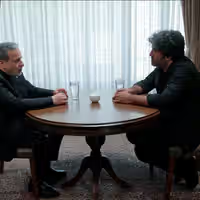
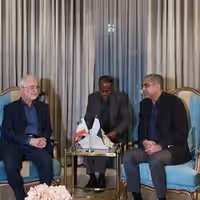
Talks began early Sunday afternoon after the Iranian delegation, led by Foreign Minister Abbas Araghchi, arrived and held a meeting with Omani counterpart Badr al-Busaidi.
The discussions were carried out through indirect message exchanges, as in previous rounds, wrote ISNA.
According to analysts cited by Iranian media, this round was more difficult than the previous three, due to what they described as hardened US positions—including demands that Iran dismantle its nuclear program and end domestic enrichment.
The Iranian delegation included a technical advisory team and was led by Araghchi, who is expected, along with foreign ministry spokesman Esmail Baghaei, to brief media on the outcome, as in prior rounds.
A former commander in Iran’s Islamic Revolutionary Guard Corps said Tehran should have treated Donald Trump’s ambitions with more tact, arguing that a deal with the US president was possible.
“We should have respected Trump’s ego. In fact, it is with such a person that an agreement can be reached,” Hossein Alaei, the former head of the IRGC Navy, said.
Alaei pointed to Washington’s 2018 withdrawal from the nuclear deal, saying the US had used the accord to contain Iran’s nuclear program. He argued that current negotiations should be elevated beyond technical discussions.
“Trump must accept that this issue is not technical or legal, but political,” he said.

Iran’s foreign ministry said it remains determined to end sanctions as nuclear negotiations with the United States continue in Muscat.
“We are equally resolved to work for termination of unlawful and inhuman sanctions that have long been imposed on our people,” foreign ministry spokesman Esmail Baghaei wrrote on X.
"Iran is firmly determined to pursue its inalienable lawful rights for peaceful uses of nuclear energy under NPT while fully prepared to continue its diplomatic engagement to ensure the already demonstrated 'peaceful nature' of its nuclear program," he added.
The confrontational stance of France, Germany, and the UK toward Tehran’s nuclear program risks triggering a global proliferation crisis that would first harm Europe, Iranian Foreign Minister Abbas Araghchi wrote in an op-ed published by Le Point.
“This strategy of confrontation risks sparking a global nuclear proliferation crisis, which would primarily impact the Europeans themselves.”
He accused the three European powers of diplomatic obstruction, saying they had “chosen confrontation over recalibration, using human rights or Iran’s legitimate relations with Russia as pretexts to distance themselves.”
Iran’s foreign ministry said backchannel negotiations with the United States are underway via Oman’s top diplomat, pushing back on earlier contradictory Iranian media reports that the talks had not started.
“The fourth round of negotiations with the United States is continuing in an indirect format, with message exchanges taking place through the Omani foreign minister,” foreign ministry spokesman Esmail Baghaei said.
Baghaei added that talks began immediately after the Iranian delegation’s arrival and a meeting between deputy foreign minister Abbas Araghchi and his Omani counterpart.
His comments came after conflicting reports in Iranian media, with some outlets saying the talks had begun while a state TV correspondent reported otherwise.
Baghaei dismissed the confusion, insisting the diplomatic track was active and ongoing.