Nuclear talks with us unlikely to yield good results, says Iranian MP
An Iranian lawmaker expressed skepticism over the outcome of ongoing nuclear negotiations with the United States, accusing Washington of exploiting fear to gain leverage in talks.
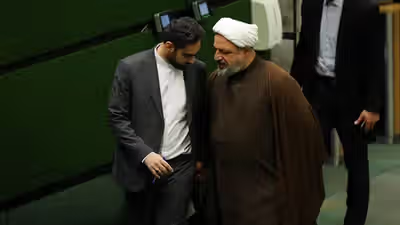
“I don’t believe the negotiations will lead to a sustainable result or a sound political agreement,” said Mostafa Taheri, a member of parliament’s Industries and Mines Committee.
He added that past experience shows the US consistently applies what he called the "chicken game theory" in its dealings with adversaries. “From their perspective, negotiations are won when the opponent is frightened,” Taheri said.
Iran announced the completion of major maintenance and refueling at its Bushehr nuclear power plant this week, preparing the country’s only operational nuclear facility to meet peak summer electricity demand.
The announcement comes as Tehran accelerates work on two new reactor units at the site and reiterates its long-term commitment to nuclear energy amid stalling US nuclear talks.
The head of the Bushehr nuclear power plant, Reza Banazadeh, said the 1,000-megawatt (MW) facility is now fully prepared to contribute to the national grid during the hottest months of the year.
Daily electricity consumption in Iran can vary, with peaks reaching over 72,000 MW, exceeding the actual power generation capacity of 60,000 MW during the summer.
Since its commissioning, the plant has generated more than 72 billion kilowatt-hours of electricity, equivalent to saving over 110 million barrels of oil, Banazadeh said in an interview with Iranian state media.
"Nuclear energy is one of the safest, cleanest, and most cost-effective sources of power,” Banazadeh said, adding the plant avoids burning fossil fuels and thereby prevents the emission of an estimated 7 million tons of greenhouse gases annually.
Bushehr, Iran’s first commercial nuclear facility, sits on the Persian Gulf and is central to the country’s broader nuclear ambitions.
Mohammad Eslami, head of the Atomic Energy Organization of Iran (AEOI), said earlier this year that 5,000 workers are involved in the construction of Units 2 and 3, which are expected to triple the plant’s output when completed.
“Our aim is to increase nuclear power capacity to 20,000 megawatts by 2041,” Banazadeh said, adding that new projects across the country will help meet rising energy demands and reduce reliance on fossil fuels.
While Iranian officials highlight the civilian and environmental benefits of nuclear energy, the program remains under international scrutiny amid concerns about its potential military dimensions.
Tehran maintains its program is peaceful and conducted under the oversight of the International Atomic Energy Agency (IAEA) despite the restrictions that Tehran has put on the agency’s activities such as expelling inspectors and reducing monitoring equipment.
Iranian President Masoud Pezeshkian during a visit to `Bushehr Nuclear Plant (February 2025)
Tensions around Iran's nuclear facilities resurfaced in recent months, with Israel and the US warning of potential military action. During a February visit to Bushehr, Iranian President Masoud Pezeshkian warned: “If they strike a hundred [nuclear sites], we will build a thousand more ... They can hit the buildings, but they cannot erase the minds of our scientists.”
US President Donald Trump, in a Fox News interview, said he would prefer a diplomatic solution to prevent Iran from acquiring nuclear weapons but acknowledged concerns over possible Israeli military action.
Iran's air force commander Hamid Vahedi said that the country’s defense posture is deterrent but warned of “forceful” retaliation if attacked.
Despite geopolitical strains, Iran’s nuclear chief Eslami highlighted the use of domestically manufactured equipment and engineering milestones in the Bushehr expansion, including 34,000 rod injections to stabilize the reactors’ foundations and a record 22,000 cubic meters of concrete poured in a single day.
The AEOI aims to increase this figure to 65,000 cubic meters daily next year, showing Iran’s intent to push ahead with nuclear infrastructure development.
The IAEA has not yet commented on the latest developments at Bushehr.
Iran's cooperation with the IAEA remains central to international efforts monitoring and constraining its nuclear program under a potential new deal, with the next round of indirect Iran-US negotiations scheduled for this weekend.
President Donald Trump has issued a blunt warning to Iran, saying that the United States must destroy Tehran’s nuclear centrifuges if diplomacy does not succeed.
Trump outlined what he called the only two options available: “blow them up nicely or blow them up viciously,” in a phone interview with commentator Hugh Hewitt.
“I’d much rather make a deal, you know, really verified deal,” Trump said. “But the other — there are only two alternatives there. Blow them up nicely or blow them up viciously.”
The remarks come as efforts to revive nuclear negotiations between Tehran and Washington remain deadlocked.
Iran insists its nuclear program is for peaceful purposes and denies pursuing nuclear weapons.
The United States has stationed B-52 bombers at its Diego Garcia outpost, Newsweek reported, reinforcing long-range strike capabilities in the Indian Ocean as efforts to revive a nuclear deal with Iran remain deadlocked.
Satellite imagery from Wednesday showed two B-52s at the base, joining B-2 stealth bombers deployed in March following US airstrikes on Houthi forces in Yemen.
The B-2s, which can carry bunker-busting bombs, had previously been used last autumn to strike underground Houthi targets in Yemen.
Open-source analyst MT Anderson first identified the B-52s via satellite image, with Air & Space Forces Magazine corroborating their presence.
President Donald Trump has warned that military action remains an option if diplomacy fails. Iranian officials have previously singled out Diego Garcia as a potential target.
“The response to Trump's threats should be action, not words—every base in the region is within range of our missiles. The missiles are locked and loaded, ready to target any area from which Iran could be threatened, whether from Diego Garcia or Bahrain,” an Iranian official told The Telegraph in March.
A British Royal Navy patrol vessel guards the oil supertanker Grace 1, that's on suspicion of carrying Iranian crude oil to Syria, as it sits anchored in waters of the British overseas territory of Gibraltar, historically claimed by Spain, July 4, 2019.
A US-based watchdog group on Thursday accused Panama of playing a key role in enabling sanctions evasion by Iranian oil tankers while Tehran’s oil ministry announced a significant rise in crude exports.
The organization United Against Nuclear Iran (UANI) said 17% of a fleet of vessels it suspects of smuggling sanctioned Iranian oil are currently flying the Panamanian flag.
In a statement, UANI described Panama’s maritime registry as the “most commonly used national registry among this shadow fleet,” citing tactics such as flag-hopping, fake ownership records, and manipulation of automatic identification systems (AIS).
“Panama has long been the flag of choice for sanctions violators and oil smugglers,” said UANI CEO Mark D. Wallace. “We’ve repeatedly provided the AMP [Panama Maritime Authority] with names, evidence, and warnings. Their lack of consistent, proactive enforcement continues to undermine global sanctions compliance.”
UANI’s tanker tracker lists 542 foreign-flagged vessels suspected of involvement in sanctioned oil shipments from Iran.
Following mounting pressure, Panama in March deregistered 107 vessels and is currently reviewing 18 more, acting under Executive Decree No. 512, which allows authorities to remove ships owned by sanctioned entities from its registry.
The allegations come as Iranian officials publicly celebrate rising energy production and oil exports.
Oil Minister Mohsen Paknejad, speaking during the inauguration of Iran’s 29th Oil, Gas, Refining and Petrochemical Exhibition in Tehran, said the country has boosted oil output by 150,000 barrels per day under the current administration, with daily gas production up 30 million cubic meters and petroleum refining capacity growing by 180,000 barrels per day.
Paknejad added that gasoline and diesel output has increased by 7 million and 8 million liters per day, respectively, despite what he called intensifying sanctions. “Oil exports are continuing at the highest possible level,” he said.
He added that Iran plans to complete over 30 major oil and gas projects by March 2026, representing $10 billion in investment, which he said will further raise daily oil production by 250,000 barrels and gas by 30 million cubic meters.
He also said Iran needs over $20 billion in annual funding to maintain and expand production, adding that the ministry is pursuing innovative financing tools and encouraging greater private sector participation to meet these goals.
While Iran has not publicly addressed the UANI report, it has consistently rejected the legality of unilateral US sanctions and insists that its energy exports comply with international law.
The Panama Maritime Authority has not yet responded to the latest allegations. However, officials have previously defended their compliance with international norms, citing recent regulatory changes intended to strengthen enforcement.
In spite of sanctions, Iran's oil sales have continued to grow in recent years.
In October, the Energy Information Agency (EIA) in the US reported that Iran's oil sales reached $144 billion in the first three years of the Biden administration, $100 billion more than what Tehran exported in the last two years of the Trump administration when the oil sanctions were in effect.
In March, the US seized multiple Iranian oil tankers in the Persian Gulf which were using forged Iraqi documents.
Speaking on state television, Iraq's Oil Minister Hayan Abdel-Ghani said: "We received some verbal inquiries about oil tankers being detained in the Persian Gulf by US naval forces carrying Iraqi shipping manifests.
"It turned out that these tankers were Iranian ... and were using forged Iraqi documents. We explained this to the relevant authorities with complete transparency and they also confirmed this."
A US Air Force B-52 strategic bomber, C-17 and F-22s take part in a joint drill with South Korea's Air Force, in South Korea, December 20, 2022.
New satellite imagery shows two US B-52 bombers deployed at the Diego Garcia airbase in the Indian Ocean, reinforcing Washington’s long-range strike posture near Iran as nuclear talks remain postponed, Newsweek reported Thursday.
The image, captured by the European Space Agency’s Sentinel-2 satellite on May 7, was first identified by open-source analyst MT Anderson and shows aircraft matching the dimensions of B-52 bombers parked at the US Naval Support Facility.
The B-52s join a buildup of US assets at the base, including previously deployed B-2 stealth bombers, C-17 cargo planes, and aerial refueling tankers, according to Air & Space Forces Magazine and The War Zone.
The enhanced deployment follows months of rising tensions between Washington and Tehran. While US President Donald Trump has said he prefers a peaceful resolution to the standoff over Iran’s nuclear program, he has also warned of military action if no agreement is reached.
Tehran has rejected talks outside the framework of the 2015 nuclear deal.
In March, a senior Iranian military official warned that Iran would target the joint US-UK base on Diego Garcia if it is used to launch attacks. “There will be no distinction in targeting British or American forces if Iran is attacked from any base in the region or within range of Iranian missiles,” the official told The Telegraph.
However, the remote Indian Ocean base is located some 3,800 kilometers from Iran—beyond the estimated 2,000-kilometer range of Iranian ballistic missiles.
A UK government spokesman condemned the threats at the time, calling the base “vital to UK and US security” and underscoring London’s efforts to promote de-escalation in the region.
Diego Garcia has previously been used to launch US strikes in Iraq and Afghanistan. The latest deployments suggest the US is positioning for potential large-scale operations, even as diplomatic efforts with Tehran remain uncertain.