Iran has welcomed the end of US military attacks on the Tehran-aligned Houthis in Yemen and praised Oman for helping to broker the halt.
Foreign Ministry spokesperson Esmail Baghaei said Iran “welcomes the developments in Yemen and the end of US aggression,” and thanked Oman for its diplomatic efforts. He also praised the Houthis’ “steadfast support for the Palestinian people,” calling their resistance “legendary.”
Omani Foreign Minister Badr Albusaidi said Tuesday that both sides had agreed not to target each other, including US vessels in the Red Sea and Bab al-Mandab, to ensure safe navigation and uninterrupted commercial shipping.
Houthi chief negotiator Mohammed Abdulsalam told Reuters on Wednesday that the ceasefire does not cover operations against Israel.
Israel’s ambassador to the United Nations warned that any further attacks from Yemen’s Houthi militia or their Iranian backers would be met with crushing force, saying such action would render their “own lands unrecognizable.”
“If the Houthis and their Iranian masters want to play with fire, they will find their own lands unrecognizable,” Danny Danon said Tuesday during Israeli Independence Day celebrations at UN Headquarters in New York.
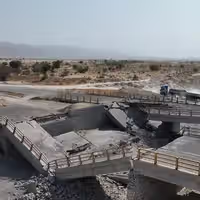
His comments followed Israeli airstrikes on Yemen’s capital and Red Sea port after a missile launched by Houthi fighters struck near Tel Aviv’s Ben Gurion Airport in recent days.
Israeli warplanes hit Sanaa’s international airport and the strategic port city of Hodeida on Tuesday, according to official statements from the Israeli military.


The former Iranian ambassador to Afghanistan has suggested that the recent escalation of tensions between India and Pakistan is part of a US and Israeli plot to reshape the geopolitical map of the region.
Abolfazl Zohrevand, also a member of the Iranian parliament's National Security Committee, told Rouydad 24 news website that the "extremist current" in India had been ensnared in a trap set by the US and Israel, with the aim of destabilizing the region.
"The conflict between Islamabad and New Delhi is one of the schemes orchestrated by the US and Israel to reshape the region's geopolitics, a move that could have catastrophic consequences for the subcontinent, South and Central Asia, especially China," he said.
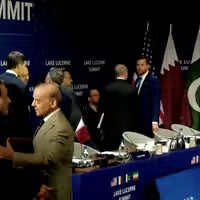
Zohrevand's comments follow the most serious clashes between the nuclear-armed neighbors since 2019, India claiming strikes on what it called "terrorist infrastructure" inside Pakistan, and Pakistan announcing it shot down five Indian fighter jets in response.
The lawmaker stressed that Tehran will not take sides in the conflict that has seen heavy exchanges of fire along the Kashmir Line of Control.
"Iran has played an important role in maintaining the geopolitical map of the region, and in this episode, it will also try to prevent this tension from escalating and going astray," Zohrevand said.
India has long been a key trade partner for Iran, although last year, an Iranian trade official admitted that trade with India dropped by up to a third due to global sanctions.
However, relations with Pakistan have been more fragile. Last year, Iran and Pakistan engaged in tit-for-tat attacks which both sides said were targeting terrorist hideouts on the borders.
Earlier on Wednesday, Foreign Ministry Spokesman Esmail Baghai voiced deep concerns regarding the heightened tensions, urging both India and Pakistan to show restraint.
A senior figure in Iran’s power sector warned that even a breakthrough in nuclear negotiations with the United States would not alleviate the country’s worsening electricity shortages without immediate fixes to fuel supply and financial constraints.
“Even if negotiations succeed, the power crisis won’t be resolved in the short term,” said Mehdi Masaeli, secretary of the Power Industry Syndicate, in an interview with ILNA.
“We must first solve the problems of gas, diesel, water—and more importantly, liquidity.”
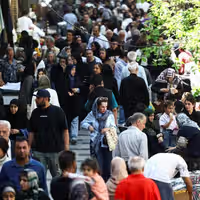
The remarks come as prolonged blackouts and water disruptions grip cities ahead of peak summer demand. Masaeli explained that many apartment residents now face a cascading loss of services.
“When there’s no electricity, there’s no water, no cooling, no elevators,” he said. “This reduces welfare and may increase social unrest.”
He urged citizens to prepare for a difficult summer and said authorities should not downplay the severity of the situation.
“I recommend people prepare fans and water jugs,” he said, calling for practical readiness in the face of nationwide supply gaps.
On Tuesday, government spokesman Fatemeh Mohajerani also acknowledged the crisis, calling it a “reality that must be accepted.”
The Houthis' pledge to stop targeting American vessels showed “peace through strength does work,” said US Senator Lindsey Graham, attributing the shift to recent US military action.
“This has come about because of the decisive action President Biden has taken,” Graham wrote on X. He warned that the Houthis’ continued assaults on Israel were only possible “at Iran’s own peril,” calling on Israel to “consider hitting Iran hard” and suggesting it “wouldn’t take much to put Iran out of the oil business.”
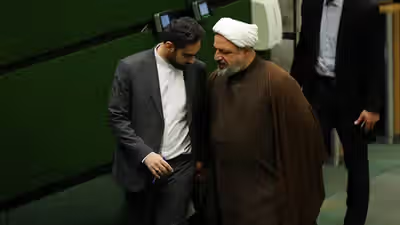
The position of the clerical establishment on indirect Iran-US negotiations aligns with that of Supreme Leader Ali Khamenei, said Alireza Arafi, deputy chairman of Iran’s Assembly of Experts.
“Our view is what the Leader has outlined,” Arafi said, cautioning against extremes. “There should be neither excessive optimism nor deep pessimism. The path must be pursued with readiness, endurance, and firmness.”