Iran denied involvement in Houthi attacks on Israel and international shipping, with foreign ministry spokesman Esmail Baghaei saying Monday that Tehran does not operate through regional proxies.
“Iran needs no deputy in the region,” he said, adding, “Only the Zionist regime acts as someone else's proxy and has brought chaos to the region.”
“The decisions made by the people of Yemen reflect their own will, and all such accusations against Iran are baseless.”

Iran remains committed to pursuing diplomatic engagement with the United States amid delays to talks, but expanding negotiations beyond the nuclear issue is unacceptable, the foreign ministry spokesman said on Monday.
“We have announced our commitment to continuing the path of dialogue and diplomacy. We have shown our full readiness by participating in several rounds of negotiations,” Foreign Ministry spokesperson Esmail Baghaei told reporters in Tehran.
“The decision regarding the timing of the negotiations was made based on the proposal of the Omani side and with the coordination of both parties," he said, Oman a key mediator.
"The decision to postpone was logistical,” Baghaei said.
Talks between Iran and the US remain focused on nuclear-related issues and sanctions relief, the spokesman emphasized, pushing back against French calls to expand the negotiations to include non-nuclear matters.
“Such statements are not new, and they are not acceptable to us,” he said. “The scope of the talks is limited and confined to the nuclear issue and the lifting of sanctions.”
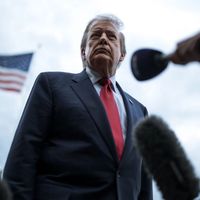
Responding to US President Donald Trump’s recent comments that Iran does not need nuclear energy given its fossil fuel reserves, Baghaei said, “Our peaceful nuclear program is based on rights enshrined in international law and dates back to the 1970s, when Iran’s energy needs were even less than today.”
Addressing recent Israeli military threats, Baghaei warned that Iran would respond decisively to any aggression. “The Iranian armed forces will respond to any act of hostility or adventurism in the strongest possible manner. There should be no doubt about that,” he said.
Baghaei criticized what he called Washington’s mixed signals that include both sanctions and calls for dialogue but reaffirmed Tehran’s willingness to continue diplomacy.
“If the US is sincere in its claim that Iran should not possess nuclear weapons, many issues can be resolved,” he said. “We have already declared clearly, and shown in practice, that we are not seeking to weaponize our nuclear program.”
Baghaei maintained that Iran is not orchestrating military actions through proxies, particularly in Yemen. “Iran needs no proxies in the region,” he said. “Yemen’s decisions are sovereign and independent, and the accusations are baseless.”
The US, which has designated the group a terrorist organization, has repeated warnings to Tehran that a failure to curb the Houthis' military attacks on the US and Israel, in addition to the militant group's blockade on global shipping, will result in military consequences for Iran.
Iran will consider any location used to launch attacks against it as a legitimate target, foreign ministry spokesman Esmail Baghaei said Monday.
“If aggression is carried out against Iran from the soil of any country, that point will be regarded as a legitimate target,” he said at a press briefing.
Baghaei added that Tehran remains committed to maintaining friendly and close ties with its neighbors and regional states.
Iran’s foreign ministry said changes within the US National Security Council are Washington’s internal matter and will not alter Tehran’s approach to nuclear talks.
“What matters to Iran is the behavior and position of authorized US officials at the negotiation table,” spokesman Esmail Baghaei said Monday.
Baghaei also dismissed any legal basis for triggering the UN snapback mechanism, saying that “some parties misuse their position at the Security Council to gain leverage.”
He said such tactics, along with “contradictory signals from US officials,” would only hinder progress.
Iran is waiting for Oman to finalize arrangements for the fourth round of nuclear talks with the US, foreign ministry spokesman Esmail Baghaei said Monday.
“There was no cancellation of negotiations. We are ready to hold the session by mutual agreement,” he said, adding that discussions will remain focused solely on nuclear issues and sanctions relief.
Baghaei also said Iran is ready to meet again with the European trio.

Iran’s foreign ministry confirmed that a planned meeting with European powers was canceled due to the suspension of Iran-US nuclear talks in Rome.
“A political directors’ meeting between Iran and the E3 was supposed to take place in Rome before the fourth round of talks, but the Iranian delegation did not travel after the Rome negotiations were called off,” spokesman Esmail Baghaei said.
He added that Iran remains open to such talks and has maintained contact with European envoys in Tehran, but scheduling now depends on coordination with the other parties.