Tehran's red lines dominate parliament's closed-door session on US talks
A session of the Iranian parliament on April 27, 2025
Iran's parliament convened a closed-door session on Tuesday to review the ongoing indirect negotiations between Tehran and Washington, with lawmakers expressing firm red lines on domestic nuclear enrichment, lifting of sanctions and foreign oversight.
Speaking to reporters after the session, Abbas Goudarzi, spokesperson for the Iranian Parliament's presiding board, said the meeting included a briefing from the National Security and Foreign Policy Committee, emphasizing the Islamic Republic’s core demands in the talks.
“Iran remains committed to negotiations as long as the other side remains committed,” Goudarzi said. “Our emphasis is on peaceful domestic enrichment. Our definition may differ from the Americans; enrichment means internal production, not the import of enriched material.”
He underlined that any final deal must include the removal of sanctions, unfreezing of blocked assets, and restoration of banking ties. “These are fundamental pillars of our position,” he said.
Goudarzi added that regional issues, Iran’s defensive capabilities, and the suspension of enrichment are not open for negotiation. “The talks are strictly nuclear in scope. We reject any inspection outside of those by the International Atomic Energy Agency,” he added.
Parliament Speaker Mohammad Bagher Ghalibaf echoed this stance, saying that the legislature’s role is supervisory. “The government must remain within the framework of the Strategic Action Law to lift sanctions and protect the Iranian nation’s interests,” he said.
The Strategic Action Law to Lift Sanctions and Safeguard the National Interests of Iran, passed in 2020 and aimed at more parliamentary influence on nuclear policy, mandated a rapid escalation of nuclear activities and a significant reduction in IAEA monitoring in reaction to the US' withdrawal from the JCPOA and the subsequent reimposition of sanctions in 2019.
Ghalibaf also addressed recent remarks by Israeli Prime Minister Benjamin Netanyahu, who has stepped up rhetoric against Iran, dismissing the comments as attempts to influence the Iran-US talks.
Earlier this week, Netanyahu said, “A real deal that works is one that removes Iran’s capacity to enrich uranium for nuclear weapons... Dismantle all the infrastructure of Iran’s nuclear program. That is a deal we can live with.”
Ghalibaf brushed off the remarks. “Netanyahu, in a desperate attempt to avoid political extinction, has resorted to threats. These worthless tirades are not taken seriously”, he said.
Drawing attention to the alignment between US and Israel, Ghalibaf said, "The Zionist regime cannot take independent action without US permission," in spite of threats.
However, it is US President Donald Trump who has said outright that if Iran does not agree to a nuclear deal, the US will bomb Iran.
Ghalibaf also delivered a stark warning: "Should even a fraction of these threats be executed, Iran’s response will be decisive. Any aggression would be akin to igniting a powder keg, putting not just the Zionist regime, but all US bases in the region squarely in the crosshairs of Iranian retaliation."
France warned on Monday that it would reimpose sanctions on Iran if European security interests are not guaranteed under the expiring nuclear deal, while the head of UN nuclear watchdog said time was running out to prevent military conflict over the issue.
"We will not hesitate for a second to reapply all the sanctions that were lifted ten years ago," French minister for Europe and Foreign Affairs Jean-Noel Barrot told reporters, referring to the snapback mechanism that can reactivate sanctions lifted under the 2015 nuclear deal, set to expire in October.
"These sanctions would then permanently close Iranian access to European technologies, investments and markets, with devastating effects on the country’s economy."
IAEA Director General Rafael Grossi, speaking alongside Barrot, stressed the urgency of the situation, saying, "It's not a matter of months or years. It's perhaps a matter of weeks whether we can really come to something that is doable, is feasible, and above all, avoids the spectre of more military conflicts."
Barrot, however, said there was no military solution to the Iranian nuclear issue, calling the diplomatic path "a bumpy road" but necessary as France is coordinating closely with Britain, Germany, and US Secretary of State Marco Rubio to support the ongoing dialogue with Iran.
"Iran is on the verge of acquiring nuclear weapons. Ten years ago, Iran made a commitment to the international community to contain its nuclear activities," Barrot said.
"Today, Iran has exceeded all the thresholds to which it committed itself. According to IAEA reports, Iran now has 6,000 kilograms of enriched uranium, thirty times more than the limit set by the agreement ten years ago," Barrot added.
Last week, speaking at the US-based think tank Council on Foreign Relations, Grossi said Iran has enough enriched uranium to produce several nuclear warheads and could do so within months.
Iran and the United States opened a third round of nuclear negotiations in Oman over the weekend with the next round expected to be held in Rome on Saturday.
Negotiations between Iran and the United States are making cautious progress, but the outcome remains highly uncertain as fundamental divisions persist and any overlap between the two sides’ red lines remains elusive.
The third round of talks took place in Muscat on Saturday, marking the first time that technical experts engaged directly.
Although the initiation of technical discussions is a positive development, addressing detailed issues exposed deep divisions, slowing the momentum. Statements by Oman’s Foreign Minister Badr al-Busaidiand Iran’s Foreign Minister Abbas Araghchi were notably cautious, signaling limited optimism.
Araghchi emphasized the substantial gap between the two sides' demands, noting that goodwill alone will not bridge it. Talks are scheduled to continue next week at both expert and chief negotiator levels.
Potential breakthrough?
Despite the uncertainties, a deal could be easier to forge compared to the one in 2015, for several reasons:
Regional dynamics have shifted, with Arab states now largely supporting an agreement.
Iran’s frozen assets are significantly lower—$10–20 billion today, compared to $80–150 billion in 2015.
Iran’s regional influence through proxy groups has weakened.
Domestic unrest has eroded the IRI’s internal position, increasing its incentive to negotiate.
The reduced intensity of US-Russia rivalry removes a complicating factor.
The US-China trade war may hamper Washington’s ability to apply maximum pressure.
Both Washington and Tehran prefer a diplomatic outcome over military confrontation. However, historical, political, and ideological differences complicate the path forward.
Core obstacles
First, the legacy of mistrust remains deep. Decades of conflict, sanctions, and failed diplomacy have hardened suspicions on both sides.
President Trump's withdrawal from the 2015 deal heightened Iranian concerns about American reliability. Meanwhile, US officials remain wary of Iran’s actions. Any agreement would require both sides to genuinely believe that commitments will be honored—an especially tall order given the political volatility in both countries.
Second, Tehran is unwilling to fully dismantle its nuclear infrastructure, resisting a repeat of Libya’s disarmament model. It may agree to reduce uranium enrichment and degrade highly enriched stockpiles but will preserve advanced centrifuge capabilities.
Iran’s regional influence, although waned, still concerns Washington, particularly with regard to Israel. Many in Benjamin Netanyahu's cabinet believe the current window offers a rare chance to cripple Iran’s nuclear capabilities and may push for covert or limited military operations to derail negotiations.
European powers are another factor. Britain, Germany, and France, alarmed by Iran’s growing military cooperation with Russia, are considering reimposing UN sanctions if no progress is made. Though not directly involved in current talks, their support will be critical to any final agreement.
Sanctions are another obstacle. While economic pressure has hurt Iran deeply, many sanctions, particularly those linked to terrorism, were codified by Congress and cannot be lifted by the administration alone. A complex framework for phased sanctions relief will be necessary.
Interim agreement?
In sum, while opportunities for a breakthrough exist, formidable challenges remain. Mistrust, nuclear safeguards, regional tensions, domestic politics, and sanctions enforcement all complicate diplomacy.
An interim agreement—laying the groundwork for a broader, binding deal—appears the most realistic short-term path.
Iran’s foreign ministry said on Monday that any agreement with the US must respect Tehran’s key demands, including the continuation of uranium enrichment inside the country and the effective lifting of sanctions.
Foreign Ministry spokesman Esmail Baghaei told reporters at his weekly press briefing that the upcoming talks — expected to be chaired by Iran’s foreign minister and the US special envoy — follow an understanding reached in Muscat.
Baghaei stressed that Iran’s fundamental negotiating principles remain unchanged. "Entering the details of any negotiation must be within the framework of broad outlines agreed upon by both sides," he said.
"Uranium enrichment inside the country and the effective removal of sanctions are Iran’s red lines and will be pursued with seriousness."
On the ongoing visit of an International Atomic Energy Agency (IAEA) technical team, Baghaei said the discussions would focus purely on technical issues and pending safeguarding matters.
"The visit of the IAEA technical delegation is a continuation of the discussions that took place between the Director General (Grossi) and Iranian officials, and today they will have talks with officials of the Atomic Energy Organization, and it is only technical. The discussion will be about the remaining safeguards issues,” he said.
Following the conclusion of the third round of nuclear talks in Oman on Saturday, Iran's foreign minister said IAEA experts might join the next round of talks on Saturday.
Visiting Tehran earlier in April, IAEA Chief Rafael Grossi said his agency could help achieve a positive outcome in the negotiations.
Last week, speaking at the US-based think tank Council on Foreign Relations, Grossi said Iran has enough enriched uranium to produce several nuclear warheads and could do so within months.
In 2018, Trump withdrew the US from a 2015 nuclear pact between Iran and major world powers, leading Iran to subsequently surpass that deal's uranium enrichment limits and limit the IAEA's oversight.
In February, the IAEA released a report saying the current situation is concerning as Tehran is enriching uranium to up to 60% purity, near weapons grade. Tehran has long denied seeking nuclear weapons.
Baghaei also addressed the role of European nations in the nuclear talks. "We hope the Europeans will play a constructive role," he said, adding that Iran’s continued engagement with neighboring countries and other JCPOA participants signals the Islamic Republic's good will.
When asked about the decision to exclude three European parties of the JCPOA from the talks, Baghaei said, "That was their own choice... Iran stands ready for European nations to play a role in these discussions.”
He criticized US pressure tactics beyond Iran, saying, "The maximum pressure policy is not limited to Iran; it is being pursued against other countries like China and disrupts free trade. It ultimately violates the human rights of individuals subjected to sanctions."
US President Donald Trump has threatened to bomb Iran if it does not agree to a new nuclear deal and on Sunday night, Israeli PM Benjamin Netanyahu said: "We are in close contact with the United States. But I said, one way or the other, Iran will not have nuclear weapons."
Baghaei responded to the threats saying: "Any adventurism against Iran will face a crushing response. Western countries, especially those continuing to support this regime [Israel], must understand they are assisting an entity whose survival depends on crisis."
Baghaei confirmed that the next round of talks is planned for Saturday, warning that the process will not be fast. "Entering technical issues is time-consuming and an inseparable part of negotiations," he said. "We have said that we are serious."
He emphasized that sanctions relief must be comprehensive and includes Tehran’s access to its assets blocked in foreign banks due to US sanctions. "Effective termination of sanctions is a key term that must include a diverse set of commitments. Ensuring free access to Iran’s resources and assets is our right."
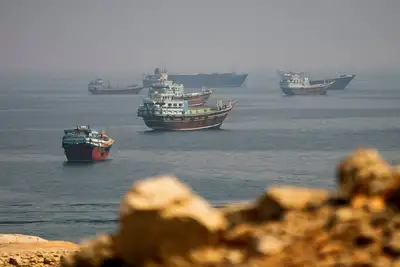
Tehran's morning newspapers on Sunday presented divergent accounts of the explosion at Rajaei port in southern Iran, exposing political fault lines over the incident’s cause.
While conservative outlets attributed the blast to safety failures, one reformist-aligned paper warned of sabotage linked to foreign adversaries.
Kayhan, Vatan-e-Emrooz, and Javan, outlets close to Iran’s security establishment, attributed the explosion to negligence in container safety. Javan accused “external enemies of spreading disinformation.”
In contrast, Ham-Mihan, a reformist-leaning daily, suggested the timing of the explosion — coinciding with Iran-US negotiations in Muscat — was unlikely to be accidental.
“It is improbable that the explosion’s concurrence with the start of technical talks between Iran and America is coincidental,” the editorial said.
The paper cited US President Donald Trump’s past comments on Israeli operations, saying Washington might tolerate Israeli non-military acts of sabotage. Ham-Mihan argued the port blast may have been subcontracted to proxies rather than being a direct Israeli operation.
The editorial read, “In a country of 85 million, at least ten thousand individuals have sensitive access; without patriotism, they could deal irreversible blows.”
Kayhan countered that linking the explosion to the Muscat negotiations was based on “unsupported narratives spread by fake news networks,” and urged authorities to clarify whether the explosion resulted from negligence or other factors.
Iran and the United States opened a third round of nuclear negotiations in Oman on Saturday.
Foreign Minister Abbas Araghchi is leading Iran’s delegation. The US State Department confirmed that Steve Witkoff, the special envoy for nuclear affairs, is heading the American team, alongside Michael Anton, who previously served as National Security Council spokesman during Trump's first term as leading the American technical delegation.
“We’re having very serious meetings, and there are only two options. And one option is not a good option. It’s not a good option at all,” President Donald Trump said Friday, according to Reuters. He added, “I think we’re doing very well with respect to Iran.”
The negotiations follow last weekend’s session in Rome. Iranian officials are said to be willing to return to the technical constraints of the 2015 nuclear deal, including reactivating International Atomic Energy Agency surveillance cameras at nuclear facilities.
Under the 2015 Joint Comprehensive Plan of Action (JCPOA), Iran was restricted to enriching uranium up to 3.67 percent with a stockpile limit of 300 kilograms.
Following Washington’s unilateral withdrawal from the accord in 2018, Iran expanded enrichment to 60 percent and accumulated more than 8,000 kilograms of uranium, while maintaining that its program remains civilian in nature.
An Iranian official participating in the negotiations told Reuters that "the only remaining point of disagreement in the general discussions and mutual understanding is the missile issue."
According to the official, Iran's position — that it would not exceed the obligations outlined in the 2015 deal and related resolution — means it would "only refrain from building missiles capable of carrying nuclear warheads as a gesture of goodwill."
Both negotiating teams arrived in Muscat on Friday. Araghchi and Omani Foreign Minister Badr Albusaidi later attended the Muscat International Book Fair, where Araghchi’s Arabic-language book The Power of Negotiation was unveiled.
Witkoff traveled to Oman after meetings with Russian President Vladimir Putin in Moscow.
Iranian state media reported the talks were initially scheduled for one day but may be extended depending on technical progress.
The outcome could shape whether Iran steps back toward nuclear restrictions or deepens a confrontation already straining regional security.