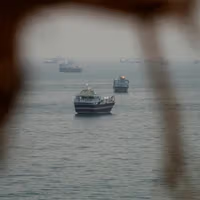
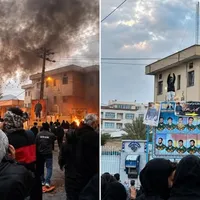
Officials summoned over deadly port explosion, says minister
Several individuals were summoned over the explosion at Rajaei port that killed tens of people, said Iran's interior minister on Monday.
Eskandar Momeni told a crisis meeting the blast was linked to failures in civil defense and safety protocols. "A committee determined that shortcomings, including failure to observe passive defense and safety measures, contributed to the incident," he added. He said that the number of missing or unidentified bodies matches the confirmed death toll. According to the minister, only about 3,500 out of 130,000 containers at Rajaei port were affected by the fire.
The explosion at Rajaei port stemmed from internal safety failures and mismanagement, said an Iranian lawmaker, rejecting foreign involvement.
"No evidence has been presented so far to suggest foreign actors were involved," said Ali Khezrian, a member of parliament’s National Security Committee said on Monday.
"Deflecting blame under current circumstances will only distract public attention from those truly responsible for this disaster," he added, according to Iranian media.
The Iranian president said that Nagorno-Karabakh is an inseparable part of Azerbaijan's territory during a meeting with his counterpart, supporting the country's rights over the disputed region as the two nations attempt to mend ties.
"We believe that the rights of the people of Azerbaijan must be respected, and Karabakh must belong to the country of Azerbaijan. Karabakh is an inseparable part of the soil of Azerbaijan, and we respect that," Masoud Pezeshkian said during a meeting with Azerbaijani officials in Baku on Monday.
Azerbaijani President Ilham Aliyev officially welcomed Pezeshkian at the Zagulba Presidential Palace on Monday afternoon, followed by a private meeting between the two leaders and a joint session of their high-ranking delegations.
Tensions between Tehran and Baku have run high for years, largely due to Baku's close ties with Iran's nemesis Israel and a January 2023 attack on Azerbaijan's embassy in Tehran.
Last week, Pezeshkian expressed hopes for a rapid improvement in relations and cooperation between the two countries as part of a broader effort to mend ties.
Iran and Azerbaijan held two-day joint naval exercises in the Caspian Sea in November, in moves towards rapprochement.
Iranian and Azerbaijani presidents during a meeting in Baku on April 28, 2025
Pezeshkian’s remarks come a month after Iran welcomed a peace agreement between Azerbaijan and Armenia.
The Nagorno-Karabakh conflict, a decades-long dispute rooted in the aftermath of the Soviet Union's dissolution, saw a significant development in March when both Azerbaijan and Armenia announced an agreement on the text of a peace treaty.
Nagorno-Karabakh, internationally recognized as part of Azerbaijan but historically with a majority ethnic Armenian population, had long been a flashpoint between the two South Caucasus nations.
Iran, sharing a northern border with both countries, has consistently underscored its interest in regional stability, particularly along its 44-kilometer frontier with Azerbaijan.
The fire at Rajaei port symbolized the collapse of the Islamic Republic, said Iranian filmmaker and former political prisoner Jafar Panahi.
"The Bandar Abbas fire is the flame of a regime’s collapse that has turned Iran to ashes over nearly half a century, resulting in poverty, corruption, discrimination, repression, destruction of infrastructure, and global isolation," Panahi wrote in a post on Instagram.
“An unaccountable system ruling in the name of religion and security had become the nation’s main enemy.”
Panahi called for a peaceful resolution through "a free and transparent referendum under international supervision" to restore sovereignty to the people.
The following video shows rescue teams at Rajaei Port in Bandar Abbas were clearing debris at the site of explosion on Monday.
An Iranian newspaper close to parliament speaker Mohammad Bagher Ghalibafsaid that the recent explosion at the Rajaei port in southern Iran might be a deliberate act to undermine ongoing negotiations with the United States.
In an editorial, Sobh-e No daily said that while the cause of the large blast remains officially undetermined, the timing of the incident alongside nuclear talks and threatening rhetoric from Israel warranted consideration of potential sabotage aimed at derailing diplomatic progress.
"The swift news reporting by foreign media and the creation of rumors regarding the containers that caught fire is the same scenario of disrupting the negotiation atmosphere by the Zionist regime,” read the article.
The newspaper highlighted a prior warning from Foreign Minister Abbas Araghchi, who tweeted two days before the explosion about potential disruptive actions by Israel against the Iran-US nuclear diplomacy. Araghchi had said that Iranian security forces were on high alert for potential sabotage and assassination attempts.
“Considering the political aspects of this incident, the economic sensitivity of this port, and the history of attacks on nuclear facilities, the possibility of sabotage cannot be ignored; just as the possibility of negligence and a natural accident also exists."
Containers burning at Rajaei port, Bandar Abbas (April 2025)
US President Donald Trump's optimistic pronouncements regarding negotiations with Iran are primarily an effort to maintain Tehran's engagement in the talks, according to Shahram Kholdi, a professor of international relations.
Speaking to Iran International, Kholdi characterized Trump's optimism as a strategy to prevent any disruption to the process.
"Trump is trying to paint a silver lining around this very gray and ambiguous cloud of negotiations, in the hope that there might be a light at the end of the tunnel and the Islamic Republic agrees to stop enrichment," he said.
Kholdi said that Trump's expressions of confidence are largely intended to keep the Iranian delegation at the negotiating table. "Trump's optimism is mostly to keep the other side at the negotiating table."