Explosion at Rajaei Port injures 516, rescue teams struggle to reach blast site
An explosion at Rajaei Port has left 516 people injured, Iran’s Emergency Organization spokesman Babak Yektaperest said on Saturday.
The acting head of the Red Crescent’s Relief and Rescue Organization said teams have not yet been able to reach the main site of the explosion. Eleven operational teams have been deployed to the area, and firefighters are working to contain the fire.
Iran and the United States opened a third round of nuclear negotiations in Oman on Saturday.
Foreign Minister Abbas Araghchi is leading Iran’s delegation. The US State Department confirmed that Steve Witkoff, the special envoy for nuclear affairs, is heading the American team, alongside Michael Anton, who previously served as National Security Council spokesman during Trump's first term as leading the American technical delegation.
“We’re having very serious meetings, and there are only two options. And one option is not a good option. It’s not a good option at all,” President Donald Trump said Friday, according to Reuters. He added, “I think we’re doing very well with respect to Iran.”
The negotiations follow last weekend’s session in Rome. Iranian officials are said to be willing to return to the technical constraints of the 2015 nuclear deal, including reactivating International Atomic Energy Agency surveillance cameras at nuclear facilities.
Under the 2015 Joint Comprehensive Plan of Action (JCPOA), Iran was restricted to enriching uranium up to 3.67 percent with a stockpile limit of 300 kilograms.
Following Washington’s unilateral withdrawal from the accord in 2018, Iran expanded enrichment to 60 percent and accumulated more than 8,000 kilograms of uranium, while maintaining that its program remains civilian in nature.
An Iranian official participating in the negotiations told Reuters that "the only remaining point of disagreement in the general discussions and mutual understanding is the missile issue."
According to the official, Iran's position — that it would not exceed the obligations outlined in the 2015 deal and related resolution — means it would "only refrain from building missiles capable of carrying nuclear warheads as a gesture of goodwill."
Both negotiating teams arrived in Muscat on Friday. Araghchi and Omani Foreign Minister Badr Albusaidi later attended the Muscat International Book Fair, where Araghchi’s Arabic-language book The Power of Negotiation was unveiled.
Witkoff traveled to Oman after meetings with Russian President Vladimir Putin in Moscow.
Iranian state media reported the talks were initially scheduled for one day but may be extended depending on technical progress.
The outcome could shape whether Iran steps back toward nuclear restrictions or deepens a confrontation already straining regional security.
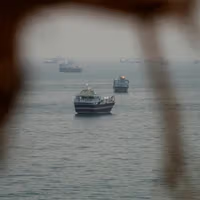
The explosion at Iran’s Shahid Rajaei port was preceded by a small fire in the container terminal area, Fars News Agency reported on Saturday. The fire quickly escalated, causing a major blast, fueled by high temperatures and the presence of flammable materials, Fars quoted witnesses as saying.
Local reports said the exact contents of the containers are still unknown, but initial information pointed to combustible goods near the scene. Fars also reported a sulfur-like odor in the area.
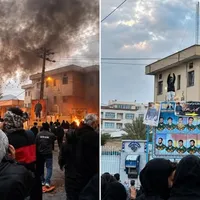
State television later reported that additional explosions were heard at Shahid Rajaee port, but said "the situation is under control." Thick smoke was seen over the port as emergency teams continued operations to evacuate vehicles and assist the wounded.
Sabotage is considered unlikely in the explosion at Iran’s Shahid Rajaei port, a national crisis management spokesman said on Saturday, citing earlier official safety warnings issued for the site.
Hossein Zafari told ILNA news agency that chemical materials stored inside containers were likely the cause of the blast and that previous inspections had flagged safety concerns. "Past warnings about the port’s safety reduce the likelihood of sabotage," Zafari said.
He urged the public to rely on official sources for updates, warning that widespread rumors were circulating. "The volume of rumors is so high that we are forced to clarify even obvious matters," he added.
Zafari said toxic smoke from the fire was hampering rescue efforts and that the full cause would be determined after the fire was brought under control. No confirmed death toll has been announced yet, but the shockwave was felt up to 50 kilometers away.
Smoke from the explosion is seen at the Shahid Rajaee port in Bandar Abbas, Iran, April 26, 2025.
Iran said on Saturday it remains "steadfast" in its demand for the lifting of sanctions and reiterated its readiness to build trust over the peaceful nature of its nuclear program, as a third round of indirect talks with the United States got underway in Muscat.
“The Islamic Republic of Iran remains steadfast in its principled position regarding the need to end unjust sanctions and its readiness to build trust,” foreign ministry spokesman Esmail Baghaei said.
Talks began around 10 a.m. local time, with Iranian and US delegations meeting in separate rooms under Omani mediation, he said.
Baghaei added that a technical Iranian team of experts in sanctions, nuclear issues, and IAEA affairs is also present at the talks.
He stressed that “respect for Iran’s legitimate rights under the Non-Proliferation Treaty and providing assurances about the effective lifting of sanctions” were necessary to reach any understanding.
Iranian officials said several scenarios are being investigated as possible causes of the explosion at Shahid Rajaei port in Bandar Abbas, and the exact reason has not yet been confirmed.
Mohammad Ashouri, governor of Hormozgan province, said, "Several scenarios are being examined by the relevant authorities, and the cause will be announced once confirmed."
Following the blast, Iran’s First Vice President Mohammadreza Aref ordered an urgent investigation, speaking separately by phone with the provincial governor and the head of the Red Crescent. Interior Minister Eskandar Momeni also called for a special inquiry and dispatched the head of the National Crisis Management Organization to the area.