Iran’s Mehr News Agency, citing an informed source, reported Saturday that the talks in Muscat are not related to missile issues.
This comes after Reuters reported on Friday that the ongoing negotiations between the United States and Iran are not limited to Tehran’s disputed nuclear program but also include its missile program, citing an Iranian official with knowledge of the talks.
According to Reuters, following a second round of talks in Rome on April 19, Iranian negotiators were "persuaded that the US had accepted Tehran's position that it would not entirely end its enrichment program or surrender all the uranium it has enriched already".
However, the official said Iran’s missile program remained a big sticking point. "The only remaining point of disagreement in the general discussions and mutual understanding is the missile issue," Reuters quoted the official as saying.


Iran’s Minister of Culture Abbas Salehi represented the Islamic Republic at the funeral of Pope Francis at St. Peter’s Square on Saturday, appearing alongside global dignitaries in a rare display of Tehran’s diplomatic outreach.
Salehi was accompanied by Mohammad Hossein Mokhtari, Iran’s ambassador to the Vatican, to pay respects to the late pontiff, who died Monday at the age of 88 after years of declining health.
Live broadcasts showed Salehi and Mokhtari standing near US President Donald Trump and former President Joe Biden during the ceremony. Footage also showed a heavy presence of Trump’s security personnel surrounding the Iranian representatives at St. Peter’s Square.
Separately, Ali Bahreini, Iran’s ambassador to the United Nations office in Geneva, signed a book of condolences at the Vatican’s permanent mission on Thursday, expressing Tehran’s sympathy, IRNA reported.
Pope Francis, remembered for championing interfaith dialogue, drew tributes from leaders across the world, reflecting the broad reach of his papacy.

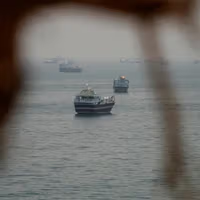
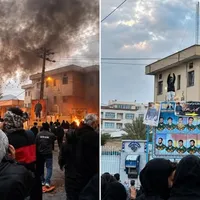
A loud explosion was heard at the Shahid Rajaee port in Iran’s southern city of Bandar Abbas on Saturday, local media reported.
Local media quoted the residents as saying the blast shook the ground and was heard in nearby towns.
Hormozgan province’s crisis management chief, Mehrdad Hassanzadeh, said the blast was caused by "the explosion of several stored containers in the port yard" and that "injured individuals are currently being evacuated from the site."
According to Tasnim news agency, the explosion occurred at an administrative building inside the port.
However, Tasnim later reported that a fuel tank had exploded for unknown reasons, prompting the deployment of rapid response teams and the suspension of all port operations.
The National Iranian Oil Refining and Distribution Company (NIORDC) said in a statement that "the explosion had no connection with the refineries, fuel storage tanks, or oil pipelines related to this company in the area," and that "operations at facilities in Bandar Abbas are continuing without interruption." It added that firefighting and emergency teams from nearby oil companies were on standby to assist port authorities.
There are conflicting accounts about the cause of the explosion, and no official confirmation has been issued.
There were no immediate reports of casualties, but Tasnim said the blast caused extensive damage.
This is a developing story.
Iran’s Fars News Agency, affiliated with the Islamic Revolutionary Guard Corps (IRGC), defended Supreme Leader Ali Khamenei’s recent remarks supporting indirect negotiations with the United States.
"The essence of the Leader’s message is that everyone must fulfill their duty," Fars wrote on Saturday, warning against "simplistic and distorted" interpretations of Khamenei’s approach.
"We must not accuse the Islamic system of deviating from its ideals just because we do not understand why the political road has twisted," it added.
Khamenei had in February called talks with Washington "unwise, undignified, and dishonorable." Earlier this month, he said he was satisfied with the progress of negotiations mediated by Oman, telling Iranian media: "The first steps have been taken well, and the negotiations may bear fruit."
Iranian Foreign Minister Abbas Araghchi met with Oman's Foreign Minister Badr Albusaidi in Muscat on Saturday ahead of the third round of indirect talks between Iran and the United States, Iranian state media reported.

US President Donald Trump has realized he must distance himself from the rhetoric of coercion and domination, a senior Iranian official said on Saturday.
Ali Shamkhani, political advisor to Supreme Leader Ali Khamenei and former secretary of Iran’s Supreme National Security Council, made the remarks in a commentary published in the government’s official daily Iran.
"Trump, despite his threats, has not resorted to military action against Iran," Shamkhani wrote. He said Trump was seeking to project strength at home after "failures" in Gaza, Yemen, Ukraine, and on economic issues.
"Trump has failed to secure victories in key dossiers and is now trying to preserve his administration’s self-assurance," he added.
Shamkhani said the talks underway in Muscat could mark a political turning point for Trump, while emphasizing Iran’s policy of combining resistance with active diplomacy.
"Iran has shown that just as it resists in the field, it also plays an active role in diplomacy," he said.