US officials say Witkoff’s travel plans to Oman still unconfirmed - The Washington Post
Plans for US special envoy Steve Witkoff to meet Iranian officials in Oman this weekend remain unconfirmed, US officials told The Washington Post, despite a public statement by the State Department that he would attend.
State Department spokeswoman Tammy Bruce said Thursday that Witkoff would join a separate meeting with Iranian Foreign Minister Abbas Araghchi on Saturday.
But other officials, speaking on condition of anonymity due to the sensitivity of the talks, said his travel plans “were not yet determined.”
Iran’s supreme leader Ali Khamenei on Thursday signaled that any potential agreement with the United States could be short-lived.
His remarks---delivered In his customary cryptic language, and invoking historical Islamic precedents---appear to be an attempt to address the concerns of his most loyal supporters, many of whom deem any rapprochement with Washington as betrayal.
“When Imam Hasan Mojtaba made peace with Mu'awiyah, some people came forward with complaints and objections. The Imam said, ‘It is temporary… this dominance of heresy and hypocrisy is not meant to be permanent,’” Khamenei said in a religious event on Thursday.
He also warned against disunity and objections without direct reference to the ongoing talks with the Trump administration.
“Our shortcomings—at times our loose talk, at times our failure to help, our needless protests, lack of patience, flawed analysis—can (have an adverse) impact," he added.
Iranian and American delegations are scheduled to discuss technical details of a potential nuclear agreement in Oman this weekend.
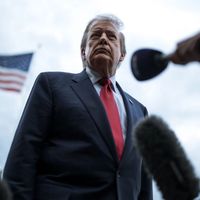
"I think we're doing very well with respect to Iran, and we're having very serious meetings, and there are only two options, and one option is not a good option. It's not a good option at all," US President Donald Trump told reporters in the White House on Thursday.
"I think we're doing very well on an agreement with Iran, but that one - we're doing a lot of things, I will say - but that one is well on its way. We could have a very, very good decision, and a lot of lives will be saved."
Iranian foreign minister Abbas Araghchi proposed to US special envoy Witkoff that the two sides agree an interim deal, Axios reported, citing the technical complexity of any agreement and the brevity of a two-month deadline set by US President Donald Trump.
Witkoff said the US side preferred to reach a comprehensive deal and was not interested in an interim deal for the time being, the Axios report said citing two officials familiar with the matter.
The two sides could revisit the idea, Witkoff said according to the sources, if both sides agree that significantly more time is needed.
Araghchi and Witkoff met directly for a short period, they added according to Axios, during their indirect talks mediated by Oman in Rome on Saturday.
Long one of the Islamic Republic's staunchest ultra-conservatives, cleric and Chief Justice Gholam-Hossein Mohseni-Ejei has lately championed anti-corruption and urged caution on a new hijab law in a shift which has confounded allies.
But as Iran has reeled from the sudden death of a president, regional setbacks as well as deepening unrest and poverty, the rebranding by a conservative political fixture may be a calculated maneuver to survive in one of Tehran's most uncertain times.
In July 2021, Iran’s Supreme Leader Ali Khamenei appointed Mohseni-Ejei as Chief Justice following the election of another arch-reactionary cleric and former judge, Ebrahim Raisi, to the presidency.
But since taking office, he has gradually distanced himself from those of ultra-hardliners of the Paydari (Steadfastness) Party and other supporters of the former nuclear negotiator Saeed Jalili.
He has also cultivated a relatively cooperative relationship with the moderate administration of President Masoud Pezeshkian and supported some of its moves including the push for the temporary suspension of a new and very strict hijab law that could provoke public unrest if implemented.
Once infamous for his hardline stance and alleged human rights violations, Mohseni-Ejei has also attempted to rebrand himself as a champion of anti-corruption, repeatedly emphasizing the theme in public speeches.
The political repositioning has drawn sharp criticism from ultra-hardliners. In recent months, Mohseni-Ejei even publicly criticized the late President Raisi after his death over the handling of high-profile corruption cases, angering the Paydari Party and other staunch conservatives.
Hardliners have also condemned the judiciary’s handling of a long-standing and politically sensitive case involving alleged corruption in a failed gas export agreement with the UAE known as the Crescent deal, accusing the judiciary of neglecting to prosecute key reformist figures including former oil minister Bijan Zanganeh.
Rise to prominence
Born in 1956, Mohseni-Ejei studied at the Haqqani School in Qom, a seminary known for producing many of Iran’s leading hardline clerics. He holds the religious title of Ayatollah, signaling his status as a mujtahid—a scholar authorized to independently interpret Islamic law.
His public profile rose dramatically in 1998 during the televised corruption trial of Gholam-Hossein Karbaschi, the reformist mayor of Tehran. Acting as both judge and prosecutor, Mohseni-Ejei’s confrontational courtroom exchanges with Karbaschi were broadcast by state television, elevating his public profile.
Later that year, in November 1998, Khamenei appointed him as Prosecutor General of the Special Clerical Court, a powerful institution that operates independently of the judiciary and prosecutes only members of the clergy, often for politically charged offenses.
Around the same time, Mohseni-Ejei also represented the judiciary on the Press Supervisory Board, which played a central role in the mass closure of reformist newspapers in April 2000, just one day after a sermon by Khamenei attacking the free press.
The crackdown led to the arrest of numerous journalists and the shuttering of dozens of publications, and one of the most colorful alleged episodes in the jurist's career.
Prominent journalist Isa Saharkhiz accused Mohseni-Ejei of going berserk at a 2004 meeting of the Press Supervisor Board and said the cleric threw a two bowls full of sugar cubes at him and went on the attack, biting him in the shoulder.
Saharkhiz filed a lawsuit, but the case was never investigated or brought to court.
Mohseni-Ejei's career soared nonetheless.
Intelligence minister
In August 2005, Mohseni-Ejei joined President Mahmoud Ahmadinejad’s cabinet as Minister of Intelligence. He held the post until July 2009, when he was dismissed in the aftermath of the unrest following Ahmadinejad’s disputed re-election.
Following a brief transitional period during which Ahmadinejad temporarily assumed control of the ministry, Heydar Moslehi was appointed as Mohseni-Ejei’s successor.
Sanctioned chief justice
In August 2009, shortly after leaving the cabinet, Mohseni-Ejei was appointed Prosecutor General of Iran by then-Chief Justice Sadeq Amoli-Larijani. He was later promoted to First Deputy to the Chief Justice in 2014, a position he held until his elevation to Chief Justice in 2021.
In 2011, both the United States Department of State and the European Union sanctioned Mohseni-Ejei for his role in the deadly suppression of protests following the disputed 2009 elections, citing serious human rights abuses.
Russian foreign ministry spokeswoman Maria Zakharova on Thursday strongly backed Iran's nuclear program and warned a military attack could plunge the Middle East into turmoil.
"Russia is making active efforts to prevent another serious deterioration or a new crisis over Iran and its nuclear program," Zakhova said according to official Russian outlet Tass.
"We oppose any attempts by certain countries to resolve emerging issues through the use of military force and urge all those who are considering such actions to refrain from them, as it could ... result in turmoil for the entire Middle East.
Zakharova added "all of Iran's right-minded neighbors" were aware of the stakes.
"Like us, they have a vested interest in ensuring that the endless escalation of tensions - which the West has been diligently fueling for years under the pretext of some imaginary threats over Iran's peaceful nuclear activity - does not spiral into an open conflict, but is resolved via agreements that duly take into account legitimate rights and eliminate mutual concerns."
"The Russian side is holding regular and productive discussions with Tehran on the prospect of a settlement around Iran's nuclear program," she added.