Former trade minister Reza Fatemi-Amin received a one-year sentence and former agriculture minister Javad Sadatinejad was handed two years after both were found guilty of “complicity in disrupting the country’s economic system”.
The charges related to an alleged multi-billion-dollar corruption case dubbed the Debsh Tea scandal.
Many in the media and on social media argued that ordinary Iranians and political prisoners receive much harsher sentences, criticizing the ruling as unjust.
Ham Mihan newspaper in Tehran wrote that, “As former ministers, the convicted individuals should have faced stricter, not more lenient, sentences.”
It has been one of the largest financial corruption cases in Iran’s history, involving financial misconduct amounting to approximately $3.4 billion.
Investigations uncovered widespread fraud, including large-scale tea smuggling, currency manipulation and illegal acquisition of foreign exchange.
Gholamali Imanabadi, a well-known former lawmaker, went so far as to accuse some ruling figures of orchestrating the ouster of the economy minister and former foreign minister Javad Zarif from the government on Sunday to create chaos and divert attention from the light sentences issued in the Debsh scandal.
Supporters of the Reformist faction within the Islamic Republic pointed out that the two convicted ministers served in the previous government of former President Ebrahim Raisi—a government that had presented itself as “revolutionary” and committed to higher ideals.
The sentencing of former government officials is a rare instance of high-profile figures being prosecuted in Iran. However, similar cases have often resulted in appeals or commutations that prevent full enforcement.
Now, the unusually light sentences for the two ministers are widely seen as another example of leniency for insiders loyal to the system.
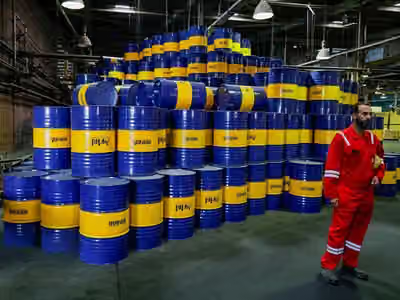
At the center of the scandal was the industrial group’s CEO Akbar Rahimi Darabad, who on Monday was sentenced to 66 years in prison for multiple economic crimes according to his spokesman, including organized smuggling and bank fraud.
Rahimi Darabad has also been required to return over €2 billion in received foreign currency facilities and pay fines for various smuggled tea shipments.
The two ex-ministers were among 44 individuals found guilty in the case, which allegedly involved Iran’s Central Bank, customs and a string of other ministries, raising public concerns over the extent of economic misconduct in the country.
The investigation alleged that Debsh Tea had exploited government policies to acquire vast amounts of foreign currency at official exchange rates, later selling it at significantly higher prices on the open market.