Satellite images show Iran building large warship - Newsweek
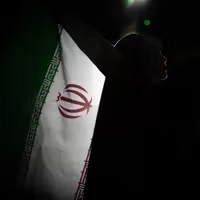
Satellite images suggest Iran is building a large warship at a Revolutionary Guards (IRGC) naval facility in southern Iran, according to Newsweek
"The vessel, analyzed by open-source intelligence monitors, is significantly larger and more heavily armed than many current IRGC naval assets," the exclusive report said.
The Netherlands summoned Iran's envoy on Thursday after Dutch intelligence accused Tehran of an attempted assassination of an Iranian dissident in the country.
It is likely that Iran ordered the attempted assassination of an Iranian activist Siamak Tahmasbi in Haarlem, Netherlands, in the summer of 2023, the agency’s annual report on Thursday of the General Intelligence and Security Service (AIVD) said.
An attempted assassination in Madrid of former Spanish lawmaker Alejo Vidal-Quadras, a vocal critic of the Islamic Republic, at the end of 2023 was also attributed to Iran, Dutch news outlet Nieuwsuur added citing the report.
"Iran used a tried and tested method in both cases: using criminal networks to silence opponents of the regime," Nieuwsuur's report said citing AIVD in reference to the alleged assassination attemp against Tahmasebi and Vidal-Quadras.
"This makes it difficult to prove under criminal law that the order actually came from Tehran," it added.
The report said that on June 6 2023, Tahmasebi noticed two men attempting to enter his home. Tahmasebi alerted the police, who arrived in time to arrest the armed intruders. The northern Netherlands prosecutor's office confirmed the arrests and the possession of firearms by the intruders.
One of the two suspects, Mehrez Ayari, is a 38-year-old Tunisian criminal from Villejuif, Val-de-Marne, France. Ayari had been sought by French police since August 2022 and is accused of murdering a cannabis dealer.
Nieuwsuur reported that the two detained were in contact by phone with a third man, who sent them instructions. The report added that the third person who allegedly directed them by telephone on behalf of Iran remains at large.
The leader of a Swedish criminal network accused of assisting Tehran in attacks on Israeli-linked targets in Europe is currently living in Iran under the protection of the Islamic Revolutionary Guard Corps (IRGC), sources told Iran International.
Rawa Majid received funds from Iran’s embassy in Denmark to help coordinate attacks against Israeli diplomatic facilities in Copenhagen and Stockholm, according to a source familiar with the matter inside the IRGC.
The source also said the gang leader travels between Iran and Afghanistan for operations overseen by the IRGC.
Majid leads a criminal group, Foxtrot, recently sanctioned by the UK and the US for its alleged role in orchestrating attacks on Israeli interests. Both governments accused the group of working as a proxy force for Iran in Europe. Tehran has denied the charges.
"Iran’s brazen use of transnational criminal organizations and narcotics traffickers underscores the regime’s attempts to achieve its aims through any means, with no regard for the cost to communities across Europe,” US Treasury Secretary Scott Bessent said in a statement in March as the US sanctioned Majid and Foxtrot.
Rawa Majid
The US Treasury said the group has carried out operations targeting Israeli and Jewish institutions, including an attempted bombing outside the Israeli embassy in Stockholm and grenade attacks near the Israeli embassy in Copenhagen in October 2024.
The attacks are part of an apparent broader strategy that has alarmed European security services. In a December 2024 report, Bloomberg detailed how Iran-affiliated groups have increasingly recruited local criminals — including minors — to carry out assaults on Jewish and Israeli institutions across Europe.
Iran’s expanding covert footprint in Europe is linked to the broader regional conflict between Israel and Iranian proxy forces, Bloomberg reported, and the strategy may be aimed at fueling social tensions in countries already divided over immigration and integration.
Sweden’s Security Service (Säpo) and Israeli intelligence agency Mossad have both identified the Foxtrot criminal network as one of the groups recruited by Tehran for sabotage operations in Europe.
While Iranian officials deny using criminal organizations abroad, leaders of the Islamic Republic have repeatedly praised attacks on Israeli interests globally.
With inflation and unemployment mounting, some Iranians and officials are stepping up calls to expel the millions of undocumented and impoverished Afghans in their midst to claw back jobs and government handouts for citizens.
“They have taken many job opportunities,” Interior Minister Eskandar Momeni said during a meeting of provincial governors on Monday, addressing public concerns that foreign nationals were crowding Iranians out of the job market.
Momeni added that more than 1.2 million undocumented immigrants were repatriated in the past Iranian calendar year ending on March 20.
At the same meeting, the head of the Foreign Nationals and Immigrants Affairs Center at the ministry Nader Yarahmadi said 6.1 million Afghans currently reside in Iran. The actual number may be far higher, or up to 15 million, according to unofficial tallies by Iranian lawmakers and media outlets.
Iranian officials and media outlets frequently use the term foreign nationals as a euphemism specifically referring to Afghan citizens.
Afghans began arriving in Iran as refugees in the early 1980s, later joined by economic migrants. Until the Taliban's return to power in Afghanistan in 2021, their numbers rarely exceeded two million.
Around 780,000 Afghans hold official refugee status and are not considered undocumented. A small minority of non-refugees are wealthier Afghans who fled after the Taliban’s takeover, while the majority are undocumented economic migrants who provide low-cost labor in sectors such as agriculture and construction and live with or without their families.
Anti-Afghan sentiment has grown significantly in recent years, especially on Persian-language social media, where hashtags such as “Expulsion of Afghans is a national demand” frequently trend.
Advocates for the expulsion of Afghan nationals accuse the government of allowing them to benefit from billions of dollars in subsidies for food, fuel, and other essential services, including healthcare and education.
In addition to monthly cash payments to nearly 90 million Iranians, the government heavily subsidizes basic goods such as bread and fuel. The current fiscal year’s budget allocates 2,500 trillion rials out of 64,000 trillion rials to bread subsidies alone.
No official data quantifying the subsidies specifically received by Afghan immigrants exists.
However, Hamidreza Azizi, a lawmaker representing Eghlid in southwestern Fars Province, said in a recent parliamentary speech that the government spends approximately 7,000 trillion rials on subsidies for energy, food, medicine, and education for Afghan children. “In my constituency, Afghan nationals have taken over the entire job market from Iranians,” Azizi told Parliament.
Meanwhile, at least one-third of Iranians live below the poverty line, and workers’ strikes over unpaid wages continue in various sectors.
During his campaign, President Masoud Pezeshkian pledged to tighten border controls, register undocumented immigrants and seek support from European countries—either by encouraging them to accept some refugees or to provide financial assistance.
The relatively moderate President argued that Western policies in Afghanistan have driven millions of Afghans to Iran and that those responsible should share the burden.
“There is no reason the Iranian people should bear the costs of others’ failed policies,” Pezeshkian wrote in a series of tweets prior to the election.
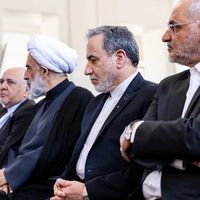
Iranian Foreign Minister Abbas Araghchi has offered a path to diplomacy with the E3 nations -- France, Britain, and Germany, acknowledging that relations are currently strained and proposing cooperation on the nuclear issue.
“Iran's relations with the E3 have experienced ups and downs in recent history. Like it or not, they are currently down. Why? Each side has its own narrative. To me, placing blame is a futile exercise. What matters is that the status quo is lose-lose," he wrote on X on Thursday.
Araghchi said he offered dialogue during a meeting with E3 foreign ministers in New York last September, suggesting cooperation on various issues beyond just the nuclear file. He lamented that the European nations declined, saying, "They unfortunately chose the hard way."
The foreign minister pointed to his recent consultations in Moscow and Beijing and expressed readiness to visit Paris, Berlin, and London.
He said that he was prepared to undertake these visits before Iran started its dialogue with the United States, but the E3 opted against it.
"The ball is now in the E3's court," he added. "They have an opportunity to do away with the grip of Special Interest groups and forge a different path," he said, warning that the actions taken at this critical juncture are likely to define the foreseeable future of their relationship.
Araghchi's overture comes as Iran is in the midst of indirect talks with the US over its nuclear program.
As parties to the 2015 nuclear deal, which expires on October 18, Germany, Britain, and France can trigger pre-deal international sanctions if they deem Iran non-compliant before that date.
The sanctions that were lifted under that agreement are due to "snap back" into place 30 days after the mechanism is triggered unless the council's five permanent members unanimously vote to keep the sanctions lifted.
Following the start of US-Iran talks in Oman earlier this month, Iran's Tehran Times reported that Tehran asked Washington to prevent European states from triggering the mechanism.
"(Iran) told the US on Saturday that it would be on Washington to make sure snap back does not get activated," the paper wrote, without specifying its sources.
Iranian Foreign Minister Abbas Araghchi has offered a path to diplomacy with E3 nations (France, Britain, and Germany), acknowledged strained relations and proposed cooperation on the nuclear issue.
“Iran's relations with the E3 have experienced ups and downs in recent history. Like it or not, they are currently down. Why? Each side has its own narrative. To me, placing blame is a futile exercise. What matters is that the status quo is lose-lose,” Araghchi said in a post on X on Thursday.
Shortly after Araghchi's remarks, France signaled its openness to renewed engagement. France supports a diplomatic resolution to Iran’s nuclear issue and remains ready to continue dialogue, a French foreign ministry spokesperson said on Thursday, Reuters reported.