Iranian press shows divisions over nuclear talks after Rome meeting
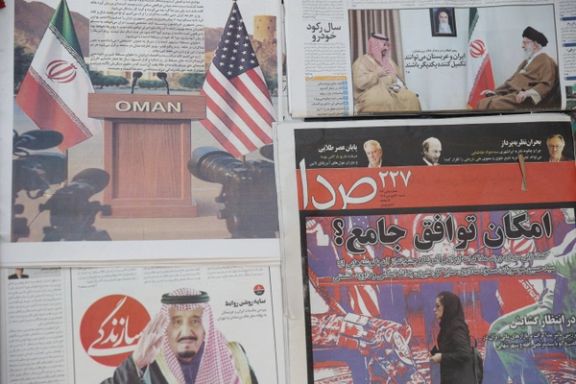
A display of Iranian newspapers
A day after the second round of nuclear talks between Iran and the United States concluded in Rome, Tehran’s major newspapers revealed the ongoing divide between reformists and hardline factions.
While reformist outlets welcomed what they described as swift progress and a move toward technical-level discussions, conservative dailies backed the negotiation team but renewed warnings against what they called US hostility and external opposition from diaspora critics.
On Sunday, Ham-Mihan, a reformist paper aligned with technocratic factions, described the shift to expert-level talks as evidence of agreement on core principles, such as Iran’s continued uranium enrichment.
It called this “a sign of rapid progress” but warned that it did not guarantee a final deal. “The stage reached suggests a framework is in place, but final terms will be decided in detail-oriented discussions,” the editorial said.
The paper also predicted the alleged indirect format of talks may soon shift to direct engagement, arguing that detailed negotiations are impractical through intermediaries.
Shargh, another reformist paper, featured interviews with four former officials and political figures. All welcomed the apparent momentum.
“If external spoilers are kept at bay, this can lead to tangible gains for the Islamic Republic,” said reformist activist Mohammad-Sadegh Javadi-Hessar, adding that European threats to trigger the snapback mechanism appear to have receded.
In contrast, the conservative Farhikhtegan focused on perceived foreign interference. Its lead story, titled “Lobbyists of Tension,” accused a range of organizations—including American Israel Public Affairs Committee (AIPAC), United Against Nuclear Iran (UANI), and the Foundation for Defense of Democracies—of undermining the talks.
It said, without evidence, that these groups, through “financial backing and intelligence ties,” aim to maintain pressure on Iran and shape US foreign policy against Tehran.
The paper also said that "Iranian dissidents abroad were spreading misleading information to derail the negotiations,” framing the process as vulnerable to outside manipulation.
The hardline Kayhan, viewed as reflecting the Supreme Leader’s position, struck a defiant tone. In a lengthy commentary, it warned that negotiations were historically a tool of colonial pressure and argued that only military and nuclear strength had forced the US to the table.
In another piece, Kayhan wrote that excluding Europe and regional states in the talks had allowed Iran to slow the pace and avoid compromise. The writer said “indirect talks humiliated the US, reinforcing Tehran’s standing.”
Saying that US enmity toward the Islamic Republic would persist regardless of the outcome, it added, “The world is watching a diplomatic clash between satanic and divine powers,” as resistance to diplomatic means continued.
A man rides a motorbike past a mural in Tehran,depicting the US flag with skulls and bombs, alongside the anti-American slogan “Death to America.”
The resumption of nuclear negotiations between Iran and the United States in Rome has drawn criticism from Iranians who view the talks as irrelevant to their daily lives and potentially beneficial only to the leadership in Tehran.
Dozens of messages sent to Iran International reflect a widespread belief that any agreement would in fact bolster the Islamic Republic while offering no relief to a population struggling under economic hardship and political repression.
The talks, held Saturday in the Italian capital, mark the second phase of quiet discussions over Iran’s nuclear program. According to diplomatic sources cited by Iran International, the Iranian delegation proposed a three-stage plan aimed at reducing tensions in exchange for sanctions relief and access to frozen assets.
But reactions gathered by Iran International painted a picture of deep skepticism. “If the Islamic Republic survives through this, nothing will change for us,” one audience said. “Only if the clergy are rooted out will people’s conditions improve.”
A number of respondents expressed hope that the negotiations would fail, believing that a collapse of talks could hasten the downfall of the ruling system.
“As long as the Islamic Republic remains, nothing will happen in favor of the people. A large percentage of the population firmly wants the fate of the Islamic Republic to be decisively resolved,” said a citizen.
“Only if the clerics are uprooted from Iran will the situation for the people improve,” said another.
“The only result will be more time for them to build weapons,” one person said, calling the negotiations a “stalling tactic.”
Others echoed similar sentiments, with one recalling the 2015 nuclear deal under then-President Hassan Rouhani. “It freed up money that the regime used to empower its regional proxies,” said another comment by an audience. “It didn’t help ordinary Iranians.”
Fox News, citing analysts, reported that Supreme Leader Ali Khamenei’s decision to reopen dialogue was influenced by military threats from former US President Donald Trump.
The same report said Tehran temporarily froze its nuclear weapons activities after the US invaded Iraq in 2003, underlining how perceived military pressure has shaped the Islamic Republic’s behavior.
Still, many Iranians remain unmoved by the prospect of another deal. “Even if sanctions are lifted, only the children of the elite will benefit,” another citizen said. “Ordinary people will just get poorer.”
Iran International has previously reported that Iran’s proposed roadmap seeks to buy time to rebuild air defenses and missile capabilities damaged by an Israeli attack last year.
One diplomatic source told the outlet the Islamic Republic “is dragging out the process to regroup militarily.”
For many Iranians, this assessment rings true. “These talks are just extending our suffering,” another one said in a voice message. “The money will go to weapons and repression, not to bread or jobs.”
Supreme Leader Ali Khamenei addressing senior officials on April 15, 2025
In the wake of talks with the US, Iran's hardliners have used historical parallels as a way to justify negotiations on the country's nuclear program which had initially been rejected by the Supreme Leader and his hardline allies.
In the days following the first round of indirect talks in Oman on April 12, which were followed by further discussions in Rome on Saturday, clerics, political figures, and media outlets compared a potential US-Iran agreement with a treaty the Prophet Muhammad signed with his adversaries in Mecca in 628 CE, showing a rare softened tone.
The Treaty of Hudaybiyyah allowed for a ten-year truce and provided Muslim access to pilgrimage in Mecca the following year in exchange for several concessions to the Prophet’s enemies.
Ayatollah Kazem Nourmofidi, Khamenei’s representative in Golestan Province, said in a sermon that at the time, some Muslims saw the treaty as unjust and believed the Prophet should not have conceded.
“But that peace proved to be a clear victory,” he argued, justifying the talks which had initially received so much criticism from the country's hardliners who have long opposed negotiations with the US.
An article on the current talks with the US published by Tasnim News Agency, which is affiliated with the Islamic Revolutionary Guard Corps (IRGC), similarly referred to the Prophet's negotiations with the enemies of Islam and the controversial Treaty of Hudaybiyyah, but argued that his strategic flexibility and concessions led to far greater conquests.
Supreme Leader Ali Khamenei made no direct reference to the recent Muscat talks during a speech to senior military commanders after the first round of talks in Oman but adopted a tone of cautious pragmatism later. “We are neither overly optimistic nor overly pessimistic about these talks,” he said—before offering a stark caveat: “I am very pessimistic about the other side.”
Khamenei’s calibrated remarks reflect a blend of strategic openness to diplomacy and deep skepticism about American intentions, appeasing the hardliners.
This is not the first time religious symbolism has been invoked to justify shifts in foreign policy. In 2013, as Iran began talks that led to the 2015 nuclear deal (the Joint Comprehensive Plan of Action, or JCPOA), Khamenei referred to his shift as a “heroic flexibility”—a reference to Imam Hassan, the second Shiite Imam, who accepted a truce with a hostile ruler to protect himself and his followers from harm.
Today, Khamenei’s renewed openness to negotiation has again fractured Iran’s hardline camp. Some factions have moved to align with the Supreme Leader’s position. Others—particularly ultra-hardliners who cannot openly challenge Khamenei without facing political consequences—remain visibly frustrated.
Indirect negotiations between Iran and the United States have been positive so far, the Iranian government spokesperson said on Sunday, adding that Tehran welcomes any initiative to lift sanctions.
Speaking to the state news agency IRNA, Fatemeh Mohajerani said of the second round of indirect talks held in Rome, "These negotiations are being held with Oman's mediation and in a constructive atmosphere".
Highlighting the importance of lifting sanctions which have crippled Iran's economy since 2018 when US President Donald Trump pulled out of the JCPOA nuclear agreement, she said, “In the continuation of the negotiation path, we will welcome any practical initiative aimed at lifting sanctions".
Since then, further sanctions have been levied on Iran from around the world for both its crackdown on protesters and human rights abuses at home, as well as Iran's support for Russia's war on Ukraine.
She confirmed that expert-level consultations would continue in the coming days, followed by higher-level talks in Muscat.
However, she also pointed to Supreme Leader Ali Khamenei's position of being neither optimistic nor pessimistic about the negotiations.
"We are neither extremely optimistic nor extremely pessimistic about these talks," Khamenei said last week, adding however that “we are very pessimistic about the other side, but we are optimistic about our own capabilities."
Separately, Iranian Foreign Minister Abbas Araghchi wrote on the social media platform X on Saturday night that "optimism may be justified, but only with great caution."
"The second round of negotiations of talks were good and positive in a positive atmosphere."
He added that Iran had explained why the 2015 nuclear deal (JCPOA) was no longer sufficient for many in Iran.
An anti-US mural is seen in a street in Tehran, Iran, April 19, 2025.
Iran's judiciary has announced legal action against the heads of two media outlets following their commentary on the ongoing nuclear negotiations between the Islamic Republic and the United States.
The judiciary's news agency Mizan reported on Saturday that "disrespectful remarks by the directors of two media outlets regarding the Iran-America negotiations led to charges being filed against them."
The agency did not initially name the individuals involved.
However, the Revolutionary Guard-affiliated Fars news agency later identified the two as Mostafa Faghihi, owner of the Entekhab News Website, and Sajjad Abedi, managing editor of Talkhand-e Siasi (Political Satire).
The move comes shortly after a commentary on Raja News, another outlet linked to the Revolutionary Guard, criticized what it described as a rise in "fake news, rumors, and false accusations" against Supreme Leader Ali Khamenei in both online spaces and some official media.
Raja News specifically accused Faghihi of labeling critics of the nuclear talks as "hardliners with clichéd and nauseating" rhetoric.
The outlet also said that Abedi had dismissed Khamenei's recent statement about not making the country's issues dependent on negotiations as "nonsense."
Abedi responded on the social media platform X, saying that his comment was directed at the hardliners' remarks, not Khamenei's.
Khamenei has shifted his stance on talks since February when he described negotiating with US President Donald Trump as "dishonorable" and "irrational," but less than two months later, he greenlit indirect talks with the US.
This is not the first instance of the Iranian judiciary taking action against media figures commenting on the nuclear issue.
Earlier this month, Mizan reported charges against Hesamoddin Ashena, a former head of the Strategic Studies Center under former president Rouhani's administration, for a social media post criticizing the Islamic Republic authorities regarding Iran's approach to negotiations with the US.
The reformist Shargh daily also offered a public apology after it published a report about the potential renewed role of Mohammad Javad Zarif in the US talks.
Additionally, the Press Supervisory Board issued a warning to the editor-in-chief of the hardline Kayhan daily, which is managed by Khamenei's representative, for threats of assassination against President Donald Trump for the 2020 killing of IRGC's Qasem Soleimani.
US President Donald Trump's primary motivation in nuclear negotiations with Iran is ensuring Israel's security rather than America's, a member of Iran's Expediency Discernment Council said.
Mohammad Sadr argued that Trump's concern over Iran potentially obtaining nuclear weapons stems from the perceived threat to Tel Aviv, not Washington.
Sadr stressed the importance of understanding Trump's personality traits – describing him as narcissistic and unpredictable – arguing they heavily influence US policy.
"We must expect zigzag positions, fluctuations in behavior, and contradictory policies," Sadr said, advising Iranian negotiators to proceed with calm and patience. "We have to prepare ourselves for negotiation ups and downs."
Sadr suggested a deal might be feasible if Trump's focus remains solely on preventing Iran from acquiring nuclear weapons – a goal Iran officially denies pursuing.
"However, if he wants to bring Israel's demands to the negotiating table – including a complete halt to enrichment or [curbs on] Iran's regional presence – naturally we will not reach an agreement," Sadr added.
He added that the outcome hinges on whether Trump's "personal desire for an achievement overcomes Israeli pressure for its security interests."