Saudi defense minister to visit Tehran after invitation from Iran’s top general
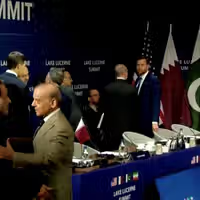
Saudi Arabia’s Defense Minister Khalid bin Salman is scheduled to visit Iran on Thursday at the head of a senior military delegation, Iranian media reported.
He will travel to Tehran at the invitation of Major General Mohammad Bagheri, chief of staff of Iran’s armed forces, and is expected to hold meetings with top political and security officials.
Talks will focus on "expanding defense cooperation, promoting regional peace and stability, and joint efforts to combat terrorism", according to the report.
Iran’s hardline Javan newspaper, affiliated with the Revolutionary Guards, said on Thursday that while nuclear talks with the United States continue, the country’s armed forces remain on alert and focused on building power.
“From a realistic perspective, the battlefield is not overlooked — our soldiers remain on alert, finger on the trigger, and committed to strengthening and expanding the country’s military power,” the paper wrote in an editorial.
The article criticized both overly optimistic and deeply pessimistic views of the diplomatic process, warning that extreme attitudes could divide public opinion. It backed a “realistic” stance echoing recent remarks by Supreme Leader Ali Khamenei, who said Tehran was neither “too optimistic nor too pessimistic” about the talks.
The editorial said a sober approach would allow Iranian negotiators to continue with “strength and confidence,” without sending signals of weakness.
An Iranian-American man who worked as a contractor for the Federal Aviation Administration (FAA) pleaded guilty on Wednesday to acting as an agent of the Iranian government without notifying US authorities, the Justice Department said.
Abouzar Rahmati, 42, a naturalized US citizen and resident of Great Falls, Virginia, admitted to conspiring to work with Iranian officials and intelligence operatives from at least December 2017 through June 2024. He faces up to 10 years in prison for acting as an agent of a foreign government and five years for conspiracy.
According to court documents, Rahmati offered his services to Tehran in 2017 and later traveled to Iran, where he met with intelligence officers and agreed to obtain information for them about the US solar energy sector. He also gained employment with a US company contracting for the FAA, where he downloaded at least 172 gigabytes of sensitive access-controlled data.
The files included documents related to the National Aerospace System (NAS), airport surveillance radar, and radio frequency data. The DOJ said Rahmati took the data to Iran and handed it over to Iranian officials in April 2022.
Abouzar Rahmati
"Rahmati agreed to obtain information about the US solar energy industry and FAA data, and deliver it to Iranian officials," prosecutors said in a statement. He also used a cover story involving academic research to hide his contacts.
"This defendant knowingly acted on behalf of the Government of Iran and took steps to place sensitive information into its hands," said Assistant Attorney General Sue Bai, who leads the Justice Department’s National Security Division.
Rahmati’s sentencing is scheduled for August 26. The FBI and FAA's counterintelligence division were involved in the investigation.
"The Iranian government continues to target American institutions for infiltration," said US Attorney Edward Martin Jr. for the District of Columbia. "We will hold accountable anyone who puts our national security at risk."
member of Iran’s parliament said the future of nuclear negotiations with the United States depends on Washington’s honesty, Iranian media reported on Thursday.
Ali Akbar Alizadeh Barmi, a member of the Cultural Commission, said Tehran would not surrender to pressure and insisted that Iran’s participation in indirect talks does not mean it is backing down.
“If President Trump and the US administration truly seek to resolve the nuclear issue, the path is open,” he said.
He added that Iran’s supreme leader has already declared, through a religious edict, that the country is not pursuing nuclear weapons. “But if the US does not build trust, the Islamic Republic will continue on its previous path,” Alizadeh warned.
“Whether these negotiations continue and succeed depends on the Americans’ sincerity,” he said.
A senior Iranian lawmaker warned on Thursday that mixed messages from US officials could harm the ongoing nuclear negotiations, urging Washington to demonstrate consistency and seriousness.
“If the US truly has the determination to pursue negotiations, it must stop sending contradictory signals and avoid dual-track policies,” said Abbas Golroo, head of the Iranian parliament’s Foreign Relations Committee, according to ISNA.
Golroo said Iran’s negotiating team had laid out a clear and precise framework during talks in Muscat, and that Tehran expects a coherent response from the US. He added that parliament supports the current negotiating track and remains hopeful that a deal that serves Iran’s national interest can be reached.
Iranian Foreign Minister Abbas Araghchi said on Thursday that the International Atomic Energy Agency (IAEA) can play a key role in resolving the Iranian nuclear issue peacefully, following a meeting in Tehran with agency chief Rafael Grossi.
“I had a useful discussion with visiting IAEA chief Grossi,” Araghchi wrote on X. “In the coming months, the agency can play a crucial role in peaceful settlement of the Iranian nuclear file.”
He added: “As variety of spoilers are gathered to derail current negotiations, we need a Director General of Peace.”
Araghchi emphasized Iran’s hope that Grossi would keep the agency focused on its technical mission. “Our predisposition is to trust Grossi in mission to keep the Agency away from politics and politicization, and to retain focus on its technical mandate,” he said.
Iranian Foreign Minister Abbas Araqchi meets with International Atomic Energy Agency (IAEA) Director General Rafael Grossi in Tehran, Iran, April 16, 2025.