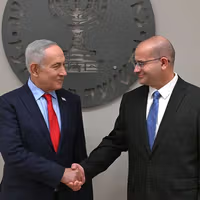
Iranian Foreign Minister Abbas Araghchi met with his Omani counterpart Badr al-Busaidi in Muscat on Saturday, before the start of talks with the United States, Iran’s Foreign Ministry said.
Araghchi, who is leading Iran’s delegation, praised Oman’s regional role and thanked it for hosting the talks. “Hosting the indirect Iran-US talks is a sign of [Oman’s] responsible approach to regional issues,” he said, according to the Iran's Foreign Ministry statement.
The ministry said Araghchi shared Tehran’s negotiating positions with al-Busaidi, who is expected to relay them to the American side. Al-Busaidi, for his part, described the Iran-Oman relationship as “excellent” and thanked Iran for choosing Muscat as the venue.


In the final moments before negotiations with the United States begin in Oman, Iranian hardline media is urging Tehran to stand firm against Donald Trump, push for the full lifting of sanctions, and highlight divisions within the White House.
Full details here.


In the final moments before indirect negotiations with the United States begin in Oman, Iranian hardline media is urging Tehran to stand firm against Donald Trump, push for the full lifting of sanctions, and highlight divisions within the White House.
Nour News, affiliated with Iran’s Supreme National Security Council, published a series of articles on Saturday. In one analysis, the outlet warned that Trump would exploit any sign of weakness during the talks and advised Iranian negotiators to remain resolute.
“One effective strategy in dealing with Trump is to avoid giving in to his unreasonable demands,” the piece argued. “If he senses that the other side lacks the will to resist, he is likely to increase the pressure.” The outlet stressed that Iran must avoid making concessions.
Nour News also claimed that Trump’s foreign policy is not guided by US national interests but by his personal ambition to be feared and short-term tactical gains rooted in his self-interest.
In another article, the site said Trump’s team is divided between those open to negotiations and “warmongers” pushing for military confrontation. It claimed that Israel is using its influence to support the pro-war camp within Washington.
Kayhan, an ultra-hardline newspaper closely aligned with Supreme Leader Ali Khamenei’s office, wrote in an editorial that Tehran should only engage in serious negotiations if all US sanctions are lifted.
The paper predicted that the talks would fail, asserting that Iran would emerge with another example to showcase America’s untrustworthiness to global public opinion. “From this perspective,” Kayhan wrote, “Saturday’s indirect talks with the US can already be counted as ‘one-nil in favor of the Islamic Republic.’”
Javan, a newspaper affiliated with the Revolutionary Guard, argued that the United States is in historic decline and that Trump is trying to mask this weakness through personal branding.
“His insistence on humiliating the leaders of other countries is also tied to this same issue: he has no hope for a long-term and reliable resolution to America’s challenges and is merely seeking temporary fixes,” the paper said. It added that Trump knows he cannot overpower Iran and is only seeking a deal to claim a symbolic victory.
Let me know if you'd like a version tailored for a particular outlet or tone (e.g. more neutral, more analytical, or more critical).
Planned nuclear talks between the United States and Iran in Oman face significant hurdles, with analysts citing deep mistrust and conflicting expectations, The Guardian reported on Saturday.
The talks, announced by Donald Trump, were described by Washington as direct, while Tehran insisted they would be indirect. Former US ambassador Dennis Jett said the disagreement “indicates that serious people are not running the show,” adding, “If you can’t even agree if it’s direct or indirect … it’s a lot harder obviously.”
Iran will be represented by veteran diplomat Abbas Araghchi. The US delegation is led by Steve Witkoff, a real estate developer with no prior experience on Iran, a mismatch that some fear could widen gaps in understanding.
However, some noted potential for limited progress. “He does seem like a more pragmatic person,” said analyst Sina Toossi of Witkoff. “I do not think the Iranians would have agreed to a high-level meeting if they didn’t believe it would be more than a one-sided negotiation.”
The "indirect talks" with the United States in Oman already represent a political gain for Iran and a setback for Washington, a senior Iranian hardliner and editor of the state-linked Kayhan newspaper said on Saturday.
“The benefit for the US from this indirect negotiation is the failure to impose its extortionist demands,” Hossein Shariatmadari, who represents Supreme Leader Ali Khamenei at Kayhan, wrote in a column. “What remains for Iran is yet another experience proving the United States is not trustworthy.”
He added, “From now, the result of Saturday’s indirect talks with the US can be scored one-nil in favor of the Islamic Republic.”
Kayhan, a fiercely conservative daily funded by the office of the Supreme Leader, often reflects the views of Iran’s most hardline political circles.