• العربية
  • فارسی
Brand
  • Iran Insight
  • Politics
  • Economy
  • Analysis
  • Special Report
  • Opinion
  • Podcast
  • Iran Insight
  • Politics
  • Economy
  • Analysis
  • Special Report
  • Opinion
  • Podcast
  • Theme
  • Language
    • العربية
    • فارسی
  • Iran Insight
  • Politics
  • Economy
  • Analysis
  • Special Report
  • Opinion
  • Podcast
All rights reserved for Volant Media UK Limited
volant media logo

Iran’s hardline media calls for strength as talks with US begin

Apr 12, 2025, 08:34 GMT+1

In the final moments before indirect negotiations with the United States begin in Oman, Iranian hardline media is urging Tehran to stand firm against Donald Trump, push for the full lifting of sanctions, and highlight divisions within the White House.

Nour News, affiliated with Iran’s Supreme National Security Council, published a series of articles on Saturday. In one analysis, the outlet warned that Trump would exploit any sign of weakness during the talks and advised Iranian negotiators to remain resolute.

“One effective strategy in dealing with Trump is to avoid giving in to his unreasonable demands,” the piece argued. “If he senses that the other side lacks the will to resist, he is likely to increase the pressure.” The outlet stressed that Iran must avoid making concessions.

Nour News also claimed that Trump’s foreign policy is not guided by US national interests but by his personal ambition to be feared and short-term tactical gains rooted in his self-interest.

In another article, the site said Trump’s team is divided between those open to negotiations and “warmongers” pushing for military confrontation. It claimed that Israel is using its influence to support the pro-war camp within Washington.

Kayhan, an ultra-hardline newspaper closely aligned with Supreme Leader Ali Khamenei’s office, wrote in an editorial that Tehran should only engage in serious negotiations if all US sanctions are lifted.

The paper predicted that the talks would fail, asserting that Iran would emerge with another example to showcase America’s untrustworthiness to global public opinion. “From this perspective,” Kayhan wrote, “Saturday’s indirect talks with the US can already be counted as ‘one-nil in favor of the Islamic Republic.’”

Javan, a newspaper affiliated with the Revolutionary Guard, argued that the United States is in historic decline and that Trump is trying to mask this weakness through personal branding.

“His insistence on humiliating the leaders of other countries is also tied to this same issue: he has no hope for a long-term and reliable resolution to America’s challenges and is merely seeking temporary fixes,” the paper said. It added that Trump knows he cannot overpower Iran and is only seeking a deal to claim a symbolic victory.

Let me know if you'd like a version tailored for a particular outlet or tone (e.g. more neutral, more analytical, or more critical).

Most Viewed

Iran negotiators ordered to return after internal rift over Islamabad talks
1
EXCLUSIVE

Iran negotiators ordered to return after internal rift over Islamabad talks

2
ANALYSIS

US blockade enters murky phase as tankers spoof signals and buyers hesitate

3
ANALYSIS

Why the $100 billion Hormuz toll revenue is a myth

4

US tightens financial squeeze on Iran, warns banks over oil money flows

5
INSIGHT

Ideology may be fading in Iran, but not in Kashmir's ‘Mini Iran'

Banner
Banner

Spotlight

  • Hardliners push Hormuz ‘red line’ as US blockade tests Iran’s leverage
    INSIGHT

    Hardliners push Hormuz ‘red line’ as US blockade tests Iran’s leverage

  • Ideology may be fading in Iran, but not in Kashmir's ‘Mini Iran'
    INSIGHT

    Ideology may be fading in Iran, but not in Kashmir's ‘Mini Iran'

  • War damage amounts to $3,000 per Iranian, with blockade set to add to losses
    INSIGHT

    War damage amounts to $3,000 per Iranian, with blockade set to add to losses

  • Why the $100 billion Hormuz toll revenue is a myth
    ANALYSIS

    Why the $100 billion Hormuz toll revenue is a myth

  • US blockade targets Iran oil boom amid regional disruption
    ANALYSIS

    US blockade targets Iran oil boom amid regional disruption

  • Iran's digital economy battered by prolonged blackout
    INSIGHT

    Iran's digital economy battered by prolonged blackout

•
•
•

More Stories

The facilitator: Oman stands at the center of Iran-US talks once again

Apr 11, 2025, 19:55 GMT+1
•
Kristian Coates Ulrichsen

If US President Donald Trump’s shock announcement in the Oval Office on Wednesday that his administration was due to hold talks with Iran this weekend was a surprise, the choice of Oman as host was not.

For years, the Sultanate has supported diplomatic back-channels between the United States and Iran, and has built up a record as a credible intermediary trusted by both sides.

Rather than act as a mediator, as other regional states such as Qatar have done, and participate in direct talks themselves, the Omani approach is to create the spaces in which dialogue can take place, thus acting more as a facilitator.

A combination of historical and geographical factors explains Oman’s pragmatic facilitation of diplomacy as a key element in its foreign policy approach.

Unlike several of its Gulf neighbors, Oman has not had a history of poor relations with Tehran, and Omanis recall that Iran under the Shah provided important support to Sultan Qaboos during the early years of his reign in the 1970s.

Even after the Iranian revolution ousted the Shah in 1979 and ushered in the theocracy headed by Ayatollah Khomeini, Oman stood aside from the regional rivalries and competition for geopolitical influence in the Gulf.

The contours of Omani foreign policy were usefully set out in 2003 by Sayyid Badr Albusaidi, a career diplomat who became Foreign Minister in 2020.

Albusaidi said "it is possible for a small state to carve out for itself a degree of relative autonomy" and "we try to make use of our intermediate position between larger powers to reduce the potential for conflict in our immediate neighborhood."

Avoiding 'I told you so'

As such, Omani officials have sought to ensure that disputes and flashpoints which have the potential to escalate into outright conflict, and thereby threaten economic and political stability and regional security, can be addressed before they spiral out of control, by leveraging their ability to engage with all sides.

Oman’s support for the backchannel that enabled US and Iranian officials to meet secretly for multiple rounds of talks in 2012 and 2013 is the most well-known example of such facilitation.

The clandestine contacts were detailed by Bill Burns, then Deputy Secretary of State, in his memoir, written before he returned to office as Director of the CIA in 2021. Burns described how the chief of Sultan Qaboos’s court and the head of Omani intelligence "greeted both delegations as we walked into the meeting room" and "offered a few brief words of welcome and then departed."

The talks succeeded in laying the framework for the subsequent P5+1 negotiation which led to the Joint Comprehensive Plan of Action, the Iran nuclear deal, in 2015, from which Trump withdrew in 2018 during his first term.

The JCPOA collapsed in acrimony and appeared to prove Burns’s point when he wrote that Araghchi and his co-delegation leader, Majid Takht-Revanchi, "would sometimes confide in me that they had a Supreme Leader who was just waiting to say 'I told you so' and prove that the Americans could not be trusted."

Secret no more

Omani officials continued to act as periodic intermediaries between Tehran and Washington. This included hosting indirect talks in 2023 and again in 2024 that involved White House Middle East coordinator Brett McGurk and Iranian nuclear negotiator Ali Bagheri that addressed the Houthi attacks on maritime shipping and the tit-for-tat Israeli and Iranian military strikes that threatened all-out regional war.

With this record in mind, it was unsurprising that the Iranian leadership responded to a letter from Trump, delivered by an Emirati intermediary, raising the prospect of talks, through Oman in late-March.

It remains to be seen whether the talks, indirect or direct or possibly a combination of the two, may lead to any form of breakthrough, given the political constraints on both sides and the legacy of decades of distrust.

In addition, the fact that the talks have been very publicly announced is a major departure from the secrecy of the backchannel in 2013 which was more characteristic of Oman’s discreet approach to diplomacy.

The choice of venue and interlocutor nevertheless reaffirm Omani centrality to the dialogue between two arch nemeses who despise each other but trust Muscat.

Iran: deal or no deal?

Apr 11, 2025, 19:28 GMT+1
•
Negar Mojtahedi

Tehran and Washington are heading into high-stakes talks in Oman this weekend that could determine the path ahead: diplomacy or war. The outcome may shape not only regional stability, but the survival of the Islamic Republic, which has ruled Iran for more than four decades.

On this episode of Eye for Iran, a powerhouse panel of experts unpacks what’s really at stake and what each side hopes to gain.

The Islamic Republic is fundamentally transactional—and deeply motivated to strike a deal in order to survive, says Arash Azizi, an Iran analyst and author of What Iranians Want.

“The result of a failure of the talks is no longer, oh, there will be a lot more sanctions, you have to deal with it economically but an escalation that could be really devastating to Iran as a nation,” said Azizi.

Pressure is mounting. Former President Donald Trump has not only issued verbal warnings but deployed strategic bombers to the Indian Ocean. The US military has also moved a Patriot missile defense battalion from the Indo-Pacific to the Middle East—a major logistical feat involving at least 73 C-17 cargo flights, according to Axios.

On Wednesday, Trump said that Israel could lead a potential strike on Iran should the nuclear talks collapse. The announcement came just two days after he blindsided Israeli Prime Minister Benjamin Netanyahu at the White House by revealing direct negotiations with Tehran.

“If it requires military, we’re going to have military,” Trump said during a press briefing in the Oval Office.

Meanwhile, Iran continues inching closer to nuclear weapons capability. Though Tehran insists its program is peaceful, the UN nuclear watchdog has warned that Iran now possesses enough uranium enriched to near-weapons-grade levels to make several nuclear bombs.

“I think they are very motivated, as real estate agents say, to get a deal,” added Azizi.

Behnam Ben Taleblu, Senior Director of the FDD’s Iran program, argues that while the Iranian establishment is ideological, it can still be pressured. “If the president wants to give diplomacy a chance, the best way to do that is to make sure that Iran doesn't have credible exit options—meaning Iran's option away from the table should not be better for the regime than the option to come to the table.”

Jay Solomon of The Free Press warns that Iran may use talks to buy time. “What's still kind of confusing is the person who's negotiating it, Steve Witkoff, and his positions, at least publicly, of what a deal would look like is a lot different than what Mike Waltz the national security advisor—he's talked about essentially dismantling the whole program.”

Solomon also pointed to rifts within the Trump camp.

“His (Witkoff) diplomacy in recent weeks was on Tucker Carlson, and Carlson himself has almost daily been lobbying very publicly against any military strikes on Iran … you can see these tensions inside the Trump administration between kind of these hawkish, almost traditional conservative Republicans like Waltz. But then you have this wing of the MAGA movement.”

Gabriel Noronha, former Special Advisor for the Iran Action Group at the State Department, sees these talks as a test—not a breakthrough.

"This is really President Trump saying that there's one last way out for Iran to avoid the disastrous fate which it has put itself into… an easy way out of this predicament or there's the hard way out, the hard way out being military strikes.”

An official familiar with the preparations was cited by Reuters as saying that the two delegations will meet in the same room.

It’s a pivotal moment—one that could reset the trajectory of US-Iran relations. Whether diplomacy prevails or war looms will likely be decided behind closed doors in Oman.

You can watch the full episode of Eye for Iran on YouTube or listen on any major podcast platform like Spotify, Apple, Amazon or Castbox.

Clerics loyal to Khamenei slam talks with US as beneath Iran’s dignity

Apr 11, 2025, 13:20 GMT+1
•
Mardo Soghom

While most semi-official media outlets in Iran and many political figures have expressed support for what they describe as indirect talks with the United States, hardline clerics loyal to Supreme Leader Ali Khamenei are voicing sharp opposition.

Media outlets in Tehran, including those close to his office, have been highlighting that without Khamenei’s support there would be no talks with the Trump administration. However, Friday prayer imams who work under his control, slammed negotiations in their sermons, saying that it is beneath Iran to enter diplomatic bargaining with Washington.

“Negotiating with America is against our national pride,” said Ahmad Alamolhoda, the firebrand imam of Mashhad, during his sermon on Friday, according to the semi-official Mehr news agency. “No Iranian with self-respect would accept to approach the US empty-handed.”

He added that US demands—ranging from dismantling Iran’s missile program to limiting its regional influence—amounted to surrender. “They want us to give up everything: our weapons, our science, even our pride. No honorable Iranian would accept that.”

Calling on Iran’s negotiators to resist pressure, Alamolhoda warned: “Direct talks are worse than indirect ones. We’ve been here before—and it always ends badly.”

Firebrand ayatollah, Alamolhoda during a sermon - File Photo
100%
Firebrand ayatollah, Alamolhoda during a sermon - File Photo

Khamenei banned negotiations with Washington one day after President Donald Trump renewed his maximum pressure on Tehran in early February. However, the mood gradually changed, as Trump repeatedly issued military threats and a large US naval force gathered in the region.

President Masoud Pezeshkian confirmed on Wednesday that Foreign Minister Abbas Araghchi will conduct upcoming talks with US representatives in Oman under Khamenei's guidance.

The conservative daily Khorasan, which is closely affiliated with parliamentary speaker Mohammad Bagher Ghalibaf, echoed this stance. The paper noted that despite previously opposing direct engagement, Khamenei has now approved the indirect negotiations and is expected to closely oversee their progress.

However, Khamenei has allowed prominent Friday Imams, who wield power in their cities and provinces, to speak out against the negotiations. The Supreme Leader adopted a similar stance during the Obama administration when the JCPOA nuclear deal was being negotiated. He reluctantly admitted that he allowed the talks but often voiced doubt if the outcome would be beneficial.

Khamenei with Tehran Imam, Sedighi - File photo
100%
Khamenei with Tehran Imam, Sedighi - File photo

“Direct talks are beneath us,” said Tehran’s interim Friday prayer Imam Kazem Sedighi during his weekly sermon, according to the semi-official Tasnim news agency. “How can we trust those who tore up the [JCPOA] deal?”

Sedighi said any engagement with Washington must be approached with caution, citing Khamenei’s guidance that negotiations should only take place when there is certainty the other side will honor its commitments.

“There is no room left for negotiation where they try to take the nuclear industry from us,” he said.

Other Friday imams argued that lifting sanctions is not a good enough reason for negotiating with Trump. They reverted to Khamenei’s calls of strengthening the Islamic Republic from within – an ideology that has failed to create a stable economy. Iran’s currency has tumbled 22-fold since 2018 and incomes have nosedived, pushing close to half the population into poverty. Workers' salaries are now barely above $100 per month.

An Iranian hardline lawmaker also said on Friday that the upcoming talks must center on proving Iran is not pursuing nuclear weapons, warning that any effort to dismantle the country’s nuclear program would make talks unacceptable.

“In the talks with the US, we must prove that Iran is not pursuing the construction of a nuclear weapon,” Mousa Ghazanfariabadi said, according to the Mehr news agency.

“But if the other side tries to shut down Iran’s nuclear program or raise unrelated issues, the negotiation is invalid and unacceptable,” he added.

Iranians hold their breath as nuclear talks with US near

Apr 11, 2025, 09:25 GMT+1
•
Behrouz Turani

In Iran, anticipation is mounting as the countdown begins for the upcoming talks between Iranian and US delegations over the future of the country’s nuclear program and the possible lifting of crippling sanctions.

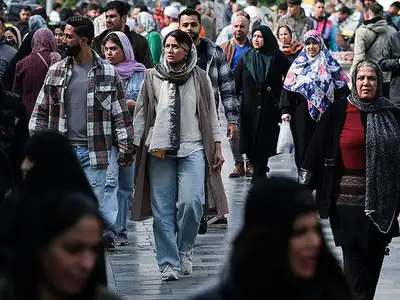
The mere presence of both teams in the same place—even if not in the same room—has sparked fresh hopes among a public weary of years of inconclusive diplomacy. Many Iranians have grown frustrated with what has often felt like a “negotiations for negotiations” cycle, with little to show in terms of real progress.

This time, however, the mood feels different. With Donald Trump pushing for concrete results and Iranian officials hinting that Supreme Leader Ali Khamenei may finally be open to genuine engagement, optimism is spreading across Iranian cities. Many are hoping not only for economic relief but also for a de-escalation of tensions and an end to the ever-present threat of war.

The economic daily Tejarat asserted on Thursday that “Iran and America will come to the negotiating table with genuine intent—and perhaps even political honesty.” The paper noted that public optimism is high about the possibility of an agreement between Tehran and Washington. According to Tejarat, Trump is seeking a swift deal to halt Iran’s nuclear advances, while Iran is acutely aware that time is limited—particularly with the trigger mechanism of the 2015 nuclear agreement likely to be activated by October 18.

Over the past week, many Iranians appear to have moved past the debate over direct versus indirect negotiations, the paper said. Even Foreign Minister Abbas Araghchi now seems to agree that the substance of the talks matters more than their format. At this stage, confidence-building appears to be the top priority for both sides.

Still, Tejarat cautioned that “despite Trump’s efforts to restrain Israeli Prime Minister Benjamin Netanyahu, the shadow—and possibly the quiet influence—of Israel on the Oman negotiations cannot be ignored.”

In a hopeful assessment, Iranian academic Alireza Soltani, an international relations and foreign policy analyst, told Khabar Online that “the very fact that the talks are set to begin is already the first achievement in Iran-US diplomacy.” Soltani expressed optimism about the potential success of the negotiations in Oman.

He suggested that the two sides are likely to reach a quick agreement on at least two initial points: continuing the negotiations and moving toward direct talks. From there, progress could follow on Iran’s nuclear program and, more broadly, on reducing tensions in the region.

Meanwhile, in interviews with the Fararu website, foreign policy analysts Abdolreza Faraji Rad and Ali Ghanbari noted that the talks are unlikely to produce results quickly, estimating that it could take at least six months to reach any agreement. Ghanbari also cautioned that the Iranian market’s positive response to news of the talks may be short-lived. “However,” he added, “if the negotiations proceed smoothly, we could see an economic breakthrough.”

Meanwhile, in an interview with the pro-reform daily Arman Melli, reformist figure and former Tehran City Councillor Zahra Nejad Bahram stressed that “Iranian society seeks peace.” She suggested that, to counter hardline opposition to the talks, the government should allow a public rally in support of negotiations—demonstrating the popular backing such efforts enjoy.

“Hardliners who entered parliament with the support of only three percent of eligible voters lack legitimacy,” she said. Still, Nejad Bahram emphasized that Iran will proceed with the talks based on national interests. “While there’s no guarantee of success, opposing negotiations amounts to betrayal of the country,” she added.

As preparations for the talks continue, hardline media close to the core of power appear eager to shift responsibility to the Pezeshkian administration—seemingly to shield Supreme Leader Ali Khamenei from blame should the negotiations fail. In contrast, pro-Pezeshkian outlets such as Etemad argue at length that the president is simply carrying out the Supreme Leader’s directives, with little independent authority of his own.

This gap in messaging reflects the deeper political struggle over who owns the process—and who will answer for its outcome.

Iran's nuclear program at 'extreme danger' level, think tank warns

Apr 10, 2025, 19:48 GMT+1

Iran's nuclear threat has worsened to an "extreme danger" level since last year, according to a new report by a US-based research institute.

“Since February 2024, the date of the last edition of the Geiger Counter, the threat posed by Iran’s nuclear program has worsened significantly,” the Institute for Science and International Security (ISIS) said in its report published Tuesday.

The Geiger Counter is an assessment tool used by the institute to measure the threat posed by Iran to the United States and its allies, focusing on its potential to develop nuclear weapons.

The report cited several factors contributing to its finding, including Iran’s increased nuclear capabilities, shorter timelines to develop nuclear weapons and growing internal discussions about weaponization.

It raised concerns over Iran's continued development of advanced centrifuges and the possibility of secret enrichment plants. Iran's non-cooperation with the International Atomic Energy Agency (IAEA) and the ongoing military conflicts in the Middle East have further intensified fears of the country’s nuclear ambitions, the report said.

The report raised Iran’s overall threat score to 157 out of 180, up from 151 in February 2024, indicating "Extreme Danger."

The report comes as Washington and Tehran prepare for indirect talks on reaching a nuclear deal, with US President Donald Trump announcing the negotiations will begin on Saturday.








