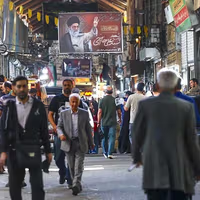
Iran's foreign ministry spokesperson said on Monday that indirect negotiations between Tehran and the United States have not yet started.
Esmail Baghaei added that Iran is awaiting a decision from the United States regarding Tehran's proposal for the commencement of indirect negotiations.
During a press briefing, the spokesperson also indicated that Oman is a primary candidate to host potential indirect talks with the US.
Bagahei also announced a trilateral meeting in Moscow in the coming days, where Iran, China, and Russia will discuss various aspects of the nuclear issue, the 2015 nuclear deal, and UN Security Council Resolution 2231.
Former Iranian foreign minister and veteran nuclear negotiator, Mohammad Javad Zarif, has dismissed widespread suggestions about his involvement in the country's current foreign policy processes, labeling the rumors as akin to an "April Fool's joke" that started before April 1st and persists.
Responding to various rumors circulating about his potential role in ongoing diplomatic efforts, Zarif emphasized that he has not even seen the letter from former US President and Iran's response, adding that his knowledge of its content is limited to what has been reported in the media, according to Iran's official news agency IRNA.
Earlier on Sunday, reformist newspaper Shargh also refuted media speculations that Zarif will once again lead Tehran's talks with the United States.
Several powerful Iranian-backed militia groups in Iraq are prepared to disarm for the first time to avert the threat of escalating conflict with the US administration, multiple senior commanders and Iraqi officials told Reuters.
The move to defuse tensions follows repeated private warnings from US officials to the Iraqi government since January, sources including six militia commanders said.
Washington has told Baghdad it could target the groups with airstrikes unless it acted to disband the militias operating on its soil.
The militia commanders, from groups including Kataib Hezbollah and Nujabaa, said their main ally, Iran's Revolutionary Guards (IRGC), had given them its blessing to make necessary decisions to avoid a damaging conflict with the US and Israel.

Several powerful Iranian-backed militia groups in Iraq are prepared to disarm for the first time to avert the threat of escalating conflict with the US, according to senior commanders and Iraqi officials speaking to Reuters.
The move to defuse tensions follows repeated private warnings from US officials to the Iraqi government since January, sources including six militia commanders said.
Washington has told Baghdad it could target the groups with airstrikes unless it acted to disband the militias operating on its soil.
A senior Shi'ite politician close to Iraq's governing alliance, Izzat al-Shahbndar, said discussions between Prime Minister Mohammed Shia al-Sudani and militia leaders were very advanced, with the groups inclined to comply with US calls for disarmament, acknowledging the risk of being targeted.
"The factions are not acting stubbornly or insisting on continuing in their current form," he said.
The militia commanders, from groups including Kataib Hezbollah and Nujabaa, said their main ally, Iran's Revolutionary Guards (IRGC), had given them its blessing to make necessary decisions to avoid a conflict with the US and Israel.
"Trump is ready to take the war with us to worse levels, we know that, and we want to avoid such a bad scenario," said a commander of Kataib Hezbollah, the most powerful Shi'ite militia.
Later on Monday, Iraqi politician Muthal al-Alusi denied the Reuters report, calling the claims a nominal effort to protect involved politicians. He told Iran International that "in practice, the real militias have received advanced weapons, and their participation on the battlefield may be completely evident."
These militias form a key part of the Islamic Resistance in Iraq, an umbrella group claiming responsibility for numerous attacks on Israel and US forces since the Gaza war.
Prime Minister Sudani's advisor said he was committed to bringing all weapons under state control through dialogue.
Security officials said some groups had already evacuated headquarters in fear of air strikes.
While a US official expressed skepticism about the long-term nature of any disarmament, the discussions mark a potential shift amid a weakened "Axis of Resistance" for Iran.
Options for the militias' future include becoming political parties or integrating into the Iraqi army, though no deal is finalized.
The shift comes as Iraq balances its alliances with both the US and Iran, with the militias having grown significantly since the 2003 US invasion. The US had warned Iraq against revenge attacks by these groups after recent strikes on the Houthis.
Iran has never accepted negotiations under the shadow of threats, a former senior Iranian official said, adding that any future talks with the United States require Washington to abandon threats.
Mahmoud Vaezi, former chief of staff to the Iranian president when the 2015 nuclear deal was signed, suggested that if the Trump administration ceases threats during indirect negotiations with Iran and demonstrates genuine goodwill, a change in approach towards reaching an agreement is possible.
“It's crucial for American authorities to understand, through historical context, that Iran's leadership has never accepted talks under pressure, bullying, threats, or intimidation in its over 40-year history, including during the Iran-Iraq War and various crises, and has never yielded to any form of pressure.”
He said that Iran has always responded positively to negotiations conducted with mutual respect, equality, and fairness. "Negotiations have taken place and yielded effective, constructive outcomes whenever there has been an approach based on equality and mutual respect,” he said.
Vaezi pointed to the previous successful negotiations with the P5+1 that led to the JCPOA, saying that reaching a constructive agreement is possible under new circumstances, provided the US acts in good faith.
He added that Iran's preference for indirect talks stems from the US's unilateral withdrawal from the JCPOA despite direct negotiations leading to the agreement.
Iranian reformist newspaper Shargh has refuted media speculations that former foreign minister and chief nuclear negotiator Mohammad Javad Zarif will once again lead Tehran's talks with the United States.
"Some sources have claimed that, following a confidential meeting on Friday morning between Parliament Speaker Qalibaf and the Supreme Leader, the issue of direct negotiations with the United States has been approved, and three political figures — namely Ali Larijani, Mohammad Forouzandeh, and Mohammad Javad Zarif — have been appointed as the selected representatives for this mission," Shargh wrote on Sunday.
However, the report added, sources close to Zarif strongly dismissed the claim in an interview with the newspaper.