Hardline Iranian newspaper repeats threat on Trump's life
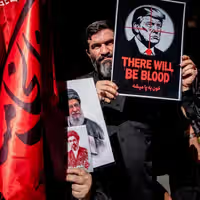
A rhetorical column, written in a satirical tone, in an Iranian newspaper on Saturday called for violent revenge against former US President Donald Trump, mocking his threats and invoking the killing of Qassem Soleimani.
The ultra-hardline Kayhan newspaper, published under the supervision of Supreme Leader Ali Khamenei’s office, mocked Trump’s threats of military action should Iran fail to reach a new agreement not to produce nuclear weapons.
Speaking about Trump’s threats and tariffs even against US allies, Kayhan wrote, “He’s way out of line! Any day now, in revenge for the blood of Martyr Soleimani, a few bullets are going to be fired into that empty skull of his and he’ll be drinking from the chalice of a cursed death.”
A rhetorical column, written in a satirical tone, in an Iranian newspaper on Saturday called for violent revenge against US President Donald Trump, mocking his threats and invoking the killing of Qasem Soleimani.
The ultra-hardline Kayhan newspaper, published under the supervision of Supreme Leader Ali Khamenei’s office, mocked Trump’s threats of military action should Iran fail to reach a new agreement on nuclear weapons.
Speaking about Trump’s threats and tariffs even against US allies, Kayhan wrote, “He’s way out of line! Any day now, in revenge for the blood of Martyr Soleimani, a few bullets are going to be fired into that empty skull of his and he’ll be drinking from the chalice of a cursed death.”
After President Trump’s threats of a military strike, Tehran has agreed to indirect talks, despite a previous ban by Khamenei. However, Trump has said he prefers direct negotiations.
Kayhan, mocking the US president also wrote, “He makes threats and then backs down! The result? The situation in America gets worse by the day. Just yesterday, it was announced that his actions have caused $3 trillion in damage to the US economy, American exports are facing serious problems, and top officials in the military, CIA, and elsewhere have either resigned or been dismissed…”
Any potential US airstrike would target not only Iran's nuclear facilities but also its air defense and missile capabilities in a bid to prevent possible retaliation, the former commander of US Central Command told Iran International.
The US military has in recent days deployed long-range bombers at a strategic Indian Ocean airbase amid escalation of tensions with Tehran, a move which presaged major bombing campaigns against Afghanistan in 2001 and Iraq in 2003.
In an exclusive interview with Iran International, former CENTCOM commander and CIA chief David Petraeus described the deployment as a step toward preparing for military action against Iran if it failed to reach a deal with the Trump administration over its disputed nuclear program.
"They are also steps to show that we are very serious and that you should not do this, and therefore trying to deter Iran from doing what would be unacceptable and would force the United States to take action," he said.
Petraeus said, "There's great concern about how close Iran is to the possibility of having a nuclear weapon. They're literally just one turn of the enrichment process from having weapons-grade uranium. That is something that President Trump has said he will never allow the Iranians to have a nuclear weapon."
Trump has warned Iran would be bombed if it did not agree to a new nuclear deal, prompting Iran's Supreme Leader Ali Khamenei to say on Monday that the Islamic Republic would deal a "strong blow" in retaliation for any attack.
Iran's retaliation
Iran has threatened to target American interests in the region, including its strategic Diego Garcia naval base in the Indian Ocean if it is attacked by the US.
However, Petraeus says Trump would not stop at a limited attack on the nuclear sites and would go after the Islamic Republic's air defense and missile capabilities.
"You probably have to take out some of the retaliatory capacity of Iran as well because you don't want to just take out the nuclear program and then have them go after the bases where we have forces, and that would then bring in all these other countries, of course," he said.
Former CENTCOM chief David Petraeus and Iran International's Marzia Hussaini in Washington DC
"This is not just a surgical attack on discrete nuclear capabilities. This is against the retaliatory capabilities, against the defense capability, and that's what has to be done if you're going to carry out this operation."
Plan to destroy Iran's nuclear program
Petraeus said he actually developed the plan to destroy Iran's nuclear program over 15 years ago when he was the commander of the US Central Command.
"It's publicly known that we actually rehearsed that plan one time inside the United States, with all the planes flying all the distances that they would have to fly, the refuelers, all the command and control, the jammers that drop, the munitions that we would drop, and so forth. And it all worked."
Gen. David Petraeus, commander of US Central Command, speaks to soldiers from the 4th Infantry Division, Multi-National Division – Baghdad, on Dec. 25, 2008.
"We were prepared one time actually, to set the theater, in other words, to identify all the locations from which the planes would fly, where they would be based. The munitions were in place, the food, fuel, water, etc. All was set. We thought there was a likelihood of this. We told the White House we probably should get more prepared than we were."
'Israel proved it's possible'
Petraeus said Iran currently "does have more effective, more elaborate air and ballistic missile defenses" than in the past. However, he said, "Israel penetrated them twice, showing that that can be done."
The surface-to-air S-300s were the last in the Islamic Republic's arsenal after one was destroyed in an attack in April 2024 also likely carried out by Israel, Fox News quoted a senior US official as saying.
Still, Petraeus says Iran has "more retaliatory capability in terms of missiles and so forth, even though Israel dramatically reduced the ability of Iran to make solid fuel rocket engines from several per day to one or two per week."
Bunker busters
The former CENTCOM commander said the US military has bombs like the 30,000-pound GBU-57, aka Massive Ordnance Penetrator (MOP), that "is very accurate and can penetrate very hardened targets".
"It would be used against the most deeply buried hardened targets... you can imagine which target that might be," he said, adding that the use of such bunker busters is "not just possible but would be necessary" in a potential strike against Iran.
Iran’s most secretive nuclear facility, known as Fordow, has been carved deep into a mountain in central Iran, and is reportedly some 90 meters (295 feet) deep. It is also protected by several feet of reinforced concrete.
In 2012, defense experts contacted by Reuters believed the chances of a US strike against Fordow succeeding are slim. However, Petraeus says, "they can do enormous damage and destruction".
B-2 bombers have been deployed in US strikes against Iran-backed Houthi militants in Yemen, but the campaign has seen limited success, CNN reports citing three sources with knowledge of the campaign.
The operation has cost nearly $1 billion in less than three weeks, according to the report, but does not appear to have significantly degraded Houthi capabilities.
One source told CNN the Pentagon may request supplemental funding.
The commander of Iran's Joint Air Defense Headquarters warned of overwhelming retaliation if the country is attacked.
The commander of Iran's Joint Air Defense Headquarters Alireza Sabahifard Amir meets with Ali Hajizadeh, the commander of the Aerospace Division of the Revolutionary Guards.
"The Air Defense Force of the Army stands firm and resilient like a mountain in the face of threats and will undoubtedly deliver a crushing response to any act of aggression," Alireza Sabahifard said while touring the country's southeastern military sector on the shores of the Persian Gulf.
Also present in the tour was commander of Revolutionary Guards Aerospace Force Amir Ali Hajizadeh.
"Today, the Air Defense Force of the Army is at its peak readiness, and the enemies are certainly aware of this, which has prevented them from daring to commit any transgressions," he added.
"Unity and solidarity among the armed forces has brought peace of mind provide to the leader of the revolution and our people, while instilling fear and apprehension in the hearts of the enemies."
Iranians wave the national flag next to a missile at a rally protesting the United States ne
Under the shadow of US President Donald Trump’s threats to bomb Iran and after over a year of punishing blows at the hands of Israel, a bruised Islamic Republic remains defiant and seeks a comeback.
“Iran is not giving up,” Dr. Eric Mandel, founder of the Middle East Political Information Network (MEPIN) told Eye for Iran. “Iran's proxies—they may be down—Hezbollah, Hamas, the Houthis—but they’re not stopping.”
As the US positions aircraft in the Indian Ocean capable of striking Iran’s nuclear facilities, some Iranian officials have warned it will be forced to develop a nuclear weapon.
Iran has stepped up its production of fissile material in recent years, and the UN nuclear watchdog says it could accumulate enough enriched uranium for a nuclear weapon in less than a week.
Ali Larijani, a senior adviser to Supreme Leader Ayatollah Ali Khamenei, delivered this message on Monday. “If the US or Israel bomb Iran under the nuclear pretext, Iran will be compelled to move toward producing an atomic bomb,” he said.
Mandel, who regularly briefs members of Congress and national security officials, argued that supporting the Iranian people must become a central pillar of US foreign policy.
“America needs to start saying, we are pro-Iranian, pro-Iranian people, and that it becomes American policy that we want, without boots on the ground, regime change.”
In Congress, the bipartisan bill the Maximum Support Act aims at bolstering dissidents within Iran.
Developed with input from the Foundation for Defense of Democracies (FDD) and the National Union for Democracy in Iran (NUFDI), the draft legislation envisions funding opposition groups in Iran.
“I'm ashamed as an American who talks about American national security interests that we were not in 2022 standing strong with the protests,” said Mandel.
In that year the nationwide protest movement dubbed Woman, Life, Freedom was sparked by the death in morality police custody of Mahsa Jina Amini, a young woman.
'Window of opportunity'
“There is a closing window of opportunity to strike Iran, which is particularly vulnerable because of the successful Israeli attacks against their defensive anti-missile array," Mandel said, who also advocates a US strike on vital Iranian economic infrastructure.
"There is also a decreasing window of opportunity for negotiations even if the Iranians believe there is a credible military threat."
A potential ceasefire between Russia and Ukraine could allow Moscow to deliver advanced weapons systems to Iran. That includes the S-400 air defense system—an upgrade from the S-300 system Israel disabled in an Oct. 26 strike in response to Iran’s October 2 missile barrage on Israel.
Putting the Iranian S-300s out of action opens the door to Israeli or American strikes, possibly on a larger scale. But Iran could rebuild with Russian help.
“Those missile defenses will not be down for much longer,” said Mandel, “not only for S-400s and even more evolved system, but for the SU-35 jets that the Russians have promised. And again, the Russians owe the Iranians because they've been very helpful to them during their Ukraine war.”
Moscow has publicly tried to dissuade Trump from bombing Iran’s nuclear facilities, warning of “catastrophic consequences.”