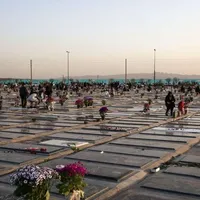
A woman wearing chador prays for a loved one killed in the Iran-Iraq war, Tehran, Iran, March 2020
My 23-year-old cousin, Ali, newly married and the father of a two-month-old baby, was killed in the Iran-Iraq war in 1985. From that moment, everything in my uncle’s family changed.
As talk of another war grips the nation, the devastating legacy of the Islamic Republic's defining conflict casts a long shadow.
Before Ali’s death, my female cousins, his sisters, were the main supplier of pop music in our extended family, duplicating cassette tapes that were banned by the ever-encroaching Islamic rules. They were good dancers too, showing us younger ones how to shake hands and bottoms in tandem.
And then their brother, my cousin, died—martyred, in their words. Overnight, they became observant Muslims. They had to. They all adopted the chador, the black cloth covering all but a woman’s face. My cousin’s 21-year-old widow also joined the ranks of women in black, absorbed into a new world of mourning and restriction.
A year later, one of my cousins, the martyr’s younger sister, got married. She had a wedding only in name. There was no dancing, no music, no clapping or loud cheering.
This transformation was common among families who lost loved ones in the war. The Islamic Republic, having cemented its rule after the revolution, framed the war as a religious not a national affair.
The Sacred Defense, it was called - a holy struggle to preserve Islam.
People standing under a worn-out mural depicting a soldier killed in the Iraq-Iran war, Tehran, Iran, Dec. 2015
Those killed in the war had given their lives for their faith, the state propaganda went. So for their family to turn away from that faith would be to dishonour their memory and blood.
The martyrs were glorified by the state, not as national heroes but as loyal servants of the faith and its embodiment, Ayatollah Khomeini. As such, their families received benefits—monthly stipends, housing assistance, government jobs, university admissions quotas.
In a country racked by war, poverty, and cutthroat competition for higher education, these privileges created a rift between martyr families and the rest of society.
Atefeh, Ali’s daughter, was born two months after her father got killed. She is 40 now, recalling her life as a martyr’s daughter, a life she had never chosen.
“I never saw my father, but his shadow fashioned my life,” Atefeh says. “The pressure was too much for little children like me. They kept telling us we had to honor his sacrifice and follow our fathers’ or brothers’ path. What was their path, though, I wonder. My dad’s wasn’t Islam, for sure, if the few pictures we have of him are any clue.”
Atefeh attended one of the many Shahed schools, established for the children of martyrs. She says she always wanted to attend a regular school and blend in. But she was constantly reminded that she had to be a role model because of her father—that she was obligated to be ‘modest’: to wear long and loose clothes, avoid boys, shun fashion, close her ears to music and open instead to the words of God, the Quran.
“Sometimes, I hated my father and the fact that we were part of a martyr’s family,” she says.
As she grew, Atefeh fought harder with her mother and managed to convince her to go to a regular high school. She wanted to be ‘normal’, as she puts it. She tried to hide her father’s fate even. But it wasn’t that easy.
“Being a martyr’s daughter meant people saw me a certain way before even meeting me,” Atefeh says. “Other girls at school assumed I was religious and had no interest in the things they enjoyed. It was an Ugly Duckling kind of situation.”
Students taking off their mandatory head-covers during Iran's 2022 Woman Life Freedom movement
On the other side, the authorities at school scolded her for not being strict enough, constantly reminding her that her father had died for the hijab and she had to have a proper one.
“But nowhere in my father’s will did he mention the hijab,” Atefeh says with a bitterness that comes off a long, dulled anger. “That was just a lie, or a gross exaggeration at the very least, by the government, to claim that martyrs prioritized women’s veiling.”
Because of the pressures she endured growing up, Atifeh refused to use the university admissions quota for martyr families. She didn’t want the privilege, but others assumed she had taken the spot of a more qualified student. She rarely had the opportunity to explain herself.
As public resentment toward the government grew, so did hostility toward martyr families. Many saw them as symbols of the regime, beneficiaries of an unjust system.
Some children of high-profile martyrs have tried to distance themselves from the government in recent years, openly criticizing its actions. But the state has so thoroughly co-opted the image of martyrdom that shedding the label is nearly impossible.
In February, when a group of Iran-Iraq war veterans and commanders announced plans to protest the 15-year house arrest of war-time prime minister Mir-Hossein Mousavi and his wife Zahra Rahnavard, they were detained—and the public barely reacted.
Atefeh has been an outspoken critic of Iran’s ruler for quite a while. She despises them and ‘their martyr enterprise‘ as she puts it.
“I never say or write that I am a martyr’s daughter when I criticize the government because even that feels like an unearned privilege,” she says.
Over the years, my female cousins fought to remove their chadors, and more recently, their headscarves. It took decades for Atefeh and her aunts to reclaim even minimal personal freedoms and shape their own lives.
But changing public perception has proved almost impossible.
Iranians—a vast majority at least—are angry with their near-half-century-old theocratic rule. They are fed up with everything it stands for and promotes, including the "martyr enterprise" in Atefeh’s words.
“It’s hard to blame people for lumping together martyr families and the Islamic Republic,” she says. “Many deserve it for becoming part of the system or shutting up to gain something. But some gained nothing and are stigmatised nonetheless. It’s all fair perhaps, but it’s painful too.”
A conscript sitting on a metal bench at a train station in Iran
Soroush Salehi campaigned to have Canada label Iran’s Revolutionary Guards a terrorist group but now the law for which he strived may eject him and others forced into the group as conscripts.
In June of last year, Soroush celebrated Canada's decision to list the Islamic Revolutionary Guard Corps (IRGC) as a terrorist entity.
Little did he know, however, that his activism to ostracize the group that had dragooned him into service would upend his own life.
Soroush is part of a community of Iranians living in Canada who bitterly resent their country's rulers for impressing them into the Islamic Republic's security forces.
Along with the regular military and police, the IRGC is another agency that Iranian men could be forced to join to complete their mandatory military service.
A transnational paramilitary force, the Revolutionary Guards spearhead Tehran's influence in the Middle East, including training and arming of affiliates like Hamas, Hezbollah, the Houthis and Iraqi militias.
Now their lives on Canadian soil are in jeopardy and are left to the discretion of immigration officers who may deem them inadmissible under the new policy.
Iran International spoke to Soroush and two other Iranian nationals whose permanent residency applications are also in limbo and who do not wish to be identified due to security concerns. Iran International has also reviewed evidence demonstrating the men were conscripts and not permanent IRGC servicemen.
From advocate to victim
Photo of Soroush Salehi.
Soroush Salehi washed dishes and carried out other menial tasks and errands as an IRGC conscript fulfilling his mandatory service more than 18 years ago in Iran.
The mechanical engineer moved to Calgary, Alberta in search of a peaceful life, leaving his theocratic homeland where he saw no future.
He came to Canada in 2022 in the same year Iran's clerical rule saw the biggest challenge to their system in decades as the so-called Woman Life Freedom protest movement swept the country, only to be quashed with deadly force.
Soroush chose Canada after being rejected by the United States in 2020, despite his wife's American citizenship, after US immigration authorities deemed him a “member of a terrorist organization.”
Conscription end-card (kart-e-payan khedmat), which shows the start and completion date of mandatory military service.
After US President Donald Trump put the IRGC on the US terrorist list in 2019, no exemptions were made for conscripts. Promises by President Joe Biden’s administration to look into exempting conscripts never materialized.
Now Soroush may be deemed inadmissible in Canada, too. Soroush is currently a temporary resident under a work permit and if no exemptions are provided, he might be deemed inadmissible and deported.
“I had dreams with my wife for a life here. Everything was good until September 2024,” Soroush told Iran International, “All my dreams are going to be devastated and are going to be shattered.”
Humiliation
Shahed, whose declined to use his real name citing security concerns, lives in Vancouver, British Columbia with his wife and five-year-old son who was born in Canada, who is a citizen.
From 2013 to 2015, Shahed completed his mandatory military service with the IRGC, and was tasked with administrative work, never training in military activities. The experience was deeply degrading, he said.
“The only purpose is just humiliating you, sitting there and cleaning the desk.”
In Canada with a work permit as an on-site engineer, Shahed's permanent residence application has been under review for more than three years.
Shahed had officially declared his mandatory military service and provided an ID card indicating the end of his mandatory service in a sworn affidavit reviewed by Iran International.
But he received and official letter saying immigration officers had “concerns surround your membership to the IRGC.”
“Based on your previous membership to the IRGC, I have reasonable grounds to believe you may be inadmissible to Canada ... (based on) membership in an organization that has engaged in subversion or terrorism,” the letter said. Shahed has responded protesting his innocence but has yet to hear back from authorities.
“Every day I have to deal with the stress when I wake up and be prepared that today I could be inadmissible and would have to leave Canada,” Shahed said. “I am not safe anymore.”
Shahed took part in Canadian protests in support of the 2022 unrest in Iran and fears for his safety if deported back to Iran.
Divorce - a way out?
Iran International spoke to another conscript and his wife over Zoom. They too did not want to be identified for their protection and for the safety of their family in Iran.
Since the designation, their lives are mired in uncertainty.
“This decision by the government is affecting every aspect of our lives,” said Farid's wife Roya. “We feel like prisoners here.”
They are both on an open work permit and applied for permanent residency in 2024, but since the IRGC designation their application has been stuck in security checks.
The married couple said they have decided not to leave Canada to travel or visit family because they fear being barred reentry.
Major life decisions like starting a family and buying a house have all been put on hold. If Farid is deported, they said they will likely get a divorce so his wife can have a life in Canada.
Farid told Iran International he served his mandatory service more than 10 years ago and never took part in military drills but worked in a clerical role at an Iranian bank.
Random process
The process in Iran for selecting conscripts to the various branches - whether for the regular army, the IRGC or law enforcement - is random.
Islamic Republic officials tasked with picking conscripts and officers often select recruits by pointing out young men arrayed in a line in front of them.
Prior to listing the IRGC a terror entity, Canada’s former Prime Minister Justin Trudeau had resisted calls to make the designation because of the plight of conscripts.
Activists continued to lobby for the change, arguing that identifying those low-level conscripts was an easy and verifiable task.
The terrorist designation empowers the justice system to prosecute IRGC members who have obtained Canadian citizenship and hold them criminally liable for crimes committed overseas.
On the fourth anniversary of the IRGC's downing of a civilian airliner which killed scores of Canadian citizens and residents, Trudeau said in Jan. 2024 that Canada was looking at a way to punish the group.
“We know there is more to do to hold the regime to account and we will continue our work, including continuing to look for ways to responsibly list the IRGC as a terrorist organization.”
When the official announcement was made, Justice Minister Arif Virani said an individual’s willingness and intent to support the IRGC would be an important consideration under the Criminal Code.
Immigration, Refugees and Citizenship Canada told Iran International that applications are considered on a case-by-case-basis.
“Conscription, in itself, does not necessarily result in a person being deemed inadmissible to Canada," it said. "The admissibility of individuals will be assessed based on a number of considerations."
Those range from the nature of their role in the IRGC to their level of engagement with the organization, it added.
Sadeq Bigdeli, a Toronto-based lawyer who represents several conscripts, said probably only under ten former conscripts have been deemed inadmissible by courts.
Bigdeli said he submitted a petition for guidelines excepting conscripts and even provided a draft text.
“It's not only unfair, but also basically helping the Islamic Republic by diverting resources from where they should be: the real terrorists."
While IRGC conscripts have declared their service voluntarily, actual IRGC members - whom Bigdeli called "masters of deception" – are likely walking free in Canada.
More than 40 years after the 1979 revolution and despite persistent tensions between Tehran and Washington, American cars remain a prized symbol of prestige and nostalgia in Iran.
Classic American cars, often spotted cruising the streets of Iranian cities, serve as moving relics of a bygone era. For many Iranians, these cars are more than just a means of transportation; they represent cultural heritage, status and a deep-rooted admiration for American engineering.
Even Ayatollah Khomeini, Iran’s first supreme leader - the man who led the 1979 revolution and coined the term Great Satan for the United States - was driven in an American car upon his return to Iran from exile.
The 1977 Chevy Blazer disappeared soon after that momentous day and was found and restored only in 2025.
Iran's revolutionary leader Ayatollah Khomeini upon his return from exile, Tehran, Iran, Feb. 1979
Other prominent figures of the Islamic Republic have also been spotted riding American cars. Gholamali Haddad Adel, a former parliament speaker and a close relative of current leader Ali Khamenei, was often seen behind the wheel of a Chevrolet Caprice Classic in the 1990s.
Saeed Jalili, former chief nuclear negotiator and a hardline contender in the 2024 presidential election known for his staunch anti-US rhetoric frequently drove an Oldsmobile during his tenure at the Foreign Ministry’s watchdog bureau.
While Iran’s domestic auto industry spearheaded by Iran Khodro since the late 1950s has made strides in assembling European and Korean vehicles, American cars remain synonymous with distinction and exclusivity.
In a country where foreign imports are tightly restricted, owning a US-made vehicle is a luxury—an emblem of prestige often reserved for the elite.
'Good old days'
The appeal of American cars predates the 1979 revolution.
Three years previously the Iranian government launched the "Cadillac Iran" assembly line, producing nearly 2,500 Cadillac Seville luxury sedans. This venture blended local manufacturing with American craftsmanship, solidifying the place of US vehicles in Iranian automotive culture.
Screenshot of an Instagram page showing a young Iranian posing next to a Buick
Popular Iranian car vlogger and enthusiast Alireza jokingly claims that being a true driver in Iran requires either a German luxury car or an American gas-guzzler.
“If you can’t afford a Mercedes, you can’t call yourself a driver unless you’re behind the wheel of an American V8,” he quips. He also shares a favorite saying among Iranian classic car lovers: “A man must drive a Chevy for work, a Buick for leisure and only a Cadillac for a rendezvous.”
The admiration for American cars, particularly those from the 1960s and 1970s, is rooted in their durability, reliability, and timeless design. While the revolution led to a strict ban on American imports, the restriction only intensified their appeal and elevated them to the status of coveted classics.
Much like Cuba where vintage car restoration has become a national pastime Iran has seen a growing demand for mechanics skilled in repairing and maintaining American cars.
A mechanic in southern Iran promoting his work on old cars on Instagram
29-year-old Tehran mechanic Farhad Keshavarz inherited his shop from his father, who specialized in these vehicles long before the revolution.
“These cars demand the highest level of care, and their owners can’t wait to show off their roaring engines,” says Farhad, who receives daily requests for full overhauls and engine restorations.
For over four decades, American V8s in Iran have transcended political divides, symbolizing status, power and a golden age of automotive excellence.
While many Americans now associate reliability with Japanese brands like Honda and Toyota, in Iran, "Made in America" still carries a mystique.
Here, an American car is not just a machine—it is a statement, a status symbol, and a cherished link to an era when luxury and power ruled the open road.
It starts with a text message on social media by an established cafe. A few million rials deposit, and a promise of a night unlike any other in Tehran.
In a city where theocratic authorities dictate dress codes and public behavior, a parallel universe comes alive after dark—one where music pounds, glasses clink, and young Iranians carve out their own kind of freedom.
“You have to pay some money in advance and reserve your place,” the organizer of a cafe tells us.
“How much?”
“Fifteen million rials ($17). It will be deducted from your table invoice at the end. We also charge each person seven million rials ($8) for the special service.”
Special service. A vague but enticing phrase that means DJ performances, fireworks, and, most importantly, a space where the Islamic government's restrictions on dancing, drinking and mixed-gender gatherings don’t apply.
A city of two faces
By day, Tehran echoes with debates in parliament, where bearded and grey-haired hardliners push for tougher hijab enforcement laws. Police cameras scan the streets, automatically fining women who dare to drive without a headscarf. But by night, in certain corners of the city, a different reality takes shape.
Girls in night events in Tehran
Our night begins with a purchase. Alcohol is banned in Iran, but an underground network ensures that everything from Chivas scotch to homemade Aragh Sagi (Iranian vodka) is readily available—for a price.
Farid, our contact, offers original whiskey bottled abroad for up to 150 million rials ($170) and vodka smuggled into Iran for half that price. "Or you could take my own homemade Aragh Sagi,” he suggests, referring to a type of Iranian moonshine.
Laughing, I ask, “Are you sure we won’t go blind?”
“Bro, I’m not a con. Buy an ethanol test kit online and check it yourself,” he says.
A bottle in a plastic bag is tossed into our car from a passing motorcycle. No words, no exchange. The deal is done for 500,000 rials ($6).
The club behind closed doors
The location is in Saadatabad, one of Tehran’s affluent northern districts. We arrive to find a nondescript door with no sign of activity. No doorbell, just the entrance bears the name of the café-restaurant. Then, from behind a tree, a guard emerges, unlocking the way into a hidden world.
A DJ performs in a night club in Iran
Inside, 300 to 400 people sit shoulder to shoulder. The air is thick with music, laughter, and the clinking of glasses. Nearly every table has bottles—of what appears to be mineral water—being discreetly poured into soft drinks.
The DJ takes the mic: “I do hope the day you’re waiting for arrives very soon.” The space erupts in cheers, everyone knowing exactly what he means.
A song dedicated to those killed in the Woman, Life, Freedom protests plays, and the energy shifts—defiant, unbreakable.
Security is tight. Two well-built bodyguards patrol the large saloon with lasers, flashing them on anyone who dares to stand up. “No dancing until 1 AM,” a second DJ announces.
At our table, we order salads, side dishes, and soft drinks. I add a splash of Aragh Sagi. A couple at the next table raises their glasses to us, smiling.
The hours pass in a blur of music, hushed toasts, and fleeting moments of stolen joy. Then, at 1 AM, the lights go out.
The dance begins
A deep bass vibrates through the floor. Strobe lights flash. And suddenly, everyone is on their feet. Girls in tight dresses, men in designer shirts—moving, shaking, celebrating a night that shouldn’t exist.
“No filming,” the DJ warns. “If you want us to host you again, keep your phones down. One video can shut this place down.”
A man beside me leans in, raising his voice over the music. “I just got back from Italy. Even there, you don’t find clubs running this late.”
A man dancing in a night club in Tehran
Another guest scrolls through Instagram, showing us pages of similar cafes holding parties in Fereshteh, Andarzgoo, and Aghdasieh—each promising luxury, secrecy, and freedom.
By 3:30 AM, we are stumbling out, buzzed on more than just alcohol. The bill? Sixty-five million rials (around $75) for a chicken salad, soft drinks mixed with Farid's vodka, and two beef sandwiches. But the cost is irrelevant.
“Let’s do this again next week,” my girlfriend says as we drive home. “It’s expensive, but still cheaper than a weekend in Dubai or Istanbul.”
She’s right. And as I reflect on the years we lost in fear, in silence, I regret not stepping into this world sooner.
This is Tehran. A city where, by day, women are harassed for loose headscarves, but by night, they dance in hidden saloons, reclaiming the freedom they refuse to surrender.
Nowrouz spread with sprouted greens, coins, and sweets
Millions of Iranians across the world are welcoming Nowruz, an ancient tradition deeply rooted in Iran's heritage, marking the beginning of 1404 in the Persian solar calendar.
Nowruz is more than just a celebration of renewal, prosperity, and the arrival of spring; it is a cultural cornerstone that has survived centuries of change. Its enduring spirit reflects the resilience of Persian heritage, bridging the past and present while continuing to bring families and communities together.
Nowruz begins at a precise astronomical moment—the Spring Equinox, usually on March 21—when families gather around the traditional haft-seen table, exchanging greetings and gifts to welcome the new year. If the Equinox falls in the second half of March 20, celebrations begin earlier, though the new calendar year officially starts the next day.
Nowruz and the Iranian Calendar
Unlike the lunar-based Islamic calendar, where the year is 1446, the Iranian calendar follows the solar-based Jalali system, introduced in 1079 AD. The first year of the Jalali calendar aligns with Prophet Muhammad’s migration (Hijra), yet its months are named after ancient Persian deities, reflecting Iran’s fusion of Islamic and pre-Islamic traditions.
The lunar-based calendar is around ten days shorter each year than the Iranian calendar year. This sometimes causes an overlap between Nowruz and Shia mourning days or Ramadan. Like last year, Nowruz coincides with Ramadan this month, and the second day of the New Year will be a mourning day for the first Shia saint, Imam Ali. Such coincidences complicate the celebrations for observant Muslims and others in Iran who must be careful not to offend the former by making a show of the festive Nowruz spirit.
Thousands of Iranians flocked to Pasargadae, the cite of the mausoleum of Cyrus the Great, to celebrate Nowrouz in 2023 2023
Endurance of a pre-Islamic festival
Despite Iran’s Islamification 1,400 years ago and the 1979 Islamic Revolution, Nowruz remains a cherished festival, celebrated not only in Iran but also in neighboring countries including Afghanistan, Turkmenistan, Azerbaijan, and by Kurds in Turkey and Iraq.
Some Iranian clerics and their followers oppose or are lukewarm toward Nowruz due to its pre-Islamic origins and perceived ties to Zoroastrianism. However, the Islamic Republic has never sought to ban the widely celebrated holiday. Instead, it has used state media, mosques, and propaganda organizations to elevate Islamic holidays—including the birthday of Prophet Mohammed, Eid al-Fitr, and Eid al-Adha—seeking to enhance their festive significance.
Folk music group performing at Pasargadae on Nowruz day, March 21, 2023
Ancient Origins: From Persepolis to Today
Nowruz dates back to the Achaemenid Empire (550–330 BC) and likely has roots in ancient agricultural festivals that celebrated the cycle of nature. Some scholars believe it was influenced by the Babylonian spring festival of Akitu, which inspired Persians to establish their own New Year tradition.
Historical evidence suggests that parts of the Persepolis complex, such as the Apadana Palace and the Hall of a Hundred Columns, were constructed for grand Nowruz ceremonies. The famous bas-reliefs of Apadana Palace, depicting people from various regions bringing gifts to the Persian king, may represent Nowruz celebrations at the heart of the empire.
The Haft-Seen: A Table of Symbols
At the heart of Nowruz celebrations in Iran is the haft-seen, a carefully arranged spread on the floor or a table that symbolically embodies light, life, fertility, nature, and prosperity.
The names of at least seven items on the spread must start with the Persian letter “sin”, possibly derived from “sini” (meaning tray), as it was once customary to display them on seven trays. These items include sprouted greens (sabzeh), Coins (sekkeh), Apples (sib), a pudding made from freshly sprouted wheat germ (samanu), sumac (somagh), garlic (sir), hyacinths (sonbol) and vinegar (serkeh).
A mirror and candles (symbols of light), painted eggs (symbol of fertility), goldfish (symbol of life), as well as various sweets and nuts, and a holy book (such as the Quran) are often also placed on the spread.
The family gathers around the spread, and when the Equinox is announced on radio or television, they embrace and exchange well wishes. The head of the family distributes gifts, often crisp new banknotes placed inside the Quran for blessing, while sweets are shared to usher in a sweet and prosperous new year.
Traditionally, people visit the eldest members of their extended families as soon as possible after the new year begins. During the holiday season, they continue visiting other relatives and acquaintances, with each visit expected to be reciprocated.
Traditional Nowruz cuisine
Food is central to Nowruz celebrations, with special dishes symbolizing renewal and abundance. While traditional Nowruz meals once varied widely across regions, they were shaped by local ingredients and culinary traditions.
Since the mid-20th century, however, a fragrant rice dish with fresh herbs (sabzi polo), served with pan-fried fish and a rich green herb omelet (kuku sabzi), has become the most common Nowruz meal. Previously, this combination was mostly popular in the northern Caspian Sea region.
Rice mixed with noodles, served with various meat or chicken-based stews, and ash-e reshteh—a hearty soup made with legumes, herbs, and noodles—are also popular Nowruz dishes. The noodles in these meals are believed to symbolize the unraveling of life’s complexities and a clear path for the year ahead.
US president Donald Trump has sent Iran’s leader a letter, we’re told, and that it’s significant. It probably is, but nobody I know seems to think so.
"They keep saying Iran is at a crossroads. Is it really a crossroads if it drags on for years? Because we’ve been here as far as I can remember.” This is Zahra, 36, a legal consultant, almost snapping at me for bringing up this conversation.
"Trump has apparently told Khamenei to make a deal or get ready for war,” she carries on venting. “But I think he’ll dodge this one too, selling out even more to China and Russia, buying time, hanging in there at the so-called crossroads while we sink deeper in the swamp that he’s made.”
Zahra has stopped waiting for a turning point. And she’s not alone. Utter the words breakthrough in a Tehran taxi and you’ll get a bitter smile, if not a scornful look. Why talk or even think about it. As Zahra puts it, "it'll come when it comes."
For years, the government has pinned almost everything on sanctions—runaway inflation, energy shortages, environmental disasters, a failing healthcare system, you name it.
But many have long stopped buying that narrative. They’ve watched billions vanish in case after case of corruption, most involving officials and cronies that somehow always avoid justice.
"I cannot care less about sanctions,” says Mehdi, a salesman turned Snapp driver. “My children suffer with or without sanctions. And the officials’ children thrive with or without sanctions.”
Mehdi is 45, a father of two. His apathy may not help his country’s situation, he says, but at least it helps keep him sane. “I have to have my hands on this fifteen hours a day, six days a week, to make ends meet,” he says, bashing the steering wheel, “so I have no time for love-hate letters between Trump and Khamenei.”
Khamenei’s famous line—neither war nor negotiations—has defined Iran’s foreign policy for years. His recent remarks follow the same logic.
Many in Tehran believe this anti-talks position is why the face of Iranian diplomacy abroad, former foreign minister Javad Zarif, had to resign his role as vice president.
Zarif and his boss, president Masoud Pezeshkian, are clearly in favor of dialogue with the Trump administration, which puts them at odds with Khamenei even if they express their full allegiance at every turn.
Despite widespread apathy, many voted for Pezeshkian because they felt his moderate politics would increase the likelihood of a thaw with the West and potentially less sanctions that could improve their dire economic fortunes.
“If sanctions are lifted, foreign investment will return, and jobs will be created,” says Milad, a 20-year-old undergraduate and a first-time voter for Pezeshkian who sees himself in the minority.
“Most people I know prefer no talks, not because they back Khamenei, but because they hate his guts and think a thaw would help him last longer,” Milad adds. “I think they’re wrong though. Khamenei & co. would do just fine. It’s us who’ll shoulder Trump's maximum pressure.”
Milad thinks talks could potentially lead to less sanctions and improved life. But not many share his view, as he said. That flicker of hope that drove some people to polling stations last year is well and truly dead now.
Majid, a 28-year old street vendor, sums it up succinctly.
"My family was poor when oil money was pouring in, and we’re poor now with the harshest sanctions. We all work 50-60 hours a week just to survive. I can’t see how we’d get out of this."
The Islamic Republic has tied its survival to our destruction. Moderates or hardliners in government, during talks or at war, our suffering is constant," he added.
Majid’s grandfather, Akbar, interjects. He’s sitting on a stool next to his grandson to kill time, in his words.
“We’re screwed either way. So better not to have talks, I say. Any money would just fatten the bandits and thugs that rule us.” And Trump’s letter and ultimatum? “I don’t like bullies,” Akbar says smiling. “But we’re where we are because of Khamenei, not Trump.”
The grandfather may also be in the minority—of those who still follow the news religiously despite grudges. For a majority, as far as I can tell, Trump’s letter, Khamenei’s speeches, the latest threats and ultimatums barely register anymore.
People are exhausted. The news of war or negotiation causes only a brief ripple in the economic mire in which most people are trapped.
And the real question for most is, how much longer can we endure this?