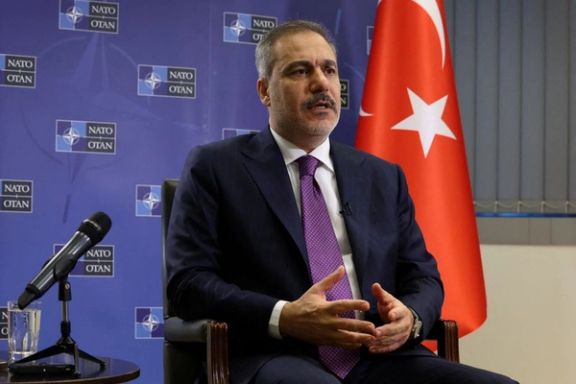
Turkish foreign minister Hakan Fidan speaks at the sidelines of a NATO summit
Turkey’s foreign minister on Friday called for peaceful negotiations between the US and Iran, warning of the risks of escalation in the region.
"Our region cannot tolerate another war, another big source of instability. And we don't know what type of escalation might occur in case of such an attack. So we don't want to see any (US) attack on Iran taking place,” Hakan Fidan was quoted as saying by Reuters in an interview on Friday.
“We need to see, as was the case in the past, peaceful negotiations employed by both sides and interested parties," he added.
A Bloomberg analysis argued that while Iran's vulnerability and proximity to nuclear weapons capability raise the specter of military action, diplomacy remains the only viable path forward despite deep distrust between Tehran and Washington.
The analysis highlights the limitations and unpredictable consequences of air strikes, noting that they would likely only delay, not end, Iran's nuclear program and could even push Tehran to pursue weapons more aggressively.
Despite a US military buildup in the region and the expressed willingness of one administration to consider force, the report emphasizes that a lasting solution requires a negotiated settlement addressing the weaknesses of the previous nuclear deal.
The Bloomberg opinion piece points to Iran's struggling economy and internal pressures as a potential opening for renewed diplomacy, but stressed the need for a comprehensive approach involving allies and regional partners.
Iranian authorities are preparing to amputate the fingers of three prisoners as early as April 11, Amnesty International warned on Friday, condemning what it called torture-tainted convictions following unfair trials.
The rights group also called on the international community to urgently intervene to halt the "gruesome plan."
Hadi Rostami, Mehdi Sharfian, and Mehdi Shahivand, held in Urmia Central Prison in northwestern Iran, were informed by prosecutors on March 13 that their amputation sentences would be carried out imminently.
Amnesty International highlighted that authorities in the same prison amputated the fingers of two brothers in October 2024 using a guillotine device.
"Amputation constitutes torture, which is a crime under international law and is a flagrant and abhorrent assault on human dignity," said Sara Hashash, Deputy Regional Director for the Middle East and North Africa at Amnesty International. She called on Iran to immediately halt the sentences and abolish all forms of corporal punishment.
Amnesty International said that the planned amputations are based on confessions obtained under torture and followed grossly unfair trials.
The organization urged that all Iranian officials responsible for ordering or carrying out these acts be criminally investigated and prosecuted, including through universal jurisdiction.
The three men, convicted of robbery in 2019, have consistently maintained their innocence and said that their confessions were forced under torture, including beatings, flogging, and suspension by their limbs.
Despite violating Article 7 of the International Covenant on Civil and Political Rights (ICCPR), to which Iran is a state party, Iranian law prescribes that for certain types of theft, those convicted must “have four fingers of their right hand completely cut off, leaving only the palm and thumb.”
Hadi Rostami reported a broken hand, and Mehdi Shahivand alleged threats of rape. Their requests for investigations into these torture allegations were reportedly ignored by Iranian authorities, including the Supreme Court, according to Amnesty.
According to the Abdorrahman Boroumand Center, a human rights organization, Iranian authorities have issued at least 384 amputation sentences and carried out at least 223 since 1979, with the actual numbers likely higher.
US Secretary of State Marco Rubio said on Friday that he is unaware of any nation that would be pleased to see Iran develop the capability to build nuclear weapons.
“I don't know of any country in the world that's excited about Iran ever having a nuclear weapons capability. Some are more forceful about it than others,” he said.
Rubio added that “the president... has made it clear that there's not going to be a nuclear- armed Iran. That is not going to happen under his watch.”
Rubio made the remarks following a meeting with foreign ministers from NATO member countries in Brussels, where he said discussions about Iran's nuclear program took place.
US Secretary of State Marco Rubio talks to reporters at the NATO headquarters in Brussels, Belgium, April 4, 2025.
Iran is open to negotiations with the United States if Washington seeks talks on an equal footing, the head of the Iranian parliament's national security and foreign policy commission said on Friday.
Speaking ahead of Friday prayers in Shiraz, Ebrahim Azizi pointed to what he described as the numerous broken promises by the United States over the past half-century, saying that Washington has only paid lip service to negotiations and remains untrustworthy.
“Iran has a logic for dialogue and is open to negotiation, on the condition that the other side does not act in a bullying manner and seeks negotiation from an equal standing,” he said.
Addressing threats from the US and Israel, Azizi said, "We tell their bullying and arrogant leaders with authority to stop threatening the great nation of Iran, and they should know that if they create insecurity, we will make the whole world insecure for them."
Fereydoun Abbasi, the former head of the Atomic Energy Organization of Iran
Iran’s nuclear facilities, research, and production are widely dispersed across the country, Tehran’s former atomic chief said Thursday, responding to US threats of military strikes if no new agreement is reached.
Fereydoun Abbasi, highlighting the history of Iran’s nuclear program, emphasized that “Nuclear knowledge in our country is distributed across both the educational and research sectors; it is not confined to the Atomic Energy Organization [AEO] or limited to specific facilities and sites associated with it. We are active in nuclear education and research nationwide.”
Abbasi is considered a political hardliner and was the head of AEO during populist President Mahmoud Ahmadinejad prior to 2013.
He dismissed President Donald Trump’s threats of strikes on Iran as “bluffing” and called his other statements about Greenland and Canada as “America’s excessive appetite.”
He noted that since mid-1970s, when the Atomic Center of the University of Tehran was transformed into the Atomic Energy Organization, “nuclear work in our country began to take an organized form, and its management came to be regarded as part of the country’s senior leadership. In other words, it moved beyond being merely an academic endeavor.”
He emphasized that AEO is at the level of a government department and its director is considered a presidential deputy. But he portrayed Iran’s nuclear activities as partly decentralized. “Nuclear knowledge in our country is distributed across both education and research sectors; it is not limited to the Atomic Energy Organization or confined to specific sites and facilities associated with it. We carry out nuclear education and research activities nationwide.”
At the same time Abbasi stressed that Iran is fully cooperation with UN’s International Atomic Energy Agency (IAEA) and is subject to detailed inspections.
However, since 2021, Tehran has significantly restricted the international watchdog’s access to its sensitive uranium enrichment sites, while producing 60% enriched fissile material—far beyond what is needed for civilian purposes.
Abbasi noted that in case of a US attack, protecting nuclear sites will be vital and Iran should have strong air defenses. He said that the adversary is well aware of Iran’s capabilities, implying that Iran has strong air defenses. However, in October, Israel carried out air strikes on a series of Iranian targets including its Russian-made S-300 anti-air missile batteries. According to both Israeli and various media reports, most of the air defense network was destroyed in the attack.