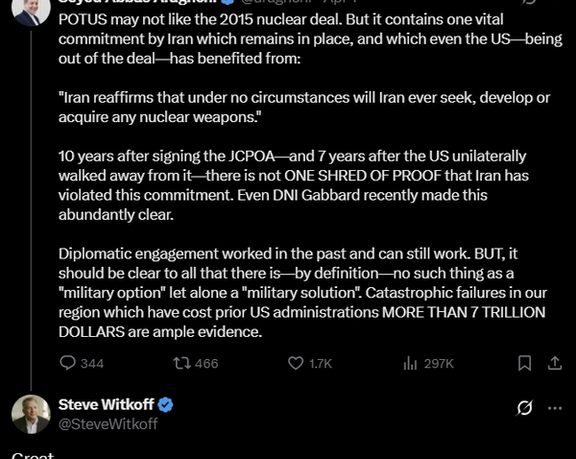
US President Donald Trump's special envoy Steve Witkoff reacted "great" to a spirited statement by Iran's foreign minister on X before swiftly deleting the post.
Foreign Minister Abbas Araghchi had written four paragraphs lamenting Washington's exit from a nuclear deal and recent talk of attacking Iran.
"10 years after signing the JCPOA—and 7 years after the US unilaterally walked away from it—there is not ONE SHRED OF PROOF that Iran has violated this commitment," Araghchi wrote, referring to a 2015 agreement from which the United States withdrew in Trump's first term.
"Diplomatic engagement worked in the past and can still work. BUT, it should be clear to all that there is—by definition—no such thing as a 'military option' let alone a 'military solution'," he added.
Witkoff, who has spearheaded talks for Trump in Israel-Hamas and Ukraine-Russia conflicts as part of the populist President's bid to wind down foreign reports, replied simply: "Great".
It was not immediately clear if the expunged monosyllable, which marks the first public interaction between Tehran and the Trump administration, was meant in earnest, irony or error.



Soroush Salehi campaigned to have Canada label Iran’s Revolutionary Guards a terrorist group but now the law for which he strived may eject him and others forced into the group as conscripts.
In June of last year, Soroush celebrated Canada's decision to list the Islamic Revolutionary Guard Corps (IRGC) as a terrorist entity.
Little did he know, however, that his activism to ostracize the group that had dragooned him into service would upend his own life.
Soroush is part of a community of Iranians living in Canada who bitterly resent their country's rulers for impressing them into the Islamic Republic's security forces.
Along with the regular military and police, the IRGC is another agency that Iranian men could be forced to join to complete their mandatory military service.
A transnational paramilitary force, the Revolutionary Guards spearhead Tehran's influence in the Middle East, including training and arming of affiliates like Hamas, Hezbollah, the Houthis and Iraqi militias.
Now their lives on Canadian soil are in jeopardy and are left to the discretion of immigration officers who may deem them inadmissible under the new policy.
Iran International spoke to Soroush and two other Iranian nationals whose permanent residency applications are also in limbo and who do not wish to be identified due to security concerns. Iran International has also reviewed evidence demonstrating the men were conscripts and not permanent IRGC servicemen.
From advocate to victim

Soroush Salehi washed dishes and carried out other menial tasks and errands as an IRGC conscript fulfilling his mandatory service more than 18 years ago in Iran.
The mechanical engineer moved to Calgary, Alberta in search of a peaceful life, leaving his theocratic homeland where he saw no future.
He came to Canada in 2022 in the same year Iran's clerical rule saw the biggest challenge to their system in decades as the so-called Woman Life Freedom protest movement swept the country, only to be quashed with deadly force.
Soroush chose Canada after being rejected by the United States in 2020, despite his wife's American citizenship, after US immigration authorities deemed him a “member of a terrorist organization.”

After US President Donald Trump put the IRGC on the US terrorist list in 2019, no exemptions were made for conscripts. Promises by President Joe Biden’s administration to look into exempting conscripts never materialized.
Now Soroush may be deemed inadmissible in Canada, too. Soroush is currently a temporary resident under a work permit and if no exemptions are provided, he might be deemed inadmissible and deported.
“I had dreams with my wife for a life here. Everything was good until September 2024,” Soroush told Iran International, “All my dreams are going to be devastated and are going to be shattered.”
Humiliation

Shahed, whose declined to use his real name citing security concerns, lives in Vancouver, British Columbia with his wife and five-year-old son who was born in Canada, who is a citizen.
From 2013 to 2015, Shahed completed his mandatory military service with the IRGC, and was tasked with administrative work, never training in military activities. The experience was deeply degrading, he said.
“The only purpose is just humiliating you, sitting there and cleaning the desk.”
In Canada with a work permit as an on-site engineer, Shahed's permanent residence application has been under review for more than three years.
Shahed had officially declared his mandatory military service and provided an ID card indicating the end of his mandatory service in a sworn affidavit reviewed by Iran International.

But he received and official letter saying immigration officers had “concerns surround your membership to the IRGC.”
“Based on your previous membership to the IRGC, I have reasonable grounds to believe you may be inadmissible to Canada ... (based on) membership in an organization that has engaged in subversion or terrorism,” the letter said. Shahed has responded protesting his innocence but has yet to hear back from authorities.
“Every day I have to deal with the stress when I wake up and be prepared that today I could be inadmissible and would have to leave Canada,” Shahed said. “I am not safe anymore.”
Shahed took part in Canadian protests in support of the 2022 unrest in Iran and fears for his safety if deported back to Iran.
Divorce - a way out?

Iran International spoke to another conscript and his wife over Zoom. They too did not want to be identified for their protection and for the safety of their family in Iran.
Since the designation, their lives are mired in uncertainty.
“This decision by the government is affecting every aspect of our lives,” said Farid's wife Roya. “We feel like prisoners here.”
They are both on an open work permit and applied for permanent residency in 2024, but since the IRGC designation their application has been stuck in security checks.
The married couple said they have decided not to leave Canada to travel or visit family because they fear being barred reentry.
Major life decisions like starting a family and buying a house have all been put on hold. If Farid is deported, they said they will likely get a divorce so his wife can have a life in Canada.
Farid told Iran International he served his mandatory service more than 10 years ago and never took part in military drills but worked in a clerical role at an Iranian bank.
Random process
The process in Iran for selecting conscripts to the various branches - whether for the regular army, the IRGC or law enforcement - is random.
Islamic Republic officials tasked with picking conscripts and officers often select recruits by pointing out young men arrayed in a line in front of them.
Prior to listing the IRGC a terror entity, Canada’s former Prime Minister Justin Trudeau had resisted calls to make the designation because of the plight of conscripts.
Activists continued to lobby for the change, arguing that identifying those low-level conscripts was an easy and verifiable task.
The terrorist designation empowers the justice system to prosecute IRGC members who have obtained Canadian citizenship and hold them criminally liable for crimes committed overseas.
On the fourth anniversary of the IRGC's downing of a civilian airliner which killed scores of Canadian citizens and residents, Trudeau said in Jan. 2024 that Canada was looking at a way to punish the group.
“We know there is more to do to hold the regime to account and we will continue our work, including continuing to look for ways to responsibly list the IRGC as a terrorist organization.”
When the official announcement was made, Justice Minister Arif Virani said an individual’s willingness and intent to support the IRGC would be an important consideration under the Criminal Code.
Immigration, Refugees and Citizenship Canada told Iran International that applications are considered on a case-by-case-basis.
“Conscription, in itself, does not necessarily result in a person being deemed inadmissible to Canada," it said. "The admissibility of individuals will be assessed based on a number of considerations."
Those range from the nature of their role in the IRGC to their level of engagement with the organization, it added.
Sadeq Bigdeli, a Toronto-based lawyer who represents several conscripts, said probably only under ten former conscripts have been deemed inadmissible by courts.
Bigdeli said he submitted a petition for guidelines excepting conscripts and even provided a draft text.
“It's not only unfair, but also basically helping the Islamic Republic by diverting resources from where they should be: the real terrorists."
While IRGC conscripts have declared their service voluntarily, actual IRGC members - whom Bigdeli called "masters of deception" – are likely walking free in Canada.

Moscow deems 'illegal' the threats against Iran's nuclear infrastructure, Reuters said on Wednesday citing the Russian foreign ministry.
The report follows a discussion between the deputy foreign ministers of Russia and Iran, Sergei Ryabkov and Majid Takht Ravanchi on Wednesday in which the sides accused Western countries of "artificially and unreasonably" inflaming tensions over Tehran's nuclear program.
Using military force against Iran and threatening to strike its nuclear infrastructure would be "illegal and unacceptable," the Russian foreign ministry said, as they would cause "large-scale and irreversible radiological and humanitarian consequences" for the Middle East and the world.

Moscow has rejected as illegal US threats against Iran's nuclear infrastructure, the Russian foreign ministry said on Wednesday, as tensions between Washington and Tehran have ramped up in recent weeks.
The remarks follow a discussion between the deputy foreign ministers of Russia and Iran Sergei Ryabkov and Iranian deputy foreign minister Majid Takht Ravanchi on Wednesday in which the two sides accused Western countries of "artificially and unreasonably" inflaming tensions over Tehran's nuclear program.
Using military force against Iran and threatening to strike its nuclear infrastructure would be "illegal and unacceptable," the Russian foreign ministry said according to Reuters, as they would cause "large-scale and irreversible radiological and humanitarian consequences" for the Middle East and the world.
US president Donald Trump has repeatedly expressed his preference for a nuclear deal with Iran but warned that a failure to reach one within a timeframe he has set could lead to military action.
The exact start date of Trump's reported two-month deadline to Iran remains unclear.
Tehran has rejected direct negotiations with the Trump administration and has suggested indirect talks via Oman.
A day earlier, Ryabkov warned against a US strike on Iran and expressed optimism that the stand-off could be resolved diplomatically.
"There is still time, and the 'train has not left the station' yet. We must intensify efforts to reach a reasonable agreement," Ryabkov said in an interview with Russian journal International Affairs.
"Russia is ready to offer its services to Washington, Tehran and all parties interested in resolving this issue," he added.
Kremlin spokesman Dmitry Peskov also said last month that Russian President Vladimir Putin had agreed to mediate nuclear talks between Washington and Tehran.

The US Treasury Department sanctioned an Iranian citizen based in Turkey accused of laundering millions of dollars in support of Yemen’s Houthi rebels, as Washington intensifies efforts to disrupt financial networks backing the Iran-aligned group.
Hassan Jafari allegedly funnelled funds through a network linked to a senior Houthi financial official who was also sanctioned on Wednesday, according to a statement by the US treasury's Office of Foreign Assets Control (OFAC).
"Turkiye-based Iranian money launderer Hassan Jafari has worked with Hushang and Sa’id al-Jamal to launder dollars on behalf of Sa’id al-Jamal’s network, enabling the network’s sanctions evasion schemes," the statement read.
"Jafari also arranged payments worth millions of dollars in support of shipments benefiting the Houthis."
The network is backed by IRGC's Quds Force, according to the US treasury, and has facilitated the purchase of commodities from Russia, including weapons, sensitive goods, and stolen Ukrainian grain, for shipment to Houthi-controlled Yemen.
A senior commander in Iran’s Revolutionary Guard has warned that Tehran could rethink its defense policy if the country's nuclear sites are hit, in yet another signal by Iranian officials that an atomic bomb could be pursued.
“If threats against our nuclear program materialize, we will reconsider our defense doctrine and the nature of our nuclear program. The meaning of this reconsideration is very clear” the IRGC’s deputy for political affairs Yadollah Javani was quoted by state media on Wednesday.

"The enemy's military action would take Iran's nuclear industry to a new stage, and then there must be a new definition for the Islamic Republic and the axis of resistance in regional and international equations," Javani added, referring to Tehran's armed allies in the region.
"The effects and consequences of Iran's strong counterattack will definitely create a new chapter in the equations and trends of developments in the region and the world."