Israel says Revolutionary Guard operative killed in Lebanon

The Israeli military said on Tuesday it has assassinated a Revolutionary Guards member coordinating Hamas and Hezbollah operations in Lebanon.

The Israeli military said on Tuesday it has assassinated a Revolutionary Guards member coordinating Hamas and Hezbollah operations in Lebanon.
Hassan Ali Mahmoud Badir, a member of Hezbollah's Unit 3900 and the Revolutionary Guards Quds Force, was killed in the Dahiyeh area of Beirut, a stronghold of the Iran-backed Hezbollah militia.
"Badir recently operated in cooperation with the Hamas terrorist organization, directed Hamas terrorists, and assisted them in planning and advancing a significant and imminent terror attack against Israeli civilians," a statement released on Tuesday said.
"Given the immediacy of the threat, Badir was struck immediately in order to eliminate the threat posed by a terror attack intended to harm Israeli civilians."
A Lebanese security source told Reuters that the target was a Hezbollah figure whose responsibilities included the Palestinian file. The Lebanese health ministry said the strike killed four people - including a woman - and wounded seven others.
The news comes amid a volatile US-France-brokered ceasefire between Israel and Hezbollah, which has seen both sides accuse the other of scores of violations.
"Hezbollah’s terrorist activity constitutes a violation of the understandings between Israel and Lebanon and poses a threat to Israel and its citizens," the Israeli military said.
Last year, in the wake of the Gaza war, sparked by the Iran-backed Hamas invasion of Israel on October 7, Israel carried out a bombing on Iran's consulate compound in Damascus, killing senior IRGC commanders and senior figures connected to operations in Syria, Lebanon and Palestine.
Among those killed were Brig. Gen. Mohammed Zahedi, the Quds Force’s commander for Syria and Lebanon, Gen. Hossein Aminollah, the Quds Force’s chief of staff for Syria and Lebanon, and Maj. Gen. Mohammed Hadi Haj-Rahimi, the commander for Palestine.
The attack triggered Iran's first direct aerial attack on Israel, bringing the one-time shadow war into the fore, with both countries launching direct attacks which have seen the conflict between the archenemies reach their most tense ever.

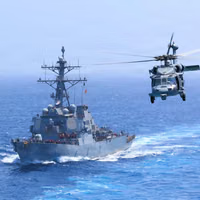
The White House said on Monday that a top Houthi missile expert was killed in US strikes, as President Donald Trump warned that that military action against the Iran-backed Houthi rebels in Yemen would continue until the group no longer threatens maritime security.
"The choice for the Houthis is clear: Stop shooting at US ships, and we will stop shooting at you. Otherwise, we have only just begun, and the real pain is yet to come, for both the Houthis and their sponsors in Iran," Trump said in a Truth Social post.
Following Trump’s remarks, the United States Central Command (CENTCOM) confirmed ongoing attacks on Houthi positions in Yemen on Tuesday, releasing video footage of the strikes.
The White House said that recent US strikes in Yemen have resulted in the death of a top Houthi missile expert. However, the US military has not confirmed the death, and the identity of the Houthi commander remains unclear.
National Security Advisor Mike Waltz, in comments to CBS News after the March 15 strikes, said that the first wave of attacks killed “their head missileer.”
Reuters reported that unnamed US officials said they were unaware of any independent confirmation from the US military regarding the death of the individual in question.
While on March 15, CENTOM said in a press release that its forces initiated an operation consisting of precision strikes against Iran-backed Houthi targets across Yemen, it did not provide further details on the targets.
Trump also referred to the death of Houthi leaders in his post on Truth Social, saying "The Iran-backed Houthi Terrorists have been decimated by the relentless strikes over the past two weeks. Many of their fighters and leaders are no longer with us."
US Air Force Lieutenant General Alexus Grynkewich did not mention a missileer in his comments about US strikes on Houthi positions on March 17 but confirmed that an aerial drone facility was targeted, along with several key leaders, the Reuters report added.
The strikes, the largest US military operation in the Middle East since Trump took office, aim to pressure the Iran-backed Houthis to end their attacks on shipping in the Red Sea, including US warships.
The group has carried out over 100 attacks on shipping since late 2023, citing solidarity with Palestinians in Gaza. What began as a campaign against Israeli-backed ships has led to a total blockade on global shipping with multiple international seamen killed in attacks.

Yemen's Houthis announced on Sunday said they targeted Ben Gurion Airport with an Iranian Zolfaghar missile, as Israel's military denied the missile reaching Israeli territory, saying it was intercepted before impact.
"We targeted Ben Gurion Airport in the occupied Jaffa area with a Zolfaghar ballistic missile, and this operation was successfully carried out with God’s blessing," Yahya Saree, the spokesman for the Houthis said Sunday in a statement.
The Israeli military disputed the Houthi claim, saying, "Following sirens that sounded a short while ago in several areas in Israel, a missile launched from Yemen was intercepted by the IAF prior to crossing into Israeli territory. Sirens were sounded in accordance with protocol."
The Zolfaghar missile is an Iranian short-range ballistic missile (SRBM) developed as an enhanced version of the Fateh-110 missile system. It was first unveiled during a military parade in September 2016 and entered service in 2017.
Shortly after IDF made the announcement, former Israeli Prime Minister Naftali Bennett said Israel should respond to Houthi attacks by targeting Iran directly, arguing Tehran finances and controls the Yemeni group.
"It is Iran that finances, arms, trains, and operates the Houthis. Iran has a lot to lose; the Houthis have much less. Therefore, Israel must levy a high price on Iran. Only in this way will Iran understand," he said on X.
This comes as US President Donald Trump, less than a fortnight ago, warned that Iran will bear brunt of any Houthi attack.
"Every shot fired by the Houthis will be looked upon, from this point forward, as being a shot fired from the weapons and leadership of IRAN, and IRAN will be held responsible, and suffer the consequences, and those consequences will be dire!" Trump wrote on his Truth Social platform.
In January last year, US forces intercepted a shipment carrying military aid from Iran to the Houthis, including drone parts, missile warheads, and anti-tank missile units.
Writing for The Council on Foreign Relations, Kali Robinson said that, "For the Houthis, the Iran connection provides more sophisticated weaponry than they could acquire on their own, especially missiles and drones.
"Iranian support has bolstered the group’s fighting abilities, helping the Houthis gain and maintain military superiority within Yemen, but experts say it has had greater impact elsewhere."

The United States on Friday intensified its campaign against Iran-aligned groups, conducting extensive airstrikes on Houthi-controlled areas in Yemen and pressuring Hezbollah in Lebanon.
Suspected US airstrikes hit Yemen overnight into Saturday, reportedly killing at least one person, as the American military confirmed an earlier strike on a major military site in central Sanaa controlled by Houthi rebels, the Associated Press reported.
According to Houthi-affiliated media, American warplanes carried out 14 airstrikes each on the Yemeni capital Sanaa and the northern city of Saada, as well as several strikes in al-Jawf province.
While full casualty figures remain unclear, the group’s said one person was killed and four injured in Saada, describing the fatality as a civilian. However, such figures may downplay military losses, given the Houthis’ pattern of operating in civilian attire.
The escalation follows Houthi threats and attacks on maritime traffic Since 2023, which the group said were acts of solidarity with Palestinians in Gaza. Between November 2023 and January 2024, Houthi forces targeted over 100 commercial vessels. The US and its allies restarted strikes in Yemen in mid-March after a brief lull.
Meanwhile, the US Treasury Department announced sanctions against five individuals and three companies accused of helping finance Hezbollah through oil smuggling operations tied to Iran’s Islamic Revolutionary Guard Corps’ Quds Force. The department described the network as a commercial front funneling millions of dollars into Hezbollah’s accounts under the oversight of senior financier Muhammad Qasir, who died in late 2024.
“These evasion networks strengthen Iran and its proxy Hezbollah and undermine the courageous efforts of the Lebanese people to build a Lebanon for all its citizens,” said Bradley T. Smith, Acting under secretary for terrorism and financial intelligence in a statement.
The Treasury added that Washington's Rewards for Justice program is offering up to $10 million for information on Hezbollah’s financial infrastructure.
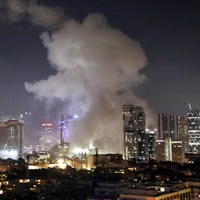
On the same day, Israeli warplanes struck a building in Beirut’s southern suburbs, a Hezbollah stronghold, for the first time since a November ceasefire. Israeli officials said the site was used by the Iran-backed group to store drones.
In Washington, State Department spokesperson Tammy Bruce defended the strike.
"The Government of Lebanon is responsible for disarming Hezbollah," Bruce told reporters. "The reason that any attacks have happened is because terrorists launched rockets into Israel from Lebanon. That is a violation of the cessation of hostilities."
"Israel has to respond as the United States would have to respond," Bruce said. "We stand by Israel."
The US push on multiple fronts highlights a broader effort to limit the influence of Tehran’s allies and proxies in the region.
US President Donald Trump recently sent a letter to Tehran giving Iran a two-month deadline for reaching a new nuclear deal, Axios reported citing one US official and two sources briefed on the letter.
"You've got a lot of stuff going on with Iran, and we sent a letter to Iran," Trump said this week. "You're going to have to be speaking to us one way or the other pretty soon, because we can't let this happen."
Trump has demanded Tehran come to a deal or face a military intervention and warned any attack by Yemen's Houthis would be treated as emanating from Iran.
Iran says it has responded to the letter through Oman.

An ongoing US military campaign must defeat Houthi fighters in Yemen to prove Washington's resolve to their Iranian backers, US Senator John Hoeven told Iran International.
"We need to take out the Houthis. We need to stop the Houthis from these attacks. It's not good enough to just play defense. We actually have to take out their ability to make these attacks," the Republican senator from North Dakota said.
"They are a proxy for Iran. They are funded by Iran. They are armed by Iran," he added. "It's not only important we take out the Houthis so that we can have safe, safe shipping in the Red Sea, in the Gulf of Aden. It's also important to send very clear message to Iran that we know their proxies are armed and funded by Iran and doing Iran's bidding."
President Donald Trump on Mar. 15 ordered large-scale military strikes against dozens of Houthi targets in Yemen, warning Iran not to keep supporting the group.
'Offshoot of Iran'
A Shi'ite religious militia, the Houthis seized much of the war-torn country beginning in 2014 and have been provided advanced drone and missile technology by Iran.
Following an attack by Iran-backed Hamas militants on Israel on October 7, 2023 and Israel's incursion into Gaza, the Houthis began attacking commercial and military vessels in the waterways astride Yemen in what they called solidarity with Palestine.
Trump has demanded Tehran come to a deal over its nuclear program or face a military intervention and warned any attack by the Houthis would be treated as emanating from Iran.
Following this week's attacks on the Houthis, Trump asserted once more that the Yemen group was Tehran's offshoot.
"They make their own missiles. They get their missiles also from Iran. It's an offshoot of Iran, another offshoot," he told reporters at the White House on Tuesday.
"You've got a lot of stuff going on with Iran, and we sent a letter to Iran. You're going to have to be speaking to us one way or the other pretty soon, because we can't let this happen," he added.

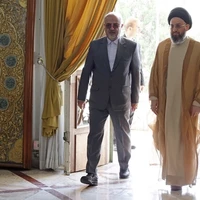
Senior Iraqi politicians opposed to Iranian influence in the country have called for Tehran-backed militias to disarm and disband now that the Islamic Republic's sway over the region has diminished.
“Armed groups supported by Tehran have no choice but to accept change,” said Sheikh Abdullah al-Jaghifi, Secretary-General of the Ahrar al-Furat Movement.
Al-Jaghifi said Syria was a cautionary tale of how geopolitical transformations can unravel entrenched alliances. Tehran lost its oldest Arab ally there, the Assad dynasty, to hardline Islamist-led rebels close to Turkey.
Speaking to Iran International, al-Jaghifi predicted 2025 would bring major changes across Iraq and the broader region, with Iran's influence continuing to wane.
The remarks come after discussions over integrating the militias into the Popular Mobilization Forces (PMF) – a move presented as a means to depoliticize Iraq’s paramilitary landscape. Yet critics question the sincerity and effectiveness of the initiative.
Mithal al-Alusi, founder of the Democratic Party of the Iraqi Nation, dismissed the proposed merger as a semantic maneuver.
“Iran is using wordplay to maintain its grip on Iraq and is turning the country into a base for extremist operations,” he told Iran International. He warned that Iran-backed networks are involved in transferring funds, passports and weaponry under the guise of Iraqi state structures.
Al-Alusi argued that Hezbollah and Hamas are being financed with dollars funneled through Iraqi channels, calling the practice “a serious crime against Iraq and the region – against people killed whether Israelis, Palestinians, Lebanese, Syrians and Yemenis alike.”
The leadership in Baghdad is pressuring Tehran-aligned armed groups not to attack Israeli targets to avoid a punishing military response, The New Arab news outlet reported on Wednesday.
The move follows a reported effort by a senior Iranian military commander to urge Tehran's armed allies in Iraq and Yemen to stand down attacks on their Mideast nemesis, potentially signaling an Iranian desire for detente in the region.
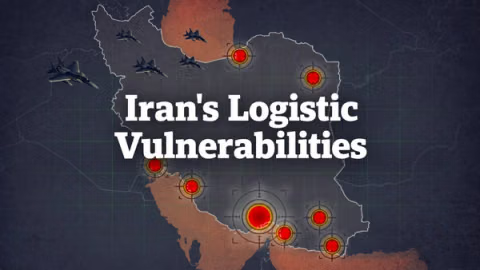
Iran faces an ultimatum by US President Donald Trump to ink a new nuclear deal or face attack after its home front and armed allies in the region have been dealt historic military blows from Israel in over a year of war.