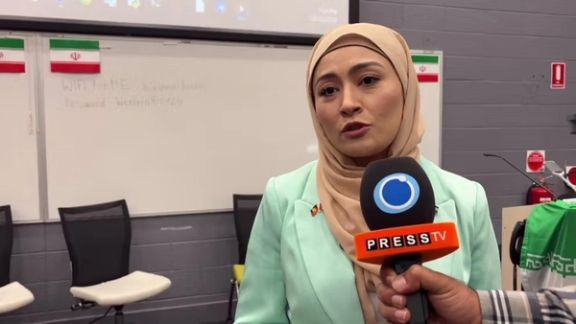
Australia must act on Iran’s Press TV’s sanctions breach, senator says
Fatima Payman speaking to Press TV during an event in Sydney
Australian Senator Dave Sharma is pushing the country's government and police to take legal action against Iran’s state-run Press TV for operating in the country in violation of sanctions.
"If breaches of the law are found to have occurred, which almost certainly they have in this instance, then people will be prosecuted under our legal system," Sharma told Iran International.
Sharma, who chairs the Senate's foreign affairs, defence and trade references committee, said that Press TV conducted an interview with an Australian senator at a university event, despite being sanctioned by Australia.
The interview was conducted last month with Australian senator Fatima Payman, who defended Iran’s treatment of women in remarks that sparked backlash and later led her to apologize.
The Albanese government sanctioned the broadcaster in September 2023, a year after the death in custody of Iranian woman Mahsa Amini, which sparked months of nationwide protests across Iran in 2022.
Sharma described Press TV as a "propaganda arm of the Islamic Republic" that has aired forced confessions of political prisoners, including Australian academic Kylie Moore-Gilbert. Moore-Gilbert was detained in Iran for more than two years before being released in a prisoner swap in 2020.
"Despite these sanctions being in place, Press TV is turning up to public events, conducting interviews, and has correspondents who are supposedly based in Australia," he said. "This is, on the face of it, a very serious violation of Australia's sanctions regime."
He said he had also written to the foreign minister demanding an investigation and expected swift government action.
Sharma warned that Press TV’s presence in Australia threatens Iranian-Australians, arguing that the network is used to "intimidate and silence" critics of the Islamic Republic.
"Their actions threaten the freedoms of local Iranians who live in Australia and still have family in Iran," he said. "This is why our sanctions must be enforced, and those responsible must be held accountable."
Iranian President Masoud Pezeshkian announced that government offices and executive bodies will be required to install solar panels as part of efforts to address the country's energy shortages, state media reported Monday.
Speaking at a meeting on energy distribution and consumption, Pezeshkian stressed the need for equitable energy policies and flexible solutions adapted to regional conditions.
“Addressing energy imbalances should not be confined to a single approach,” he said, advocating for a mix of strategies to optimize distribution and ensure fairness across different provinces.
Iranian officials refer to the shortages in the energy sector as an imbalance.
The president also emphasized public engagement in energy-saving initiatives, suggesting that mosques, health centers, and prominent cultural figures could help promote consumption reforms.
“If we involve people in implementing these decisions, we will overcome many challenges, including energy distribution and consumption management,” he added.
Among other measures, Pezeshkian highlighted the need to modernize heating equipment, ban outdated and inefficient appliances, and expand the use of smart meters in residential areas.
The energy crisis, marked by widespread electricity shortages and gas deficits, has disrupted industries across the country since the past months. Aging infrastructure, international sanctions, and poor management have compounded the problem, leading to the shutdown of approximately 80 power plants.
During the winter, Iran faces a daily shortfall of at least 260 million cubic meters of gas, further straining the electricity supply.
Iran has vast oil and gas reserves, much of which it cannot tap due to US-led sanctions which stall investment and maintenance.
Former Iranian President Hassan Rouhani suggested that Supreme Leader’s opposition to negotiations with the United States could change depending on circumstances.
“There is no absolute opposition to negotiations,” Rouhani said in a meeting with former ministers and officials on Thursday.
“Did we not negotiate with the US on Iraq, Afghanistan, and the nuclear deal? Even back then, when I was secretary of the Supreme National Security Council, the leader himself wrote that negotiations should adhere to certain principles.”
His remarks contrast with Ali Khamenei’s previous statements, particularly following Donald Trump’s outreach to Tehran, in which he ruled out talks with Washington. The Supreme Leader had also maintained that if negotiations were to happen, they would not take place during Trump’s presidency.
Rouhani linked Iran’s economic difficulties to the US withdrawal from the Joint Comprehensive Plan of Action (JCPOA) in 2018, when Washington reimposed Tehran sanctions halted under the 2015 nuclear deal.
“Since then, Iran has lost $100 billion per year,” he said. By that measure, the total economic toll would amount to $650 billion during the six and a half years since the US pullout.
Iran’s foreign minister on Thursday also signaled Tehran's willingness to engage in indirect negotiations with the United States through Oman.
During an interview with the Iran newspaper, Araghchi, when asked about using indirect channels like those in Muscat, said, "Yes, it is not a strange method, and it has happened repeatedly throughout history."
"Therefore, indirect negotiation is feasible... What is important is that the will to negotiate and reach a fair and just agreement comes up in equal conditions, and the form of it does not matter."
This apparent change came shortly after Tehran acknowledged receiving a letter from President Donald Trump, which outlined the terms of a possible agreement on Iran’s nuclear program and, potentially, other issues, including Tehran’s regional proxies.
Shifting to domestic politics, Rouhani highlighted low voter turnout in the 2024 snap presidential election, where official figures put participation at 40%.
“The most important factor in national security is having a people,” he said, adding that many who voted in the second round did so “to avoid being stuck with someone else.”
This was widely interpreted as a reference to the runoff between Masoud Pezeshkian and Saeed Jalili. Official results have been met with skepticism, but even by the government’s own tally, the 2024 vote marked the lowest turnout in the history of the Islamic Republic.
A general view shows a unit of South Pars Gas field in Asalouyeh Seaport, north of Persian Gulf, Iran.
Iranian oil exports are buoyant and cannot be halted by stepped-up US sanctions, Iran's Oil Minister Mohsen Paknejad said as Washington sanctioned him personally and expanded curbs on Tehran's crude trade.
"In Dey (January), we broke the record for oil exports in over a decade; we are announcing this news to make our people happy," Paknejad told the Entekhab News Agency shortly before the sanctions announcement on Thursday.
He also said that Iran’s oil exports had remained steady, adding, "In the past few months, we have not seen any drop in crude oil exports."
Paknejad had made similar claims earlier this year, saying in January that Iran had reached a new high in oil exports.
Soon after Paknejad's comments, the US Treasury announced sanctions against him, accusing Iran’s oil ministry of sending billions of dollars to the Islamic Revolutionary Guard Corps (IRGC) and other security forces. The move marks a major increase in Washington's efforts to cut off Iran’s oil revenues and force Tehran into talks over its nuclear program.
“The Iranian regime continues to use the proceeds from the nation’s vast oil resources to advance its narrow, alarming self-interests at the expense of the Iranian people,” said Treasury Secretary Scott Bessent. "Treasury will fight and disrupt any attempts by the regime to fund its destabilizing activities and further its dangerous agenda."
The sanctions also included entities in China, the main buyer of Iranian oil, and in India accused of helping Iran trade oil through a "shadow fleet" of ships that avoid detection. The US has been trying to block Iran’s secret oil sales and reduce its economic influence.
Iran’s Foreign Ministry also condemned the sanctions on Friday, calling them a "clear violation of international law." Spokesperson Esmail Baghaei said the sanctions showed the US was dishonest about its willingness to negotiate.
Successive rounds of US sanctions on tankers and companies involved in Iran's oil trade are slowing shipments to China, but trade with one of Iran's key allies continues in "dark mode" despite maximum pressure, according to Bloomberg.
Sanctions are affecting the trade by increasing costs and creating logistical hurdles, Bloomberg reported, citing Chinese refinery executives and shipping analysts.
In a separate report on Friday, Bloomberg said that the United States sanctioned Singapore-based Shipload Maritime Pte for its involvement in the Iranian oil trade—the first such case in the city-state. The US Department of State stated on March 13 that the company was penalized for "knowingly engaging in a significant transaction for the transport of petroleum or petroleum products from Iran," related to a ship-to-ship transfer near Indonesia in December.
Iran's Foreign Ministry has condemned the United States' latest round of sanctions, which targeted Iran's Oil Minister Mohsen Paknejad, several oil tankers, and commercial entities.
The sanctions, announced by the US Treasury on Thursday, mark an escalation in Washington's ongoing standoff with Tehran over its nuclear program.
Esmail Baghaei, spokesperson for Iran's Foreign Ministry, described the sanctions as a clear violation of international law and accused the United States of hypocrisy.
"While American officials repeatedly claim they are ready for negotiations, these sanctions are yet another undeniable proof of their dishonesty," Baghaei said on Friday. "It is a sign of their hostility towards Iran’s progress, development, and the welfare of its people."
Baghaei also condemned the broader impact of US sanctions, describing them as "a violation of the principles of free trade and international law." He said, "America's addiction to sanctions and pressure against independent countries undermines international peace and security. The United States will be held responsible for the consequences of these unlawful actions."
The US Treasuryaccused Paknejad and Iran's oil ministry of funneling billions of dollars in oil revenues to Iran's security forces, including the Islamic Revolutionary Guard Corps (IRGC). The sanctions also targeted entities in China and India, accused of facilitating Iranian oil trade through what Washington calls a "shadow fleet."
Iran's Revolutionary Guards have strengthened their grip on the country's oil industry, now overseeing up to half of its exports, according to a Reuters report from late last year. The revenue from these exports is used to bolster Iran's military capabilities and support allied armed groups across the Middle East.
Washington has been ramping up sanctions on Iran's oil exports since Donald Trump came to office earlier this year, pinching Iran's economy and deepening financial hardship for Tehran in a bid to bring it to the negotiating table over its nuclear program.
Iran denies seeking a nuclear weapon, but a United Nations watchdog said this month that its uranium enrichment levels and stockpiles of fissile material have risen significantly.
Trump said last week that Iran must reach a nuclear agreement or face military threat, in comments lambasted by Iran's Supreme Leader as an attempt to bully and dominate Iran.
Yet on Thursday, Iran's Foreign Minister hinted at the possibility of indirect talks through Oman.
Iranian oil minister Mohsen Paknejad with working gear, undated, Iran
The US Treasury slapped sanctions on Iran's oil minister Mohsen Paknejad on Thursday, putting to one side its usual practice of sparing senior political figures and escalating Washington's standoff with Tehran over its disputed nuclear program.
“The Iranian regime continues to use the proceeds from the nation’s vast oil resources to advance its narrow, alarming self-interests at the expense of the Iranian people,” said Secretary of the Treasury Scott Bessent said in a statement.
“Treasury will fight and disrupt any attempts by the regime to fund its destabilizing activities and further its dangerous agenda.”
US President Donald Trump reinstated his so-called maximum pressure campaign of sanctions on Iran last month in a bid to bring oil revenues upon which the state relies to zero and force Tehran to the negotiating table over its nuclear program.
The sanctions announced on Thursday also included entities in China and India the treasury accused of owning and operating vessels involved in the trade of Iranian oil - dubbed a "shadow fleet" by Washington.
Iran's oil ministry criticized the move and said it would circumvent US sanctions.
"The sanctions on Mohsen Paknejad are due to his extensive efforts to sell Iranian oil. He has repeatedly emphasized that Iranian oil exports will never stop and that the US policy of maximum pressure has failed," it said in a statement.
"In recent years, Iran has repeatedly demonstrated its ability to bypass sanctions and continues to sell its oil in international markets through various methods," it added.
The US treasury explained its targeting of Paknejad as a means of combatting Iran's security apparatus.
"Iran’s oil industry ... generates tens of billions of dollars annually for the regime."
"Under (Paknejad's) leadership, Iran’s Ministry of Petroleum has allocated billions of dollars’ worth of Iranian oil to the Iranian armed forces, including the Islamic Revolutionary Guard Corps and the Iranian Law Enforcement Forces, both critical instruments in the regime’s tools of oppression," it added.
Iran's Revolutionary Guards have tightened control over the country's oil industry and now manage up to half of exports, according to Reuters report late last year, funding its military capabilities and those of armed allies across the Middle East.
The US state department too announced sanctions on several Indonesia-based entities it says facilitate Iranian oil shipments.
Washington has been ramping up sanctions on Iran's oil exports since the latter days of the Joe Biden administration, pinching Iran's economy and deepening financial hardship for its people which could threaten unrest.
US competitor China, the world's top oil importer, is Iran's customer for over 90% of its oil exports and has continued to buy the supplies through a world-spanning network of traders and shell companies dodging US-led sanctions.
Iran denies seeking a nuclear weapon but a United Nations watchdog said this month that its uranium enrichment levels had sharply risen to levels which in principle could be refined further into six atomic bombs.