Iran decries Israeli jet flyover of Nasrallah funeral in Beirut
Israeli fighters jets fly low over the funeral of slain Hezbollah leader Hassan Nasrallah in Beirut on Feb. 23, 2025
Israeli fighter jets on Sunday buzzed over the funeral ceremony in Beirut of slain Hezbollah leader Hassan Nasrallah, in what the visiting Iranian foreign minister called a violation of Lebanon’s sovereignty and an attempt to intimidate mourners.
"I witnessed, with my own eyes, the violation of Lebanon's sovereignty by Israeli jets that flew close above our heads, in a pitiful attempt to terrify people who gathered only to mourn," said Foreign Minister Abbas Araghchi who was in Beirut to attend Nasrallah's funeral.
"If that is not an act of terror, then what is?" he asked in a post on his X account, in which he also embedded a video of the Israeli jet fighters flying low over the Lebanese capital.
The Israeli defense minister confirmed his country's aircraft flying over the funeral of Nasrallah, saying that the move "conveyed a clear message: Those who threaten to destroy Israel and attack Israel, it will be their end."
“You will specialize in funerals, and we will in victories,” Israel Katz said in a statement.
As the funeral was under way in Beirut, the Israeli military released videos of the moment it assassinated Nasrallah on September 27, 2024, along with several other commanders of the Iran-backed group, in an attack on their underground headquarters in Beirut.
Hezbollah, designated a terrorist organization by countries such as the US and UK, is currently in a fragile US-French brokered ceasefire with Israel, while both sides allege continued violations.
Although Israel's military has mostly pulled back from southern Lebanon, its air force continues to target what it claims are Hezbollah positions throughout the country, while its troops still maintain control over five hilltop positions along the border.
Hezbollah Secretary-General Naim Qassem on Sunday reaffirmed the group’s allegiance to Iran’s leadership, in a video broadcast during the funeral of the group's assassinated leader Hassan Nasrallah.
“We are the children of Khomeini and Khamenei,” Qassem said in a video message saying the group's struggle is guided by the ideology of Ruhollah Khomeini, the founder of the Islamic Republic, and Supreme Leader Ali Khamenei.
In the video broadcast aired during the funeral of Hezbollah leader Hassan Nasrallah and his deputy Hashem Safieddine in Beirut, both killed by Israel, he also vowed that the Iran-backed militant group would not abandon its fight.
“We will not abandon the resistance, even if our homes collapse on our heads," he said, after the group suffered its worst losses in its history last year.
Israel eliminated hundreds of the group's militants and the top echelons of its leadership, all the way to the long-time leader, Nasrallah.
Israel also destroyed swathes of the group's infrastructure during a wave of targeted strikes before the current ceasefire began in November.
Iran’s Supreme Leader Ali Khamenei also issued a message for Nasrallah’s funeral, honoring him as a pioneering leader of the resistance whose legacy will endure.
Khamenei also praised Safieddine as a vital figure in Lebanon’s resistance, offering prayers for them and all the group's fallen fighters.
“The resistance against usurpation and oppression will continue until its goals are achieved," he added.
Iran's inflation has hit a new peak this year, with the Statistical Center of Iran reporting a general inflation rate of over 35% for February, the highest since last winter.
The surge, marked by a monthly inflation exceeding 4% for the first time in the past year, has exacerbated the widespread public discontent, especially as food prices skyrocket. Hundreds of Iranian have sent messages to Iran International complaining about soaring prices.
Official data reveals that food costs are the primary driver of inflation, with rural areas experiencing a higher rate (36%) than urban centers (35.2%). Low-income households are bearing the brunt of this economic strain, particularly in provinces like Semnan, West Azarbaijan, and Hormozgan.
"The point-to-point inflation rate, indicating how much household expenses have changed compared to last year, reached 35.3% in the Persian calendar month of Bahman (ended on February 18)," said the Statistical Center. "This marks the highest inflation rate in 12 months."
Vegetables and legumes saw a staggering 16.9% monthly inflation, while fruits and nuts rose by 8.7%. Conversely, education saw the lowest monthly inflation, below 1%.
Annual inflation has risen by around 40 percent, each year in the past five years, and the rial has lost 95% of its value since 2018 when Donald Trump withdrew from the 2015 nuclear deal and re-imposed draconian sanctions on the country.
The massive depreciation of the rial and high inflation have drastically increased the cost of living, including expenses for food, housing, and healthcare and driven over 30 percent of the population below the poverty line.
Citizens engaging with Iran International have corroborated these findings, sending videos depicting a sharp rise in essential goods prices.
US Congressman Joe Wilson condemned a parade in Baghdad on Sunday honoring former Hezbollah Secretary-General Hassan Nasrallah, where attendees trampled on an American flag and an image of US President Donald Trump.
“America gives millions to Iraq. Today they form a parade to walk over our flag & picture of President Trump. @realDonaldTrump won’t forget,” Wilson wrote in a post on X Sunday.
Iraqi news website Shafaq News reported that thousands gathered in Baghdad for a symbolic funeral procession for Hezbollah leaders Hassan Nasrallah and Hashem Safieddine, whose funeral is being held in Beirut.
Nasrallah was killed in September in an Israeli airstrike on Beirut’s southern suburbs. Safieddine took over Hezbollah’s leadership after Nasrallah’s death but was killed a week later in another Israeli airstrike in Dahieh, south of Beirut.
Wilson, a longtime critic of US policy toward Iraq, also accused Iranian-backed militias of controlling the country’s judiciary, military, and government while receiving American funds.
Iranian-backed militias in Iraq have launched multiple attacks targeting Israel since the Hamas attack on the Jewish state on October 7, 2023.
Following the assault, these militias began their operations by first targeting US forces in Syria and Iraq, before escalating their actions to include strikes against Israel itself.
Known as the Islamic Resistance in Iraq, the groups are a patchwork of Shi'ite militias and factions. The factions joined forces to largely defeat radical Sunni Islamic State in Iraq but continue to exert broad military and political control.
The Iraqi militia group Kata’ib Hezbollah, backed by Iran's IRGC Quds Force, has been linked to terrorist plots targeting Jewish centers in Uzbekistan and Kazakhstan.
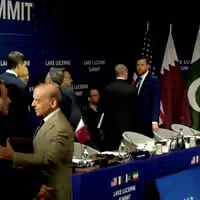
The venue of Hassan Nasrallah's funeral procession in Beirut, February 23, 2025.
Iran’s foreign minister and parliament speaker traveled to Beirut to attend the funeral of Hassan Nasrallah, the slain Secretary General of Hezbollah, and his deputy.
Abbas Araghchi and Mohammad Bagher Ghalibaf, along with several Lebanese politicians and leaders of Iran-backed groups, will attend the ceremony.
Lebanese media said Iran’s President Masoud Pezeshkian expressed a desire to attend but did not receive an invitation.
Iranian state media said that family members of the late President Ebrahim Raisi and former Foreign Minister Hossein Amir-Abdollahian, who were killed in a helicopter crash last year along with several government officials, also traveled to Lebanon as part of an official delegation of around 40 representatives.
Araghchi said: “Many people in Iran wanted to participate today to bid farewell to these two heroes of the resistance. The funeral will show that Hezbollah remains strong, loyal to its ideals, and that the struggle will continue.”
Iran’s Supreme Leader Ali Khamenei issued a message for Nasrallah’s funeral, honoring him as a pioneering leader of the resistance whose legacy will endure. He also praised Safieddine as a vital figure in Lebanon’s resistance, offering prayers for them and all fallen fighters.
Khamenei added that “the resistance against usurpation and oppression will continue until its goals are achieved.”
Hezbollah, designated a terrorist organization by countries such as the US and UK, is currently in a fragile US-French brokered ceasefire with Israel, while both sides allege continued violations.
Last year, while thousands of projectiles being fired by Hezbollah to Israel in allegiance with Iran-backed Hamas in Gaza, hundreds of Hezbollah operatives were killed by Israel, including the assassination of its decades-long leader, Nasrallah.
He was killed in a targeted airstrike targeting Hezbollah’s command center in Beirut’s southern suburbs.
Hundreds more operatives were also seriously injured in a two-day operation in which Israel targeted pagers and walkie-talkies belonging to the group's members.
Ahead of Nasrallah’s burial, the Lebanese government extended the suspension of flights to and from Iran indefinitely.
The Washington Post reported that with the cancellation of Iranian passenger flights, Hezbollah supporters are traveling through Iraq to reach Beirut.
The funeral procession for Nasrallah and Safi al-Din is set to begin Sunday at a sports stadium in southern Beirut. Naim Qassem, Hezbollah’s current Secretary General, is expected to deliver a speech.
The US Embassy in Beirut has advised its citizens to avoid areas surrounding the funeral, including the airport.
Once Iran’s most powerful regional proxy armed militia, Hezbollah was founded with the support of the Revolutionary Guards in 1982 but suffered heavy losses in last year’s war, with Israel significantly weakening its military and political power.
While Tehran remains its key backer, the group’s diminished strength has raised questions about its ability to project power as it once did.
Smoke rises after an Israeli strike, in Jenin, in the Israeli-occupied West Bank, February 2, 2025.
Israel's defense minister has announced that its war on Iran-backed groups in the occupied West Bank could go on as long as another year as Tehran refocuses its efforts in the wake of the Gaza war.
Speaking about the operation named 'Iron Wall, Defense Minister Israel Katz said on Sunday: "We will not return to the reality that existed in the past. We will continue to clear refugee camps and other terrorist hotbeds in order to dismantle the battalions and terrorist infrastructures of extremist Islam that were built, armed, financed and trained by the Iranian axis of evil."
In the latest update, he said the groups have been attempting to form what he called an eastern terror front against the settlements of the occupied West Bank, the border area and large population centers in Israel.
"We are at war with Islamic terrorism in Judea and Samaria - I have instructed the IDF to prepare for a prolonged stay in the camps that have been cleared for the coming year - and not to allow residents to return and terrorism to grow again," he said.
Since the operation began last month, 40,000 Palestinians have so far evacuated from the Jenin, Tulkarm and Nur a-Shams refugee camps, all now empty of residents.
The UN said in a statement this month: "Armed Palestinians are also increasingly active in the northern West Bank, deploying improvised explosive devices inside refugee camps, including near UNRWA facilities and civilian infrastructure.
"The militants have engaged in violent clashes with both Israeli and Palestinian forces, UNRWA said. Furthermore, from December 2024 onwards, Palestinian forces operations further exacerbated displacement from Jenin camp."
UNRWA activities in the camps have also been suspended.
Last month, Khalil Shikaki, the director of the Palestinian Center for Policy and Survey Research in Ramallah, told Iran International that Iran is taking advantage of the ruling Palestinian Authority's lack of political legitimacy in the Israeli-occupied West Bank to arm militants.
“Iran exploits this vacuum left by the lack of legitimacy of the Palestinian Authority (PA) and unpopularity of President Mahmoud Abbas to maintain and sustain this situation," he said.
Also last month, Katz said that in the wake of the weakening of Iran-backed Hamas in Gaza and Iran’s largest military ally, Hezbollah in Lebanon, a new focus had been placed on Tehran's military allies in the West Bank, compounded by the fall of Iran's major ally, President Bashar Al Assad, in Syria.
"We are seeing increasing efforts to promote Palestinian terrorism in Israel through the smuggling of advanced weapons, funding and guidance both on the part of the Iranian axis and on the part of the radical Sunni Islamic axis that is strengthening its grip on the region after the events in Syria,” he said.
Groups such as Hamas, Palestinian Islamic Jihad and Al Aqsa Martyrs Brigade all operate in the area which has now become a war zone.