• العربية
  • فارسی
Brand
  • Iran Insight
  • Politics
  • Economy
  • Analysis
  • Special Report
  • Opinion
  • Podcast
  • Iran Insight
  • Politics
  • Economy
  • Analysis
  • Special Report
  • Opinion
  • Podcast
  • Theme
  • Language
    • العربية
    • فارسی
  • Iran Insight
  • Politics
  • Economy
  • Analysis
  • Special Report
  • Opinion
  • Podcast
All rights reserved for Volant Media UK Limited
volant media logo

Iran avoids harsh crackdown as university protests continue

Maryam Sinaiee
Maryam Sinaiee

Iran International

Feb 16, 2025, 17:44 GMT+0
Students protest at Tarbiyat Modarres University, February 16, 2025

The Iranian government faces a delicate challenge in handling current university protests amid broader public frustration over rising prices and stalled diplomacy with the West.

The protests began Friday evening at Tehran University’s campus after Amir-Mohammad Khaleghi, an undergraduate business management student, was fatally stabbed by two men who stole his laptop just outside the campus.

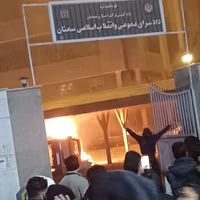
On Saturday and Sunday, hundreds of students gathered again at Tehran University and Tarbiat Modares University to protest. They submitted a list of demands to authorities, warning of further demonstrations if their concerns—including the removal of “plainclothes forces” from university campuses—were not addressed.

Students accuse authorities of neglecting their safety amid a rise in robberies near campus in recent years. Meanwhile, they criticize officials for prioritizing the surveillance of student activists and suppressing dissent instead of addressing security concerns.

During Friday’s peaceful protest, four students were arrested, and a female student was injured by one of the unidentified agents who stormed the campus. The detained students were later released.

The presidential administration took an unusually conciliatory approach, a departure from the Iranian government’s typical response. Rather than escalating force against the students, officials appeared willing to defuse tensions. This tactic can be related to current public anger at the deteriorating economic situation and the danger of widespread protests.

University official Hossein Hosseini met with the protesters and blamed the violence on vigilantes and plainclothes security agents who entered the campus without authorization.

Higher Education Minister Hossein Simaei Sarraf cut short an official visit to Saudi Arabia and returned to Iran after Friday’s protests. He later apologized to the students and pledged decisive action against unauthorized interference in university affairs.

“Certain individuals and groups are more focused on creating turmoil rather than resolving crises. These irresponsible actions, whose instigators and masterminds remain unknown, have placed a significant burden on the country,” Deputy Higher Education Minister Gholamreza Zarifian told the reformist Etemad Online, referring to the unrest triggered by Friday’s violence against students.

A law passed by Parliament in 2000, during the presidency of reformist Mohammad Khatami, prohibits police and other security forces from entering higher education institutions except under “extraordinary circumstances” and only with the university dean’s request and the Higher Education Minister’s approval.

One of the dormitory rooms destroyed by vigilantes and security forces during the 1999 student protests
100%
One of the dormitory rooms destroyed by vigilantes and security forces during the 1999 student protests

This legislation followed the 1999 student protests, which began on July 7 at Tehran University. Students had initially gathered peacefully outside their dormitories to protest the closure of Salam, a reformist newspaper. Some later moved their protest outside the campus before returning to their dormitories without any incidents.

That night, riot police, the Revolutionary Guards’ Basij militia, and vigilante groups raided the student dormitories, attacking sleeping students indiscriminately. They destroyed rooms and personal belongings, and in a tragic incident, one student was thrown to his death from an upper floor. A similarly violent raid occurred at Tabriz University dormitories two days later.

Known as the Kuy-e Daneshgah Disaster, these events sparked days of protests and unrest in Tehran and other major cities. Demonstrators marched toward Supreme Leader Ali Khamenei’s office in Tehran, chanting slogans against him.

Security forces responded with a brutal crackdown, killing at least three people, injuring over 200, and arresting hundreds more. Many detainees spent years in prison as a result of the protests.

The 1999 university unrest set a precedent for future anti-government protests in 2009, 2017, 2018, 2019, and 2022. This history may partly explain the Iranian authorities' apparent reluctance to use force against university students.

Most Viewed

The Hormuz get out of jail card turned to a grave
1
OPINION

The Hormuz get out of jail card turned to a grave

2

State media slam Araghchi's Hormuz tweet, say it let Trump claim victory

3
INSIGHT

How Tehran bends its own red lines to boost state rallies

4
PODCAST

Too early to tell who is winning Iran war, experts say

5

Three charged over attempted arson at Iran International office in London

Banner
Banner

Spotlight

  • 100 days after carnage: Iran economy reels from war, inflation, unemployment
    INSIGHT

    100 days after carnage: Iran economy reels from war, inflation, unemployment

  • The Hormuz get out of jail card turned to a grave
    OPINION

    The Hormuz get out of jail card turned to a grave

  • Too early to tell who is winning Iran war, experts say
    PODCAST

    Too early to tell who is winning Iran war, experts say

  • How Tehran bends its own red lines to boost state rallies
    INSIGHT

    How Tehran bends its own red lines to boost state rallies

  • Iran blackout cripples freelancer, small business incomes
    VOICES FROM IRAN

    Iran blackout cripples freelancer, small business incomes

  • Ideology may be fading in Iran, but not in Kashmir's ‘Mini Iran'
    INSIGHT

    Ideology may be fading in Iran, but not in Kashmir's ‘Mini Iran'

•
•
•

More Stories

Exiled prince calls for unity among Iran’s opposition

Feb 16, 2025, 14:04 GMT+0

Exiled Iranian prince Reza Pahlavi called for unity and democratic engagement among opposition forces during a meeting in Munich on Sunday.

“Our goal today is solely to save Iran, and in the future, our mission is to enable free elections,” Pahlavi said, emphasizing pluralism and the rejection of divisive behavior.

“Escalation, radicalization, and reactionary leadership will not help this movement—in fact, they could even contribute to its polarization.”

His remarks followed the cancellation of his planned speech at the Munich Security Conference, a decision confirmed by conference organizers after consultations with the German government.

The German Foreign Ministry said it had communicated with the MSC but maintained that the decision was made independently.

A source told Iran International that Berlin feared Pahlavi’s presence could jeopardize German dual-national prisoners held in Iran.

The cancellation sparked protests outside the conference venue on Saturday. Demonstrators chanted slogans in support of Pahlavi and condemned the MSC’s decision.

Addressing his supporters, Pahlavi called for calm. “We must disavow divisive elements. Profanity, threats, and any form of undemocratic behavior have no place in this struggle,” he said.

“Chanting the slogan King Reza Pahlavi contradicts the idea of having the right to choose the type of government in the future."

Iran left behind by Turkey, Saudi Arabia in Syria, says hardline paper

Feb 16, 2025, 13:42 GMT+0

Hardline Iranian newspaper Farhikhtegan has criticized the country's foreign policy establishment for being left behind in Syria as regional rivals gain power in Tehran's former outpost.

The paper argued in an article on Sunday that Iran's "clichéd diplomacy" has left it weak as Turkey and Saudi Arabia gain ground.

"If our country doesn't take immediate action to disrupt Turkey's plan in Syria, Iran's name will be removed from the list of influential actors in Syria's developments, and Saudi Arabia will turn itself into another Turkey in this arena," the newspaper wrote.

The paper lambasted the Foreign Ministry's approach, describing it as disappointing and lacking any urgent action plan to secure Iran's national interests.

"In the midst of this heavy diplomatic battle...the approach that the Iranian diplomatic apparatus has taken seems disappointing," the article stated.

Farhikhtegan pointed to what it sees as a key miscalculation. "Iran is waiting to see how the new Syrian side will behave," the paper said, referring to an earlier statement from a government official.

The article further highlighted Turkey's proactive engagement with the new Syrian government, contrasting it with what it called Iran's passivity. It also highlighted the growing influence of Saudi Arabia and the UAE in the region, suggesting they are capitalizing on Iran's inaction.

The paper concluded with a stark warning: "It seems that the procrastination of Iranian diplomacy...is closing this window [of opportunity]."

It urged a strategic shift, including engagement with Saudi Arabia and the UAE, to counter Turkish influence and reclaim Iran's stake in Syria's future after years of building itself in the country alongside ousted President Bashar Al Assad.

On Saturday, a foreign ministry official said Tehran was in indirect talks with Syria’s new government. “We are monitoring the developments in Syria with deliberation and patience and will make our specific decision when the time is right,” Mohammadreza Raouf Sheibani, Iran’s special representative for West Asia, said in an interview.

He confirmed recent remarks of Syrian Foreign Minister Asaad Hassan al-Shibani about an exchange of positive messages between Tehran and Damascus following the overthrow of Assad’s government in December.

Iran and Russia, Assad’s main backers during the brutal conflict that began in 2011, played key roles in maintaining his grip on power until a rapid rebel offensive last December forced him into exile in Moscow. Since then, both countries have sought to maintain influence in Syria while navigating the new political landscape.

Iran, which invested heavily in Assad’s survival—reportedly spending at least $30-$50 billion—now faces the challenge of recalibrating its strategy. Supreme Leader Ali Khamenei has vowed on multiple occasions to reclaim Iran’s influence in Syria.

Iran urges regional ownership of Indian Ocean

Feb 16, 2025, 09:39 GMT+0

Iran says the future of the Indian Ocean must be decided by its own nations rather than shaped by external powers as Tehran tries to gain further control in the key waterway on its southern coast.

“We cannot allow global geopolitical rivalries to determine the future of this region,” said Foreign Minister Abbas Araghchi at the 8th Indian Ocean Conference in Muscat on Sunday.

He said that some extra-regional actors are exploiting political and security vulnerabilities to disrupt natural cooperation between nations in the region.

“Decisions about the fate of the Indian Ocean must be made by the countries in the region and for the benefit of its people.”

For centuries, the Indian Ocean region has been an important trade arena, stretching from Africa’s eastern coast to Australia’s western coast. It remains critical today for the security and stability of shipping lanes and trade routes.

According to the Carnegie Endowment for International Peace, the area, home to 33 nations and 2.9 billion people, accounts for over one-third of the world’s bulk cargo traffic and two-thirds of the world’s oil shipments and ensures global access to food, precious metals, and energy resources.

Araghchi also spoke about the strategic significance of Iran’s southern coastline, describing the Makran coast as an opportunity that must evolve into an economic hub for both Iran and the region.

Last month, Iran’s government spokesperson announced an ambitious plan to relocate its capital to the southern coastal region of Makran, aiming to address Tehran’s persistent issues of overpopulation, power shortages, and water scarcity. However, the proposal was later denied following extensive criticism.

Araghchi also added that Tehran plays a significant role in combating piracy, drug trafficking, and other threats to trade routes insisting that regional security should be maintained through cooperation among Indian Ocean countries.

His comments of promoting maritime security are contested by incidents like the 2019 tanker attacks near the Strait of Hormuz -- attributed to Iran by the US, UK and Saudi Arabia -- and its seizure of vessels such as the Stena Impero in 2019 and Hankuk Chemi in 2021, which were seen as politically motivated.

Iran-backed Houthis of Yemen are behind most of the attacks on ships in the Red Sea, while Tehran has time and again threatened to close the Strait of Hormuz. Iran was also implicated in incidents like the Israeli-owned Mercer Street tanker attack in 2021.

Iranian politicians, media say talks depend on Trump’s tone

Feb 16, 2025, 09:35 GMT+0

Some Iranian politicians and media are attempting to soften Iran’s stance on negotiations with the United States after Supreme Leader Ali Khamenei’s rejection of talks, framing it as a call for President Donald Trump to change his public tone.

Meanwhile, several politicians and commentators have maintained a defiant stance, while others, including President Pezeshkian, have remained in denial about the talks, insisting they can address Iran's problems without the need to lift sanctions.

For the second time in less than a week, Jomhouri Eslami—a daily linked to Khamenei's office but often critical of hardline policies—argued in a February 15 article that negotiations between Tehran and Washington remain possible if Trump moderates his tone toward the Islamic Republic.

The daily accused Trump of "naivety," stating, "The responses he received from Iranian officials should have shown him that arrogant rhetoric does not work with Iran." It also addressed Trump directly, asserting, "Iran is not opposed to negotiations—it is opposed to blackmail."

Meanwhile, former Justice Minister and security official Mostafa Pourmohammadi told Entekhab news website on February 15 that "Khamenei has never forbade negotiations with the United States." However, this statement was in a clear and sharp contrast with Khamenei's latest remarks.

Pourmohammadi commented, "Khamenei has never closed the door to negotiations. On the contrary, it is US officials who want to portray Iran as unwilling to negotiate. In reality, we are a rational state with a strong foundation and an educated nation always ready for dialogue with the world."

Elsewhere in the interview, he contradicted himself, saying, "We would never negotiate with arrogant individuals who first slap us in the face and then say, 'Let's kiss and talk.'" His remarks closely echoed Pezeshkian’s February 10 speech on the anniversary of the 1979 revolution, where he dismissed negotiations with Trump and called his behavior "unmanly."

The conservative Nameh News website quoted ultraconservative commentator Foad Izadi, frequently presented by Iranian state TV as a US politics expert, as saying, "Trump will attack Iran if he believes the cost will be low or manageable. However, if he sees that such an attack would come at a high price, he will never go through with it."

Nameh News described Tehran and Washington as being at a historic turning point in their relations. The outlet noted that Pezeshkian had hoped to engage in talks with Trump under the conditions set by his administration in 2018. However, Trump’s latest stance—implying that Iran could avoid Israeli airstrikes if it agreed to negotiate—has left Tehran in a state of uncertainty.

The Iranian Labor News Agency (ILNA) quoted Iran's security chief, Ali Ahmadian, as saying that Iran has no ideological opposition to negotiating with the United States. However, he asserted that Tehran refuses to engage with Washington due to its "arrogant behavior" before and during the 2015 nuclear negotiations, as well as its failure to uphold commitments after the deal was reached.

Meanwhile, some Iranian politicians and commentators, including conservative figure Nasser Imani, have advocated strengthening ties with China and Russia instead of engaging with the United States. The Rouydad24 website quoted Imani as saying, "There is no point in making a deal with America. We have to pivot toward China and Russia."

At the same time, Ahmad Bakhshayesh Ardestani, a member of the parliament's national security committee, addressed US concerns over Iran’s potential nuclear weaponization. In what appeared to be support for developing nuclear weapons, he stated, "Whether we have a bomb or not, US sanctions will continue." However, echoing moderate politicians and media, Ardestani added, "We will negotiate with America if Trump adopts a softer tone and rhetoric."

Iran arrests father of slain judges’ assassin for alleged complicity

Feb 15, 2025, 21:30 GMT+0

Iran's Ministry of Intelligence agents have arrested the father of the assailant who killed two Supreme Court judges notorious for human rights violations in Tehran in January, Iran International has learned.

According to sources familiar with the case who spoke to Iran International on condition of anonymity, the Ministry of Intelligence has accused the father of conspiring with his son in the assassinations.

The assailant, whose identity remains undisclosed, had 10 years of experience working within the Supreme Court before allegedly taking his own life while being pursued by security forces.

Supreme Court judges Ali Razini and Mohammad Moghiseh were gunned down in their offices in a secure government building.

In the aftermath, Iranian security forces launched a widespread crackdown, arresting several former political prisoners. One such detainee is Bijan Kazemi, a former political prisoner whose home was raided on January 21.

All electronic devices belonging to Kazemi and his family were confiscated, and he was transferred to Ward 209 of Tehran's notorious Evin Prison. A source close to the matter revealed to Iran International that Kazemi is being tortured in an attempt to force a confession that he provided the weapon used in the assassinations.

Kazemi, who had previously served two years in prison after a 2020 arrest due to alleged ties with the Mojahedin-e Khalq (MEK), has been subjected to beatings by Intelligence Ministry agents. The MEK has been repeatedly blamed by Iranian authorities for orchestrating attacks against Tehran authorities, including this high-profile assassination.

Both Razini and Moghiseh were infamous for their harsh rulings against political dissidents, particularly during the 1988 mass executions of political prisoners. Critics had long referred to them as the "hanging judges" due to their roles in issuing death sentences during the regime's brutal crackdowns.

The assassination of the two judges has sent shockwaves across the country, particularly among former political prisoners who have recounted their encounters with the judges' severe punishments.

Despite multiple arrests, including that of Kazemi, the Islamic Republic has provided conflicting narratives about the motive and details of the attack. Authorities such as Ebrahim Rezaei, the spokesperson for the National Security Commission, and Jafar Ghadiani, the Disciplinary Prosecutor for Judges, have pointed fingers at the MEK. However, the lack of transparency and the use of torture to extract confessions have cast doubt on these claims.