President Pezeshkian expressing respect to Supreme Leader Ali Khamenei.
Since his election, President Masoud Pezeshkian has faced attacks from hardliners, and now Reformist allies warn he could lose more public support if he fails to ease hardships from US sanctions.
Reformist figures, including political commentators Abbas Abdi and Ahmad Zeidabadi, have repeatedly urged Pezeshkian to initiate negotiations with the United States to ease or lift sanctions. Calls for diplomacy grew louder in the media after US President Donald Trump stated earlier this week that he was ready to meet his Iranian counterpart.
This may shift after Khamenei’s February 7 speech, where he rejected talks with Washington and warned that Iran would respond to threats in kind. A relative media blackout in Iran on Friday suggested a changing landscape. Still, warnings to Pezeshkian remain relevant.
In one of the latest warnings, Abdi wrote in Etemad newspaper that Pezeshkian risks losing public trust if he fails to uphold his promises. Citing an example, Abdi noted that Pezeshkian has yet to deliver on his pledge to lift internet restrictions. He warned that "soon, Iranians will no longer need filter-breakers (VPNs), thanks to Elon Musk’s help."
Abdi also noted that "public trust in Pezeshkian’s administration was low from the outset, as many believed that meaningful change was unlikely under the current political structure. They were convinced that achieving anything effective was nearly impossible."
In Iran, references to phrases like “the current political structure” are widely understood to imply that Khamenei, as the ultimate decision-maker, opposes opening up to the West and abandoning his nuclear ambitions.
Ahmad Zeidabadi, Iranian commentator authorized to appear in the media
Two weeks ago, when Khamenei appeared to signal approval for talks with Washington, Zeidabadi criticized Pezeshkian for his inaction. "What are you waiting for? Why don’t you pick up the phone and call Trump?" he asked. Zeidabadi was not alone—many centrist and pro-reform politicians in Iran also urged Pezeshkian to take the initiative and reach out to Trump.
With Khamenei's hardline stance, calls for rapprochement with Washington are unlikely to persist, at least for now. However, since Khamenei cannot be openly criticized or challenged, the press and politicians will likely shift back to blaming the Pezeshkian administration for inaction and inefficiency in improving people's lives.
Even in his Friday speech, Khamenei assigned Pezeshkian the task of fixing the country's economic problems—as if unaware that without resolving Iran’s biggest foreign policy issue with the United States, any economic improvement is unlikely. This has been evident since 2018 when Trump withdrew from the nuclear deal after Tehran refused to address broader US concerns over its regional activities.
Abbas Abdi in turn called on Pezeshkian "to be honest with the people as honesty is the only remedy for distrust."
The challenge for Pezeshkian is that he cannot openly admit to the public that his ability to fix the economy is severely limited or point to Khamenei’s hardline stance as the root of their hardships.
According to Etemad in its introduction to Abdi’s article, "public trust in Pezeshkian has significantly declined since September, and his popularity has suffered due to his failure to fulfill his promises." Abdi warned that "if Pezeshkian cannot deliver meaningful progress by the Iranian New Year in late March, he will have little time to recover what he has lost."
Abdi and several other commentators argue that Pezeshkian has raised public expectations for lifting sanctions and improving the economy, making it his biggest challenge alongside ongoing energy shortages. Etemad reported that "a September poll found that 59 percent of Iranians considered lifting sanctions their top priority."
Since Tehran’s media is unlikely to criticize Khamenei for his hardline speech on Friday, state television instead praised him and his threats against the United States. Meanwhile, print media is left with only one option—criticizing Pezeshkian while avoiding any mention of Khamenei’s role in the economic crisis.
This comes as hardline former Interior Minister Abdolreza Rahmani Fazli told the press on Friday that "Iran's situation is currently far more complicated than in November 2019," when one of the largest protests in the country's history left around 1,500 dead, according to some reports.
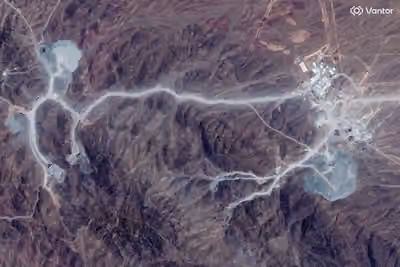
Iran says it has officially launched the production line for Iridium Hexafluoride (IR46) at the Shahid Raeisi Nuclear Site in Isfahan (UCF site) on Saturday amid US pressure to curb Iran's nuclear program.
Iridium Hexafluoride (IR46) has multiple applications, including in brachytherapy (internal radiotherapy), low-dose medical radiography, and the production of IR192, which serves as a substitute for cobalt-60 (Co-60) in radiotherapy, according to state news ISNA. Additionally, Iran says IR192 is widely used as a radiography source, particularly in the oil and gas industries, non-destructive testing (NDT), and radiobiology research to study the effects of radiation on living tissues.
With the successful production of IR46, Iran says it joins a select group of countries possessing this advanced technology, opening possibilities for exporting the product to other nations.
Mohammad Eslami, the Head of the Atomic Energy Organization of Iran (AEOI), visited Isfahan on Saturday to inaugurate several key projects, including the Iridium Hexafluoride (IR46) production line, a comprehensive technical safety testing facility, a semi-industrial sintering furnace for fuel pellets, and a resistance welding (RW) machine at the Shahid Raeisi Nuclear Site.
A poster announcing the official launch of the Iridium Hexafluoride (IR46) production line at the Shahid Raeisi Nuclear Site in Isfahan (UCF site).
The Trump administration has reinstated its "maximum pressure" policy on Iran, emphasizing that sanctions will remain unless Tehran agrees to a new deal with the US.
Under pressure for uranium enrichment and alleged secret nuclear activities, Iran always insists that its nuclear program is only for peaceful purposes and scientific advancement.
While President Trump has expressed openness to negotiations, Iran's Supreme Leader Ali Khamenei firmly rejected the idea, calling talks with Washington unwise and dishonorable. Khamenei criticized the US for withdrawing from the 2015 nuclear deal, labeling it an act of betrayal. Despite Trump's stated desire for peace, he remains committed to preventing Iran from acquiring nuclear weapons, maintaining a hardline stance unless a new agreement is reached.
US President Donald Trump's policy on Iran is a muddle lacking any coherent strategy, his former national security advisor John Bolton told Iran International’s Eye for Iran podcast, speaking after Trump pulled his security detail despite an alleged death threat from Tehran.
“This is just typical Trump confusion,” Bolton said. “He doesn't he doesn't have a philosophy. He doesn't do grand strategy. He doesn't pursue policy in the way most people understand those terms. It's a lot of conflicting things that exist simultaneously in his mind.”
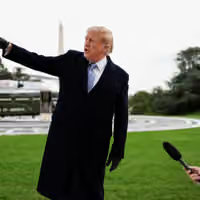
On the same day Trump reinstated the so-called maximum pressure campaign of his first term to cut Iran’s oil exports to zero, Trump expressed willingness on Tuesday to negotiate for a "verifiable agreement" to prevent Iran from acquiring nuclear weapons.
During the signing of the sanctions directive, Trump even said he was reluctant to enforce tough measures on Iran.
“This is one that I’m torn about,” he told reporters. “Everybody wants me to sign it. I’ll do that. It’s very tough on Iran.”
Some Iran analysts have viewed Trump’s conflicting statements as part of signature deal making style aimed at keeping adversaries off balance.
“Trump shifts between veiled threats, economic pressure, and conciliation with Iran’s regime. It keeps Tehran on its toes and is part of his style of coercive diplomacy,” wrote Jason Brodsky, the policy director for United Against Nuclear Iran (UANI) on X.
Iran's mixed messaging to Trump
But Bolton believes Trump would do anything to appear a master negotiator.
“I think there's a risk with Trump that he'd negotiate anything with anybody,” said Bolton, "The idea that he believes he's the best dealmaker in the world - he wrote a book called The Art of the Deal - is something that should trouble us because he doesn't really understand fully what's at stake here."
Iran’s leadership has seemingly responded to Trump's overtures with mixed messages.
Iran’s Foreign Minister Abbas Aragchi said on Wednesday that Trump’s demand for a halt on its nuclear ambitions is within reach.
But after Trump floated nuclear talks, Supreme Leader and Ayatollah Ali Khamenei responded with deep skepticism on Friday, saying negotiations with Washington “are not intelligent, wise or honorable."
Iran has still not explained its past secret nuclear activities. A recent report by the New York Times citing unnamed US Intelligence alleges that a secret team of Iran's scientists are exploring faster ways to develop an atomic weapon.
The race to potentially get a nuclear bomb is closer than ever as the country has been ramping up production of fissile material in recent years.
According to an International Atomic Energy Agency (IAEA) report from Dec. 6, Iran’s monthly production of uranium enriched to 60 percent. At that rate, Tehran would likely be able to produce the amount of enriched uranium needed for a bomb in less than a week.
The Zeal for the Deal
Serving as Trump’s national security adviser during his first term has given Bolton a window not only into the president's style but the intimate details of Iran's nuclear progress.
Iran cannot be trusted, argued Bolton, pointing to Tehran and North Korea’s alleged cooperation on the nuclear front.
“We know North Korea has cooperated with Tehran on things like the nuclear reactor in Syria that was destroyed by the Israelis in 2007," said Bolton.
"There's been cooperation in the ballistic missile work because they're both using the same Cold War era Soviet Scud missile technology. The risk that there's that there's cooperation that we have not uncovered, I think is something we need to be concerned about.”
While Bolton question's Trump's appetite for a deal, he also feels that Trump would not be fooled by the Iranian establishment's so-called charm offensive.
Iran's Vice President for Strategic Affairs, Javad Zarif, has again sought to promote a softer image of the Islamic Republic while advocating a path to diplomacy.
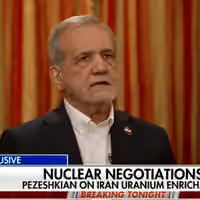
In a recent interview with NBC news, President Masoud Pezeshkian said he was willing to negotiate with the European Union and United States, while denying allegations that Iran had sought to kill Trump.
“Iran has never attempted to nor does it plan to assassinate anyone,” Pezeshkian told NBC, just months after the US Department of Justice charged an Afghan national they say was tasked by Iran to kill Trump with an alleged murder-for-hire plot.
The Islamic Republic's outreach is risky and aims only at relief from US-led sanctions, in Bolton's view.
"I think that's one reason they want to try to get another nuclear agreement in place so that they can get off the sanctions that violate the agreement and proceed to nuclear weapons. The idea, obviously, is to have the best of both worlds," said Bolton.
Trump was not deceived by the Iranians during his first term as president, added Bolton, who says he hopes Trump will again not be swayed by Iranian assurances.
The German Institute for Global and Area Studies (GIGA) canceled a Berlin event featuring Iranian-American analyst Trita Parsi, citing security concerns after public backlash over his participation.
"Protests against the program have forced us to postpone, as we feel unable to guarantee the security of the event and panel members," GIGA said in a statement.
Parsi is accused by some dissidents and opponents of the Islamic Republic of furthering Tehran's policy narratives in the West.
An Iran International investigation in 2023 linked him and other oft cited analysts as being a part of a grouping formed by the Iranian government with the aim of advancing its perspectives on nuclear talks in the run-up to an international deal in 2015.
GIGA had planned to host the event on Feb. 17 where Parsi was to discuss a recent report on the prospects of multilateralism from the Quincy Institute, where Parsi is the executive vice president.
Following the announcement of Parsi as a speaker, a petition launched on Monday demanding that GIGA rescind his invitation gathered over 4,800 signatures within four days before the event was canceled.
Political activists and opponents of the Islamic Republic had also taken to social media to protest Parsi’s participation, accusing him of lobbying for Tehran and calling for institutions to prevent figures associated with the Iranian government from attending research conferences.
Some protesters had warned they would stage demonstrations outside the event venue if it was not canceled.
"We share the concerns of many protesters about the authoritarian government in Iran and its regional role, but neither the role of Iran or any other specific country was the topic of this event," GIGA added it its statement.
No new date has been announced for the rescheduled event.
This is not the first time Parsi has taken part in GIGA’s events. In 2024, he spoke at two online discussions hosted by the institute, where he addressed topics such as the future of Iran’s allied forces in the Middle East and the Israel-Hamas war.
Swedish broadcaster TV4 recently reported that Parsi’s brother, Rouzbeh Parsi, head of the Middle East program at Sweden’s Foreign Policy Institute, was linked to a network within Iran’s foreign ministry that sought to influence Western policies.
In 2023, a joint investigative report by Iran International and Semafor uncovered thousands of emails from Iranian diplomats, exposing a network of academics and think tank analysts cultivated by Iran's Foreign Ministry to advance Tehran's soft power agenda.
This network, known as the Iran Experts Initiative (IEI), was reportedly directed by the Foreign Ministry in shaping public commentary and media appearances. Members of the IEI held influential positions in Western think tanks and policy institutions, playing a pivotal role in promoting Iran's viewpoints on the global stage.
The economic impact of the so-called maximum pressure on Iran will be significant, with a zero-exports goal set by US president Donald Trump.
On Tuesday, Trump signed a directive reinstating the "maximum pressure" policy from his first term, warning of "catastrophic" consequences if Tehran doesn't reach a deal on its nuclear program. His goal of eliminating Iran’s oil exports is particularly alarming for Tehran, as it would eliminate nearly half of the government's revenues during a seven-year economic crisis.
In its first move, the US Treasury Department on Thursday imposed sanctions on an international network, alleging that it has facilitated the shipment of Iranian oil to China. In a coordinated step, the Treasury and State Departments announced sanctions targeting networks involved in shipping Iranian oil to China. The measures cover multiple countries, including China, India, and the United Arab Emirates, and affect several vessels linked to Iran's oil exports.
While the impact of this order, if fully implemented, would be significant for Iran’s oil exports, there is doubt as to whether it will actually reduce the oil exports to zero or to the levels seen in 2020, the final year of Trump's previous presidency. In 2017, before US sanctions were imposed, Iran exported 2.5 million barrels per day (bpd). By 2020, this figure had plummeted to around 350,000 bpd.
As Joe Biden took office in 2021, Iran’s oil exports rebounded, peaking at nearly 1.9 million bpd in the summer of 2024. After President Biden administration’s imposed sanctions on dozens of tankers involved in smuggling Iranian oil, exports dropped by 500,000 bpd in the final quarter of 2024.
Yet, in January this year, exports once again surged to 1.6 million bpd.
The ship-tracking company Tanker Trackers told Iran International that the recent fluctuations in Iran’s oil exports are typical, noting that such variations are common. "We saw a similar drop during the final months of Biden's presidency, followed by a rebound. There's nothing unusual about it. The average for crude oil exports over the past year is 1.572 million barrels per day, and since January, it has been 1.567 Mbpd. So, it's too early to draw conclusions," the company said.
Iran's Kharq Island in the Persian Gulf is the main loading point for Iranian oil.
Regarding Iran's logistical challenges, Tanker Trackers explained, "There are policies, and then there are logistics. We’re not yet convinced that Iran’s oil exports will drop to the levels seen in May 2019 (439 Kbpd), mainly because there wasn’t an extensive global dark fleet available back then, unlike what we have today."
The United Against Nuclear Iran (UANI) organization, a non-profit group dedicated to preventing Iran from acquiring nuclear weapons, in collaboration with tanker-tracking companies, has identified nearly 400 vessels involved in smuggling Iranian oil, collectively known as the "dark fleet." However, fewer than half of these vessels have been sanctioned.
These tankers attempt to smuggle Iranian oil covertly by turning off their automatic identification systems (AIS).
Currently, China is virtually Iran’s only oil customer. However, it does not purchase oil directly from Iran. Instead, Iranian oil is sold through intermediaries and changes ownership documentation, being rebranded as oil from Iraq, the UAE, Oman, and especially Malaysia before being sold to China’s small, independent refineries.
Tanker Trackers noted that China has already stated repeatedly that importing oil is a matter of national security, regardless of the source.
Meanwhile, the energy consultancy firm Wood Mackenzie told Iran International that the recent drop in Iranian crude oil exports is due to a combination of tighter sanctions on tankers imposed by former President Biden and China’s Shandong port declaring that sanctioned vessels will not be allowed to discharge their cargoes to independent refinery clients.
Wood Mackenzie said that given the recent US sanctions on China and Beijing’s retaliatory tariffs, we do not expect China to comply with Trump’s ‘maximum pressure’ policy on Iran.”
Senior commodity analyst Homayoun Falakshahi from Kpler, a commodities intelligence firm, told Iran International that Iran’s daily oil exports stood at 1.66 million bpd last month. However, he predicted that due to the reinstatement of Trump’s maximum pressure policy, exports could fall to around 500,000 bpd in the coming months.
He added that the extent of this decline depends on Beijing’s cooperation with US sanctions.
China and the US conduct $750 billion in annual commodity and service trade, heavily favoring China. However, Trump recently ordered an increase in tariffs on Chinese imports, prompting Beijing to threaten retaliation.
While China has repeatedly stated that it does not recognize US unilateral sanctions against Iran, its recent ban on US-sanctioned vessels docking at its ports suggests that it takes Washington’s sanctions somewhat seriously.
Iran’s share of China’s oil imports exceeds 10%, with an annual value of around $40 billion. China is also the largest buyer of sanctioned Iranian goods, including metals and petrochemical products. Additionally, a significant portion of Iranian refined petroleum products, such as fuel oil (mazut) and liquefied petroleum gas (LPG), is shipped to China.
Iranian customs data shows that, excluding crude oil, the country exported $12.3 billion worth of goods to China and imported $14.4 billion from China in the first ten months of the current Iranian calendar year (which began on March 21, 2024).
The Ham-Mihan newspaper in Tehran has cautioned President Masoud Pezeshkian that delaying a response to US President Donald Trump for direct talks would be more detrimental than making a poor decision.
Pezeshkian has downplayed the importance of the memorandum that Trump signed on Tuesday to intensify sanctions enforcement by reducing Tehran's oil exports to zero. However, Trump also expressed a wish to hold direct talks with his Iranian counterpart and preferably reach an agreement rather than activate maximum pressure measures.
The Iranian president argued that sanctioning a country which has many neighbors and friends would not be easy and expressed confidence that "Iran could overcome its difficulties with everyone’s help and the wisdom of the Leader of the Revolution.”
"They believe our economy depends entirely on oil and aim to block our exports, but there are many ways to counter their efforts," Pezeshkian said Wednesday. However, he has previously acknowledged on multiple occasions that Iran's economy would suffer significantly if sanctions remain in place.
On Thursday, he also reiterated that proving that Iran's nuclear program is peaceful would be an easy task.
“These statements will not solve any problems,” Ham-Mihan wrote in an editorial titled “Delayed Decision Worse Than Making a Bad Decision. ” The paper urged Pezeshkian to clearly announce Iran’s position by Friday, after securing the Supreme Leader’s agreement and approval.
“Otherwise, we will be paying the costs of a ‘delayed decision’ which would be higher than the cost of making a ‘bad decision’," the editorial stated, arguing that the future of Iran-US relations could only be evaluated once Iran announces a final and official decision.
Several other reformist media outlets on Thursday similarly stressed the importance of seizing the opportunity to avoid further economic strain and escalating tensions. The moderate-conservative news website Asr-e Iran also echoed the need for decisive action in an editorial titled “Mr. Pezeshkian, Call Trump.”
The piece argued that the best response to Trump’s overtures would be for Pezeshkian to initiate a direct phone call to discuss a potential deal, focusing solely on the nuclear issue. The editorial emphasized that Trump likely expects a prompt response.
Hardline media such as Kayhan and the Revolutionary Guards-linked Javan, however, have staunchly rejected any direct talks with the Trump administration as before.
Trump’s approach and US Policy
Trump has extended multiple overtures to Iran, including dismissing rumors of a joint US-Israel military strike as “greatly exaggerated.” He expressed his preference for a "Verified Nuclear Peace Agreement," which he claims would allow Iran to grow and prosper peacefully.
However, a White House fact sheet released Tuesday, after Trump signed a National Security Presidential Memorandum (NSPM) reinstating maximum pressure on Iran, outlined a stringent policy. The NSPM mandates that Iran must be denied nuclear weapons and intercontinental ballistic missiles, its terrorist networks neutralized, and its development of missiles and other weaponry curbed.
Trump has also said he does not care who takes the first step to begin negotiations despite other people’s advice to let Iranians be the ones who reach out to the US.
Criticism of vague messages
Ham-Mihan also criticized government officials for sending vague messages including the government spokeswoman, Fatemeh Mohajerani’s vague statement that Iran's position would be decided based on the principles of “dignity, wisdom, and expediency”.
Vice-President Mohammad-Reza Aref also said on Wednesday that engaging in talks with Trump is not currently on Iran's agenda although a meeting between “two human beings” is not impossible.
Experts’ opinions
Speaking to the reformist Shargh daily, Kourosh Ahmadi, a former Iranian diplomat to the UN, noted that Trump’s decision to sign a memorandum rather than issuing a new executive order reflects an effort to pressure Iran into negotiations. Ahmadi described this as a small window of opportunity for Iran to reach an agreement before the full effects of maximum pressure measures take hold.
Abolghasem Delphi, Iran’s former ambassador to Serbia, also urged the government to act swiftly. He advocated for practical steps to initiate talks with both Europe and the United States. Delphi observed that while Trump’s current focus is on the nuclear issue, he may adopt a similar framework to address other contentious topics in the future.