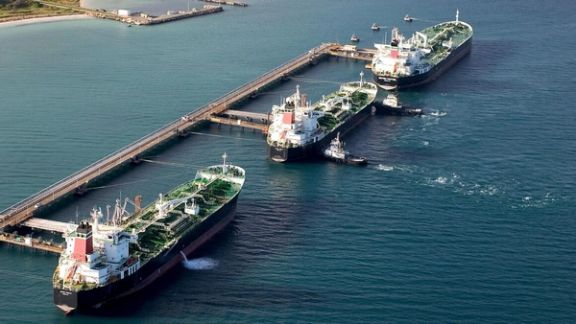
The cost of shipping oil from the Middle East to China surged by over a third in the wake of new US sanctions targeting 183 tankers carrying Russian and Iranian oil on Friday, according to a Reuters report.
Freight rates for very large crude carrier (VLCC) tankers capable of carrying 2 million barrels of oil on the route hit $37,800, marking a 39% rise compared to last Friday.
The increase reflects a determination by China, the world's top oil importer, to avoid sanctioned tankers and buy up oil from Arab exporters unburdened by sanctions.
The US Treasury Department on Jan. 10 sanctioned 183 tankers transporting Russian oil to China and India.
At least eight were also involved in carrying sanctioned Iranian oil.
Last year, the US sanctioned 139 tankers carrying Iranian oil and more than 100 tankers were also blacklisted in the previous years. However, nearly 500 tankers in total are involved in smuggling Iranian oil, according to advocacy group United Against Nuclear Iran.
Around half of the "dark fleet" carrying Iranian oil has been added to the US blacklist in recent months, senior analyst at commodity intelligence firm Kpler Homayoun Falakshahi told Iran International, presenting Iran with logistical challenges in transporting oil to its top customer by far, China.
The new sanctions targeting tankers are likely more problematic for Iran than for Russia. Russia is permitted under US and EU sanctions to export oil below the $60 price cap and can even insure these exports through Western companies and use European tankers to deliver oil to China and India.
US sanctions allow no such exception for Iran, which is prohibited from selling oil at any price.
Still, the Shandong Port Group - operator of the largest oil terminals receiving Iranian, Russian and Venezuelan oil - banned the entry of US-sanctioned tankers last week.
Iran's daily oil exports to China have fallen by about half a million barrels over the past three months compared to previous months, reaching 1.3 million barrels, Kpler’s data shows.
Just over a third of around 669 tankers transporting Russian, Venezuelan and Iranian oil are subject to some form of Western sanctions, Lloyd’s List Intelligence reported.
•
•
Most of these aging tankers, managed by non-Western companies, operate clandestinely by turning off their automatic identification systems (AIS) to smuggle oil to markets in India and China. Many of these vessels are linked to Iranian oil smuggling operations.
During last year, Shandong ports received 1.74 million barrels per day of oil from Iran, Russia, and Venezuela, accounting for nearly a fifth of China’s total oil imports, according to Kpler.
The total volume of Iranian oil unloaded at all Chinese ports last year was around 1.46 million barrels per day, it added.
Chinese refineries have resorted to more buying from Europe, Africa and Arab states in response to the sanctions, Reuters reported citing oil trade sources.
The price of the OPEC oil basket, which largely reflects oil from Persian Gulf’s Arabic states, has surged by $4 in recent days to about $82, signaling rising demand for their oil in Asian markets.
The head of Iran's Red Crescent Society said that the United States requested financial assistance from Iran to combat the wildfires ravaging California.
"The US has announced that it does not need rescue teams to contain the fire and has only requested financial aid, which demonstrates their weakness and humiliation," Pirhossein Kolivand told local reporters on Tuesday.
Iran's government on Saturday expressed its preparedness to help the authorities in the United States contain the ongoing fires in California, according to the spokeswoman for the Pezeshkian administration.
Kolivand did not specify how the alleged request for financial assistance was communicated, given that the two countries have no formal diplomatic relations.
Chinese state oil companies and major private refiners are rushing to secure crude supplies as tighter sanctions on Iran and Russia threaten to disrupt near-term oil flows, Bloomberg reported on Tuesday.
According to traders cited by Bloomberg, companies such as Cnooc, Shandong Yulong Petrochemical Co, and Jiangsu Eastern Shenghong Co are urgently seeking crude, focusing on multiple grades from the Middle East, Africa, and the Americas. February cargoes are particularly in demand as refiners prepare for potential supply disruptions.
Smaller private refiners, known as "teapots", primarily based in Shandong province, are especially reliant on discounted crude from Iran and Russia. These refiners, already struggling with declining margins, may be forced to cut processing rates and fuel output if they lose access to these supplies.
Last Friday, the US Treasury sanctioned several vessels involved in transporting Iranian oil as part of a broader crackdown on Russia's network of ships used to evade US-led energy sanctions.
Donald Trump should threaten Iran with military force if it continues to advance its nuclear program, advocacy group United Against Nuclear Iran (UANI) said in a report on Monday.
The recommendation by the hawkish privately funded group founded by former diplomats was one of several broad policy proposals for the incoming administration to confront and weaken Washington's main adversary in the Middle East.
"President-elect Trump should use (a) policy speech to publicly outline in unambiguous terms that the U.S. will not hesitate to utilize military force to destroy Iran’s nuclear program if it takes steps to further advance its capabilities," UANI said in its report.
The UN nuclear watchdog said in December that Iran is accelerating its enrichment of uranium to up to 60% purity, closer to the roughly 90% level needed for a weapon.
Tehran has denied pursuing nuclear weapons, saying its program is peaceful.
UANI also recommended Trump empower Israel to be able to hit Iran's nuclear sites.
"Begin discussions with the Israeli government to transfer the GBU-57 Massive Ordnance Penetrator to Israel to enable it strike hardened nuclear targets like the Fordow Enrichment Plant, as well as lease it a B-2 bomber as a delivery vehicle."
Israel knocked out much of Iran's air defenses in an Oct. 26 series of air strikes as retaliation against an Iranian ballistic missile salvo, but its ability to neutralize Iran's nuclear activity in deep underground facilities is in doubt.
Citing Trump's 2020 decision to assassinate in Baghdad Qassem Soleimani, the chief of the Islamic Revolutionary Guard Corps's (IRGC) foreign arm the Quds force, UANI said Trump should target commanders inside Iran if Tehran harms US nationals.
"Strike IRGC commanders, Quds Force, and Intelligence Ministry assets inside Iran if the Islamic Republic harms US persons," it wrote.
The group sketched out further recommendations including encouraging defections from Iran's security forces, tightening sanctions including on Iran's Supreme Leader Ali Khamenei, carry out cyber-attacks and encourage allies to shutter Iranian banks.
A hardline Iranian lawmaker torched an Iranian government offer to help put out fires in Los Angeles, home to a sizeable Iranian diaspora population, as a waste of money.
“I am not okay with a single cent of my taxes being spent on the weak Los Angeles good-for-nothing people before it goes to Gaza,” Tehran representative Mehdi Koochakzadeh said.
His remarks were a rebuke to government spokesperson Fatemeh Mohajerani, who over the weekend offered to send firefighters to help combat blazes which have destroyed hundreds of homes and killed at least two dozen people.
“Humanity cannot remain indifferent to the destruction of homes and natural resources, whether caused by war or the wrath of nature,” she said, drawing a parallel with Gaza which lies decimates as Israel fights Iran-backed armed groups.
Koochakzadeh also took aim at two bills seeking to reduce Iran's bank blacklisting, saying they served Washington's goals.
He slammed slammed the efforts to accede to anti-money laundering conventions under the Financial Action Task Force (FATF) as tantamount to “approving servitude to America.”
The bills aim to ease banking restrictions imposed on Iran due to its placement on the FATF blacklist, which hinders the country's international banking operations.
Earlier this month, Iran's Minister of Economy announced that the Supreme Leader had authorized a review of the two key international conventions.
Abdolnaser Hemmati shared on X that relative moderate president Masoud Pezeshkian informed him of the Ali Khamenei's approval for revisiting the Palermo and Countering the Financing Of Terrorism (CFT) bills.
Koochakzadeh's comments sparked a stir within the parliamentary session, leading Speaker Mohammad Bagher Ghalibaf to intervene after Koochakzadeh’s microphone was cut off.
Ghalibaf reminded the assembly that parliament had already fulfilled its role by referring the bills to the Expediency Discernment Council, a body whose members are appointed by Khamenei to rule on disputes between the parliament and government.
“The council had a one-year period to address this issue, which has now lapsed. The government is pursuing permission for a renewed review,” Ghalibaf said.
The Expediency Discernment Council, became involved after another senior body the Guardian Council rejected the two FATF-related bills in 2017.
The FATF, a global financial watchdog created by the G7, plays a crucial role in shaping international banking policies.
Iran’s continued placement on the FATF blacklist has done serious harm to the country’s banking system, leaving it categorized as high-risk due to deficiencies in addressing money laundering, terrorism and proliferation financing.
For Iran to re-enter the international financial system, it must finalize its legislation on the Palermo and CFT conventions.
Despite efforts to join the FATF, experts such as Mohammad Khazaei, Secretary-General of the Iranian Committee of the International Chamber of Commerce, have said additional reforms will be necessary to attract foreign investment.
Iran’s pharmaceutical industry is grappling with sharp price increases born out of the weakness of Iran's currency, causing some drug costs to more than quadriple.
The increases are likely to gain pace as the government reduces foreign currency allocations for essential goods.
Newly released data from Zahravi Pharmaceutical Company illustrates the extent of the price surge.
The price of 20 milligrams of basic antibiotic Gentamicin rose from 460,000 rials to 2,366,700 rials—a 415% increase. Vitamin B12 prices climbiedby 156% from 526,000 rials to 1,355,980 rials.
Health Minister Mohammadreza Zafarghandi recently linked rising medication prices to currency fluctuations.
“Medication prices are influenced by exchange rate fluctuations and will undergo changes,” Zafarghandi said, while emphasizing the government’s commitment to supporting consumers.
“The government intends to pay the difference caused by exchange rate changes to insurance companies. This amount will be provided to them so that the price changes for medications are not paid out of people's pockets,” he added.
Despite these assurances, the impact on the healthcare system remains a growing concern. The rial has nearly a third of its value since September, making it increasingly expensive for pharmaceutical companies to import raw materials.
The 2025 budget outlined by President Masoud Pezeshkian’s administration includes a 20% reduction in foreign currency allocations for essential goods and a 35% increase in the subsidized exchange rate, further straining the sector.
Economic observers caution that government policies may place additional burdens on patients. The head of the Tehran Chamber of Commerce previously warned that securing foreign currency and local rials for production remains a challenge, particularly in sectors reliant on imports like pharmaceuticals.
Zahravi Pharmaceutical Company’s price hikes may be the first in a wave of similar adjustments across the industry, as other manufacturers are expected to follow suit. While government intervention aims to cushion the blow, the overall trajectory suggests an increasingly precarious healthcare system.
With further cuts in subsidies and rising exchange rates on the horizon, patients and providers alike face a difficult year ahead.