Iranian actress Taraneh Alidoosti barred from travel, says filmmaker

Prominent Iranian actress Taraneh Alidoosti has reportedly been blocked from traveling, filmmaker Mina Akbari said on Friday.

Prominent Iranian actress Taraneh Alidoosti has reportedly been blocked from traveling, filmmaker Mina Akbari said on Friday.
Filmmaker Mina Akbari reported on X that Alidoosti was planning to travel to Qeshm Island with her daughter when she discovered her national ID code had been blocked for all flights.
Akbari quoted Alidoosti as saying, "Have you ever seen anything like this?" adding, "Yes; this is Iran."
This incident comes after Alidoosti's previous arrest and subsequent defiance of mandatory hijab laws.
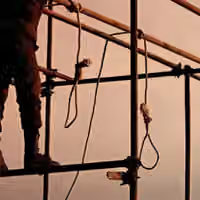
Alidoosti, a well-known figure in Iranian cinema and theater, was arrested in November 2022 after publicly protesting the execution of Mohsen Shekari, a young man arrested during the Woman, Life, Freedom protests. She was released on bail after approximately one month in detention. Upon her release from Evin Prison, she notably appeared without a headscarf, openly defying Iran's compulsory hijab laws.
Last week, images of Alidoosti without a headscarf backstage at a Tehran theater also circulated widely on social media, further demonstrating her continued defiance.


Nearly 150 welders at Tehran Refinery have been fired, and 15 representatives of oil contract workers face dismissal for protesting unpaid wages and demanding better conditions as the government continues to quash dissent.
The 150 workers were fired following demonstrations at the Tehran Refinery when workers protested four months of unpaid wages.
A source speaking to Iran International said they have now been blacklisted by the refinery, barring them from any future employment there.
The Ministry of Intelligence has reportedly pressured the welders, demanding they identify individuals who shared footage of the strike with the media, the source added.
Additionally, Etemad newspaper reported that 15 representatives of third-party contract workers in Iran's oil industry are also facing dismissal for advocating for improved wages and benefits for the estimated 120,000 workers they represent.
The representatives were referred to the supervisory body and have since been summoned for questioning. Two have already been formally dismissed, five are awaiting dismissal orders, and eight others are awaiting summons.
The contract workers have been demanding wage standardization and benefits comparable to employed workers, including shopping vouchers, loans, and access to recreational facilities, since 2022.
Thousands of them held multiple protests in 2022 and 2023 leading to summons and interrogations but failing to achieve any significant changes in their working conditions.
In November, they sent a letter to the National Iranian Drilling Company (NIDC) management and provincial officials, detailing what they called insulting treatment and requests for unjustified commitments by security personnel in response to their protests.
The workers' representatives told Etemad that the Ministry of Oil has not provided any legal justification for criminalizing the protests.
While dismissals of protesting workers began under former President Ebrahim Raisi, the latest dismissal order was issued under President Masoud Pezeshkian, shortly after a new secretary was appointed to the selection board.
The suppression of labor protests in some private and contracting workshops has been a trend since the 2010s, intensifying in the early 2020s.
Since the uprising of 2022, the government has become even more tough in its reactions to protests, with laborers across a variety of sectors facing dismissal or even legal action for industrial action.
Workers have faced various repercussions including layoffs, wage cuts, restrictions on leave and overtime, fabricated legal cases, prosecution for disturbing public order, demotions, and workplace bans.

Iranian Nobel Peace Prize laureate Narges Mohammadi has drawn parallels between the oppressive system described in Margaret Atwood’s The Handmaid’s Tale and the systemic control of women in Iranian society.
Mohammadi, who has been imprisoned multiple times for her activism and is currently on a medical furlough, appeared in a video conversation with Atwood, facilitated by TIME magazine on December 18.
In the interview, the Iranian activist turned the spotlight on what she described as gender apartheid in Iran and the restriction of women’s autonomy in ways eerily similar to Atwood’s dystopian Gilead.
Margaret Atwood is a renowned Canadian author, poet, and essayist, celebrated for her profound contributions to contemporary literature. Born on November 18, 1939, in Ottawa, Canada, she is best known for her speculative fiction, including The Handmaid's Tale and its sequel, The Testaments.
Her works often explore themes of power, gender, environmentalism, and the complexities of human relationships, blending literary brilliance with sharp social commentary. Atwood's innovative storytelling and unique perspective have earned her numerous awards, including the Booker Prize, which she has won twice.
“The handmaid’s tale is quite familiar to the people of Iran,” Mohammadi said during a rare three-week medical leave from prison.
Mohammadi recounted how she began reading the novel in Evin Prison but was unable to finish it due to restrictions.
She noted how its themes and imagery have resonated deeply with Iranians, especially during the protests sparked by the Woman, Life, Freedom movement.
“Many young Iranians have been watching the Handmaid’s Tale series, and I have also heard that many performances during Iranian protests abroad have incorporated imagery and symbols from the series in solidarity,” Mohammadi said.
Atwood, speaking from New York, expressed her admiration for the courage of Iranian women in the face of systemic repression.
“I was looking at the Woman, Life, Freedom movement when it was at its height. It was remarkable, and I was amazed that they were getting away with it with all that total repression,” she said.

The Iranian activist also reflected on the broader societal changes driven by the movement, highlighting its transformative impact on Iranian culture.
“I see this change as a positive one specifically regarding the issue of forced hijab,” she said. “The change brought about by the Woman, Life, Freedom movement in Iranian society is remarkable. If we had tried to achieve this through traditional methods, such as religious, political, sociological, or women’s rights discussions, it might have taken far longer to reach this level of progress.”
Mohammadi, a journalist and campaigner against the death penalty, was awarded the 2023 Nobel Peace Prize for her unwavering efforts in promoting women’s rights and her relentless fight against oppression in Iran.
As a prominent voice for freedom, Mohammadi has been a leading figure in advocating for the rights of political prisoners and challenging the Iranian government's systemic injustices, including its crackdowns on protests.
Despite enduring multiple arrests, imprisonment, and harassment, her resilience and dedication have inspired millions worldwide. The Nobel Committee recognized her courage and significant role in empowering women in Iran, particularly during the Woman, Life, Freedom movement, which gained momentum following the death of Mahsa Amini in 2022 in police custody for not having proper hijab.
Use of medication to torture inmates
During the Dec. 18 conversation, Mohammadi also shared details about the inhumane treatment of women in Iranian prisons.
“One of the methods used against these women is transferring them to psychiatric hospitals,” she said. “They are given heavy medications intended for those with severe mental illness and injected with powerful drugs and even subjected to electric shocks.”
Atwood connected these accounts to historical practices under authoritarian systems. “This is very Soviet Union. This hospitalization and medication—they used to do that,” she said. “Who knows, they probably still are. And this kind of treatment was not confined to Iran.”
Mohammadi then emphasized the far-reaching consequences of controlling women in society. “When women lose control over fundamental aspects of their lives, such as their clothing, bodies, and choices through anti-women laws, it paves the way for oppressive regimes to take hold,” she said.
Atwood echoed this concern, observing how such dynamics are not confined to one country. “When I wrote it, I thought perhaps this book will become obsolete,” she said. “But the opposite has happened... This kind of total control of women, particularly their reproduction, that is already happening.”
Both women expressed hope that these stories of oppression will eventually become irrelevant. “The Handmaid’s Tale is an eternal work,” Mohammadi said.
“It continues to offer new insights and warnings in different eras.” Atwood said, “If it remains relevant, then it’s because the situation remains unequal and oppressive to women.”

The lifting of official bans from two social media platforms on Tuesday may do little to dull the ire of Iranians about persistent government restrictions on their internet access.
As internet restrictions and social media blackouts continue in Iran, in spite of promises from President Masoud Pezeshkian to lift them, even the restricted local media have called for the resignation of his communications minister.
Sattar Hashemi has become a popular scapegoat for Iran’s complex censorship system, even if the dossier is largely out of his hands and run by the country’s ruling clerics and the security establishment.
Sazandegi columnist Faezeh Momeni said that "Hashemi has not even started the process of lifting the filtering, four months after he got the parliament's vote of confidence as IT and Communication Minister.”
An open letter called on President Masoud Pezeshkian, who in his election campaign promised to lift restrictions, "to appoint a new minister who would be committed to put an end to filtering."
The Minister of Economy, Abdolnasser Hemmati, recently said that "80 percent of Iranians use internet blockage circumvention tools [VPNs] to overcome the filtering and that imposes a cost of two million rials per month (around $3) on every Internet user."
He also said that "filtering causes heavy losses for the economy by restricting people's livelihood,” but only said that filtering is likely to be lifted gradually to avoid risking damage to “infrastructure”.
However, Iranian lawyer Kambiz Nowruzi told Sazandegi that lifting internet restrictions requires no specific infrastructure. “The decision to lift filtering only requires the approval of a majority—half plus one—of the 12 members of a committee, six of whom are representatives of the Pezeshkian administration," he said.
“If Pezeshkian can secure the support of at least one of the two representatives from the parliament or one of the four representatives from security organizations, the filtering can be lifted.”
He said the current filtering is illegal as per the country’s constitution which guarantees the public’s right to access information.
"From a legal point of view, the President can lift the filtering, but political and administrative realities of the country do not allow him to do that,” Nowruzi added.
In this year’s Freedom House report on internet freedom, the rights watchdog ranked Iran third in the world’s least free countries on digital freedom.
“The regime has taken steps to make access to the global internet more cumbersome and expensive, and drive users to a domestic version of the internet where authorities can more effectively control content and monitor users,” its report said.
“The regime also employs extensive censorship, surveillance, content manipulation, and extralegal harassment against internet users, making Iran’s online environment one of the world’s most restrictive.”
Since the 2022 uprising, the government has instructed internet service providers to increase their prices as much as 40 percent, making access significantly more expensive while localized internet shutdowns have continued.
In February, the Supreme Council for Cyberspace prohibited the use of unlicensed virtual private networks (VPNs) and pushed users seeking to access blocked or filtered web content to use domestic circumvention tools.
Internet expert Saeed Souzangar told Sazandegi newspaper that "using VPNs imposes a heavy burden on the backbone of the country's Internet system by increasing the volume of data transfers across the network."
It also diverts vast amounts of revenue to foreign companies such as Elon Musk’s Starlink. The website wrote, "There are at least 20,000 Starlink terminals in Iran and every one of them is paying at least $100 to Starlink, which adds up to $2 million per month."
Speaking about the mounting pressure on the minister of communications, Akbar Montajabi, the editor-in-chief of Sazandegi, told Rouydad24, ”The minister fears reaction by hardliners."
He said the minister is "an inefficient man who does not understand the requirements of modern living,” with millions of Iranians depending on the internet for commercial purposes.

The Iranian president held a meeting with some of the Ministry of Intelligence's top officials on Tuesday, warning them that without the support of the people, the country cannot confront foreign enemies.
"If we have the people with us, no power can ground us, and we will not encounter problems. We must have the people on our side and consider the people's problems as our own and have solutions for them," Masoud Pezeshkian said during the meeting held on the occasion of the fortieth anniversary of the establishment of the ministry.
Iran's intelligence apparatus is comprised of several parallel agencies overseen by different state bodies.
The Ministry of Intelligence, established shortly after the 1979 Islamic Revolution, was the first. It was later joined by intelligence organizations within the Islamic Revolutionary Guard Corps (IRGC) and the police. Most recently, in 2023, the Judiciary established its own intelligence department, creating a fourth parallel structure.
President Pezeshkian emphasized the need to foster hope in society, saying, "We must do something so that people become hopeful about the government and about the future of the country,” according to a readout of the meeting from his office.
Urging closer scrutiny of officials' performance, Pezeshkian added, "We must assess whether those entrusted with responsibility have performed effectively. We must address why problems remain despite our capabilities and entrust the country to capable and expert managers."
Amid widespread public discontent over power outages and energy shortages disrupting businesses and daily life in Iran, the Judiciary has instructed provincial prosecutors to coordinate with intelligence, security, and law enforcement agencies to prevent unrest as was seen in 2019 and 2022.
The UN fact-finding mission, established following the 2022 nationwide protests, has accused Iran's intelligence apparatus, including the Ministry of Intelligence, of human rights violations, including the extraction of forced confessions from political prisoners.
The Iranian security apparatus, which also has smaller intelligence entities, has a Council for Intelligence Coordination comprised of at least 13 to 16 separate active intelligence agencies, according to different sources.
Most of these parallel agencies have strong ties with the IRGC and the judiciary as well as the office of the Supreme Leader. The intelligence minister, the interior minister, foreign minister, and the country’s chief justice are members of the body. The IRGC’s Intelligence Organization, and its Intelligence Protection Organization, and their counterparts in the traditional Army and Police force as well as cyber police are some of the other members.

Prominent political activist Majid Tavakoli has been sentenced by an appeals court in Tehran to two years in prison, two years ban on social media activity, a ban on residing in Tehran, and a prohibition on leaving the country, his wife, Maryam Tabandeh, said on Tuesday.
Tavakoli, who was serving a six-year jail term since October 2023, was released on bail in July this year after his retrial request was accepted.
He was arrested in September 2022 at the outset of Iran’s nationwide Woman, Life, Freedom protests, sparked by the death in custody of Mahsa Amini, and was later released on bail on December 20, 2022.
Tavakoli was accused of attempting to "overthrow the Islamic Republic and establish a liberal system."
Tavakoli's activism traces back to his involvement in student protests following the disputed Presidential Election of 2009, during which he was arrested multiple times by Iranian intelligence authorities.