Lifting internet restrictions is a gift to enemies, Iranian lawmakers warn
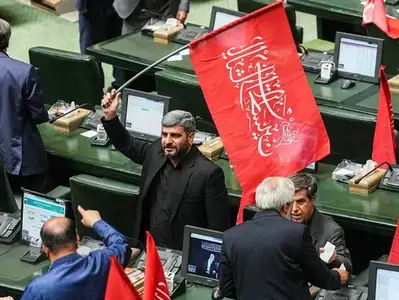
One hundred thirty-six members of Iran's parliament have warned the Supreme Council of Cyberspace (SCC), a government body responsible for overseeing the country’s internet governance, that a proposal to lift internet filtering would be a gift to the enemies in the soft war.
"Raising such an issue, especially in these critical times for the region and the world, is deeply concerning and amounts to a surprise gift to the enemies in the soft war against Iran," the lawmakers said, adding that Iran’s adversaries seek to incite unrest and social turmoil in the country.
They urged the council not to be swayed by emotional and sensationalist rhetoric in making its decision.
Iran has one of the world’s worst internet censorships with tens of thousands of websites blocked since the early 2000s and most major social media platforms banned.
Critics of Iran's President Masoud Pezeshkian have recently said that the ongoing deadlock over enforcing the new hijab law and lifting censorship on the Internet has effectively paralyzed his administration.
The lifting of official bans from two social media platforms on Tuesday may do little to dull the ire of Iranians about persistent government restrictions on their internet access.
As internet restrictions and social media blackouts continue in Iran, in spite of promises from President Masoud Pezeshkian to lift them, even the restricted local media have called for the resignation of his communications minister.
Sattar Hashemi has become a popular scapegoat for Iran’s complex censorship system, even if the dossier is largely out of his hands and run by the country’s ruling clerics and the security establishment.
Sazandegi columnist Faezeh Momeni said that "Hashemi has not even started the process of lifting the filtering, four months after he got the parliament's vote of confidence as IT and Communication Minister.”
An open letter called on President Masoud Pezeshkian, who in his election campaign promised to lift restrictions, "to appoint a new minister who would be committed to put an end to filtering."
The Minister of Economy, Abdolnasser Hemmati, recently said that "80 percent of Iranians use internet blockage circumvention tools [VPNs] to overcome the filtering and that imposes a cost of two million rials per month (around $3) on every Internet user."
He also said that "filtering causes heavy losses for the economy by restricting people's livelihood,” but only said that filtering is likely to be lifted gradually to avoid risking damage to “infrastructure”.
However, Iranian lawyer Kambiz Nowruzi told Sazandegi that lifting internet restrictions requires no specific infrastructure. “The decision to lift filtering only requires the approval of a majority—half plus one—of the 12 members of a committee, six of whom are representatives of the Pezeshkian administration," he said.
“If Pezeshkian can secure the support of at least one of the two representatives from the parliament or one of the four representatives from security organizations, the filtering can be lifted.”
He said the current filtering is illegal as per the country’s constitution which guarantees the public’s right to access information.
"From a legal point of view, the President can lift the filtering, but political and administrative realities of the country do not allow him to do that,” Nowruzi added.
In this year’s Freedom House report on internet freedom, the rights watchdog ranked Iran third in the world’s least free countries on digital freedom.
“The regime has taken steps to make access to the global internet more cumbersome and expensive, and drive users to a domestic version of the internet where authorities can more effectively control content and monitor users,” its report said.
“The regime also employs extensive censorship, surveillance, content manipulation, and extralegal harassment against internet users, making Iran’s online environment one of the world’s most restrictive.”
Since the 2022 uprising, the government has instructed internet service providers to increase their prices as much as 40 percent, making access significantly more expensive while localized internet shutdowns have continued.
In February, the Supreme Council for Cyberspace prohibited the use of unlicensed virtual private networks (VPNs) and pushed users seeking to access blocked or filtered web content to use domestic circumvention tools.
Internet expert Saeed Souzangar told Sazandegi newspaper that "using VPNs imposes a heavy burden on the backbone of the country's Internet system by increasing the volume of data transfers across the network."
It also diverts vast amounts of revenue to foreign companies such as Elon Musk’s Starlink. The website wrote, "There are at least 20,000 Starlink terminals in Iran and every one of them is paying at least $100 to Starlink, which adds up to $2 million per month."
Speaking about the mounting pressure on the minister of communications, Akbar Montajabi, the editor-in-chief of Sazandegi, told Rouydad24, ”The minister fears reaction by hardliners."
He said the minister is "an inefficient man who does not understand the requirements of modern living,” with millions of Iranians depending on the internet for commercial purposes.
Iran's tourism industry has collapsed over the past five years, with one agency owner describing the situation as "the destruction of the tourism industry," Tehran-based Etemad newspaper reported.
The crisis has reportedly forced the US-designated Bonyad-e Mostazafan (Foundation of the Oppressed), a powerful state-run charitable organization that has expanded into various sectors, including tourism, to sell its hotels.
"The condition of this industry is so dire that Bonyad-e Mostazafan has been forced to sell its hotels," the agency owner said.
Last year in December, Ebrahim Pourfaraj, the head of the Association of Iranian Tour Operators, said Iran's tourism industry was at its lowest point.
Iran, historically known for its rich cultural and historical heritage as well as its natural beauty, has struggled to attract foreign tourists in recent years, exacerbated by the detention of foreigners and dual-nationals. Despite its allure, the country faced challenges such as strict dress codes for women and restrictions on alcohol and nightlife.
Torn posters of Hezbollah leader Sayyed Hassan Nasrallah and late Iran's Revolutionary Guards' top commander Qassem Soleimani hang at the Iranian embassy after Syrian rebels announced that they have ousted President Bashar al-Assad, in Damascus, Syria December 8, 2024.
Tehran says it is in talks to reopen its embassy in Damascus even after it was sacked by rebels who took over the country and a staff member was killed in murky circumstances.
“Our approach to the embassy matter is fundamentally diplomatic. Both sides are prepared, and we are actively engaged in consultations to facilitate the reopening of embassies in both countries,” government spokeswoman Fatemeh Mohajerani said during a Tuesday press conference.
Speculation had followed a statement by the foreign ministry spokesman Esmaeil Baghaei last week, raising questions around the reopening.
“I prefer not to use the word ‘imminent,’” Baghaei said. “This is on the agenda, and as soon as the necessary conditions are met—both in terms of security and politics—we will move forward with reopening the embassy.”
The delay came on the back of the killing of a local employee of Iran's embassy, Davood Bitaraf, killed in a shooting. Baghaei blamed "terrorists" for the attack and urged the Syrian transitional government to bring the perpetrators to justice.
“The Ministry of Foreign Affairs is seriously pursuing the matter through appropriate channels and various diplomatic and international avenues,” he added.
Video footage from earlier this month, on the day President Bashar al-Assad fled to Moscow, showed militants storming the Iranian embassy, ransacking documents, and vandalizing the premises.
Shattered glass and broken furniture was scattered throughout the building. Iranian media reported that the staff had evacuated before the takeover.
Syria’s new de facto leader, Ahmed al-Sharaa, said in an interview with Asharq Al-Awsat that Iran’s influence in the region has been significantly weakened. Sharaa’s group, Hayat al-Tahrir Sham (HTS), recently defeated Assad’s forces in a rapid takeover, marking a turning point in Syria’s relationship with Iran, which had supported Assad since 2011 in the face of civil war.
“The Iranian project in the region has been set back by 40 years,” Sharaa said, threatening a key military and economic hub for Iran which had bases and forces spread across Syria.
Prominent political activist Majid Tavakoli has been sentenced by an appeals court in Tehran to two years in prison, two years ban on social media activity, a ban on residing in Tehran, and a prohibition on leaving the country, his wife, Maryam Tabandeh, said on Tuesday.
Tavakoli, who was serving a six-year jail term since October 2023, was released on bail in July this year after his retrial request was accepted.
He was arrested in September 2022 at the outset of Iran’s nationwide Woman, Life, Freedom protests, sparked by the death in custody of Mahsa Amini, and was later released on bail on December 20, 2022.
Tavakoli was accused of attempting to "overthrow the Islamic Republic and establish a liberal system."
Syria has suspended flights to and from Iran until January 22 amid regional tensions, the head of Iran's Civil Aviation Organization announced Tuesday.
Hossein Pourfarzaneh added that flights will remain suspended until after the New Year holidays.
He also noted, "Even during the tensions in Syria, Iranian flights continued with special permits," but he did not provide further details on these permits.
It remains unclear exactly when the suspension of flights was implemented.
Israeli news website Walla reported on Sunday that the new government of Syria had decided to prevent all Iranian planes - including civilian ones - from flying over Syrian skies.