Millions of Iranian families will celebrate the ancient Winter Solstice festival on Friday evening, though many have scaled back their budgets for the occasion, with businesses reporting a notable drop in sales.
Yalda Night, or Shab-e Chelleh, marks the longest night of the year and is one of the most significant events on the Iranian calendar. Similar to Nowruz, the celebration of the Spring Equinox and the Iranian New Year, Yalda's origins trace back to at least the Achaemenid era (circa 500 BC). The word "Yalda," however, is derived from ancient Syriac and means "birthday."
The celebration of Yalda, like Christmas, is an important family event celebrated with special foods, fruits such as watermelons and pomegranates, nuts and dried fruits, candles, poetry reading, games, and song and dance.
To ancient Iranians, the night of the Winter Solstice was the eve of the birth of the God of light and love, Mithra. On this night, they believed, Light defeated the powers of Darkness, and the sun gained its power again to make days longer and bring about the rebirth of nature at Spring Equinox.
President Masoud Pezeshkian who has been on a visit to Cairo, sent a special message to Iranians on Thursday to congratulate for Yalda. “We Iranians believe that Yalda will bring light [after long days of darkness]," he wrote in his message.
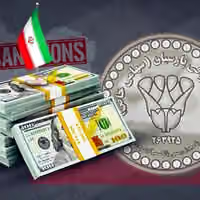
Alireza Arzani, an official with Iran's Chamber of Guilds, stated Wednesday that while the prices of food and items essential for Yalda celebrations have remained relatively stable compared to last year, people's purchasing power has dropped by around 50% during the same period, leaving many businesses struggling.
A traditional Yalda night food selection.
Arzani, representing nut and dried fruit retailers at the Chamber of Guilds, explained that declining demand has compelled retailers to reduce profit margins and lower prices in an effort to clear stock typically sold during this season.
Tejarat News, an economic newspaper, estimates that a family of four would need to spend approximately 25 million rials (around $30) for a modest Yalda spread this year. This amount represents 20-25% of the average monthly income for most Iranian workers and civil servants.
Iran's hardline Shiite clerical establishment frowns upon pre-Islamic celebrations, viewing them as remnants of paganism. However, the deep-rooted traditions of the Iranian people have largely thwarted their efforts over the past four decades to diminish the significance of ancient festivals in favor of Islamic ones.
Most Iranians find no contradiction in celebrating both ancient festivals and Islamic occasions. Each year, they send tens of millions of text messages to mark the Winter Solstice, much like they do during Nowruz. Similarly, a minority of devout individuals exchange greetings on religious occasions, such as the birthdays of Prophet Muhammad and the first Shiite Imam, Ali ibn Abi Talib.
In 2023, Iran's Supreme Council of Cultural Revolution (SCCR) renamed some calendar events including Yalda which they designated as the "Day of Promotion of the Culture of Hosting and Connecting with Relatives”.
Many of the members of SCCR are appointees of Supreme Leader Ali Khamenei. The Council is mandated with ensuring that non-Islamic cultural influences and ideologies are defused, and education and culture comply with values prescribed by the religious establishment and the state.
The public reacted very negatively to the SCCR’s move. In defiance of what they saw as an attempt to obliterate the country’s pre-Islamic past, many vowed to celebrate the festival with even more vigor. Social media users also posted numerous jokes about the long name proposed for the ancient festival.
The highly negative reaction forced the authorities to backtrack. The state-run television which has a monopoly on broadcasting, and the hardline dominated Tehran municipality, even tried to show an unprecedented interest in honoring Yalda with special programs and decorations installed around Tehran by the municipality. The same trend has continued this year.