“Over the past three days, 4,000 Iranian citizens in Syria have returned to Iran on 10 Mahan Airlines flights,” Fatemeh Mohajerani, the Iranian government spokesperson, said on Tuesday.
“We leave the determination of Syria’s fate to its people while closely monitoring developments on the ground” Mohajerani added.
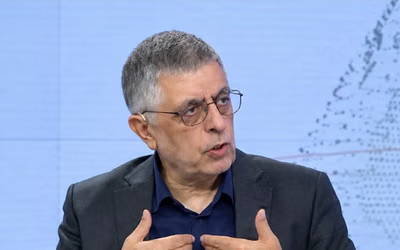

When Canada’s former Justice Minister Irwin Cotler penned an op-ed warning of the dangers of Iran's transnational repression and plots to assassinate dissidents - he did not yet know he too was already a target.
Cotler said he was the subject of an alleged Iranian plot to kill him on Canadian soil.
The threats, according to Cotler, mean anyone who dares speak up against repression even non-Iranians as far away as Canada is in danger, imperiling free speech and posing a key national security challenge.
“My assassination attempt that I experienced should be seen as a wake- up call of a larger phenomenon,” said Cotler, adding that domestic stifling of dissent is linked to Iran's attempts to silence critics abroad.
"The confluence of massive domestic repression, which incentivizes and underpins the extraterritorial aggression targeting those who are engaged in supporting the very Iranian people that are the targets of mass repression."
In an interview with Iran International, Cotler - a vocal critic of Iran’s government - said he was informed by the Royal Canadian Mounted Police (RCMP) in October of an active plot to try and kill him.
“I was supposed to attend the 60th anniversary of my McGill Law class in Montreal. I was prepared. The [RCMP] security detail was prepared to take me there and then I was advised that day that they had a warning of an imminent assassination attempt within the next 48 hours,” said Cotler.
The Globe and Mail, a Canadian newspaper, first reported on the alleged plot in early November, citing law enforcement sources about two suspects involved in his case. Cotler said he’s not aware of the two individuals but said he received confirmation that the threat against him has been lowered substantially.
Threats for more than a year
Cotler’s life has been under threat since 2023, he said, citing Canadian authorities.
The former parliamentarian was flying back home to Montreal from Washington DC with his wife on November 14, 2023 when he was advised by RCMP officials not to leave the airport. Then the text messages started popping up on their screens from neighbors curious about armored vehicles outside the Cotler home.
From that moment he has been under 24-hour police protection. Cotler is accompanied wherever he goes including his medical treatments and family outings.
The life of Cotler and his family would be changed forever, but his voice was not to be silenced.
Armored cars, armed protection and other security details soon became the norm.
“My life was altered with my freedom of movement restricted, but it has not altered my advocacy because I know that the objective of transnational repression and assassination are carried out," said Cotler. "Their purpose is really to intimidate, to silence and to arrest the target. Because I had the beneficiary of the protection, I've been able to engage in my continued public advocacy,”
When he learned later that the threats were coming from Iran, he wasn’t surprised.
“I first advocated for putting the IRGC on the terrorist list back in 2008 when I was a Member of Parliament. It took until 2024 and I fought until it happened.”
As a lawmaker, justice minister and now as chair of human rights organization the Raoul Wallenberg Centre, Cotler has been an advocate for human rights in Iran for decades.
A former lawyer, he also represented Iranian dissidents and political prisoners throughout his career.
As a retired politician, Cotler receives protection that an average Canadian under similar circumstances would not. In speaking directly with Iranian dissidents in Canada and abroad, he understands their fears and threats they face.
One major concern is Iran’s connections to organized crime in Canada.
US law enforcement agencies say two Canadians with ties to the biker gang Hells Angels were hired at the behest of Iran’s intelligence services to carry out assassinations in Maryland.
An unsealed US indictment revealed last month that two men, allegedly hired by the Islamic Republic to kill prominent Iranian-American human rights advocate Masih Alinejad.
Alinejad, whom Cotler refers to as a friend and colleague, has been the subject of several Iranian murder-for-hire plots on US soil. The same indictment also alleges Iran planned to assassinate president-elect Donald Trump prior to the American elections.
Iran's Foreign Minister Abbas Araghchi denied that Tehran was linked to an alleged plot to kill Trump.
While Cotler continues to raise alarm bells, he said Canada can and should be doing more by taking the lead in fighting transnational repression.
In a recent conversation with Canadian Prime Minister Justin Trudeau, Colter said he encouraged the Prime Minister to make Iran's attempts to assassinate critics abroad a top priority at next year’s G7 summit, which Canada is hosting.
“The real problem has been the culture of impunity," said Cotler. "What is needed now is a culture of accountability,”
Tehran's mayor warned that the fall of Iran's main Arab ally Syria to rebel forces would pose a long-term threat to the country.
“If we fail to address this situation, we risk enduring harm for centuries,” Alireza Zakani said on Tuesday.
"But with care, we can turn this threat into an opportunity," he added, without elaborating.
The Israeli military has been pounding military infrastructure in Syria in attacks they say aim to ensure Syrian and Iranian weapons and facilities don't fall into the hands of extremists.
Around 300 airstrikes have taken place in Syria, in the wake of the fall of the Assad government, with attacks intensifying on Tuesday.
Read more...
As images of brutality and prison abuses flood the internet following Bashar al-Assad’s fall, Iran’s tightly controlled media has cautiously criticized the deposed leader, hinting that a similar fate could befall the Islamic Republic.
Read more...

As images of brutality and prison abuses flood the internet following Bashar al-Assad’s fall, Iran’s tightly controlled media has cautiously criticized the deposed leader, hinting that a similar fate could befall the Islamic Republic.
“The lesson we should take is to be mindful so that [our] people do not get fed up and weary of the country and its circumstances and maintain their hope in the future,” conservative politician and journalist Naser Imani told Rouydad news website Monday.
While distancing Iran from Syria’s experience, he cautiously added, “The situation in the Islamic Republic is not comparable to Syria at all. Nevertheless, one should take note of the public opinion.”
Iran’s Supreme Leader, Ali Khamenei, has consistently praised Bashar al-Assad as a key figure in the “Axis of Resistance” and maintained unwavering support for him against adversaries. In 2019, during a meeting with the deposed Syrian president, Khamenei called him “the hero of the Arab world.”
Any strong criticism of Assad or Iran’s support for him could be interpreted as a challenge to Khamenei’s views, risking serious consequences for media outlets and public figures expressing such opinions.
The restrictions on criticizing Assad became apparent when several prominent public figures deleted critical social media posts soon after Assad’s ouster, often without explanation. These deletions were likely the result of pressure from security forces.
A commentary on the moderate conservative Asr-e Iran website suggested that foreign conspiracies may have played a role in Assad’s downfall, citing his support for the “Axis of Resistance.” However, it noted that Assad did not appeal to Syrians for support because he knew he would not get any.
“The question is should a government not be wise and discerning and treat its people with love and tolerance to protect itself if it is facing so much hostility from the outside?” the commentary asked, adding that ignoring the “views of the majority and the public’s demands” could be “the most damaging and fatal mistake a politician and a government can make,” as did Assad.
The Islamic Republic faces multiple crises at home and abroad, including Israeli strikes on its regional allies, economic devastation from Donald Trump’s “maximum pressure” campaign, setbacks in relations with Europe, and widespread corruption and decades-long human rights violations that have eroded public trust. Additionally, there is growing demand for greater social and political freedoms.
Ultra-hardliners dominating the Parliament have been pushing for the enforcement of a very controversial new hijab law, which even many conservatives and prominent clerics view as deeply damaging given the current circumstances.
Despite extensive moderation and the removal of “unpublishable” comments, some remarks published by the conservative Alef news website regarding recent events in Syria reveal that many ordinary Iranians are drawing parallels between Assad’s rule in Syria and the situation at home.
“A country’s power lies in its people, not its military force and the nuclear weapons,” a reader commented on an editorial Monday titled “Why Doesn’t the Syrian Army Fight [for Assad]?” The comment received 97 likes and only three dislikes, reflecting strong agreement among readers.
Another reader remarked, “There would be no civil war in Syria and not so much damage and loss of life if Assad had given its people some degree of political freedom and invited all political groups to participate in the government ten or fifteen years ago.”
This comment garnered 149 likes, with only six readers disapproving.
Similarly, readers gave strong approval to comments on another article, “Why Did Assad Fall?” published Sunday on the same website. The article attributed Assad’s downfall to his failure to reform the government.
One comment noted that Assad had claimed the backing of 95 percent of Syrians in elections held three years ago and emphasized, “social capital [is] the biggest asset of a government.”
Nearly 300 readers agreed with the comment, with only three expressing disapproval.