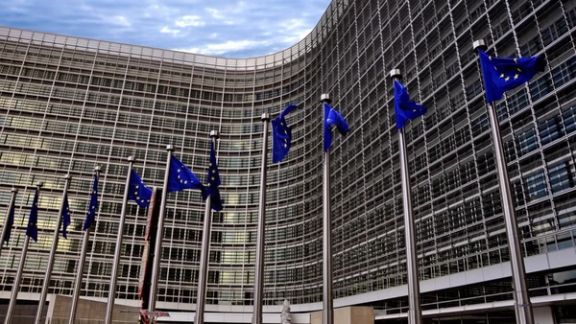
EU Flags in front of European Commission building in Brussels
Tehran is due to hold talks later this week with the United Kingdom, France, and Germany after the UN nuclear watchdog issued a censure resolution condemning its lack of transparency and violation of obligations under a 2015 nuclear deal.
The resolution against Iran may prove to be a crucial step in building a case for more binding measures and potentially initiate the UN trigger mechanism that brings back all UN sanctions against Iran that were in place before the 2015 deal.
As the Iranian Foreign Ministry expressed its readiness for negotiations, some government supporters became so optimistic about the planned talks that they began circulating speculative claims, including the idea that US entrepreneur Elon Musk might participate.
However, this turned out to be a misunderstanding based on a loosely translated post on X by a Wall Street Journal reporter.
How prepared is Iran for negotiations with the Europeans?
Based on statements by some not-so-high-ranking Iranian officials, Tehran is definitely eager for negotiations, but the issue is to what extent it is willing to make concessions on three key issues: its nuclear program, support for its militant proxy forces in the Middle East and its military support for Russia's war in Ukraine.
Is Iran's nuclear program the most critical issue in talks with world powers?
Undoubtedly, as the recent IAEA resolution underscores. However, it is far from the only significant challenge in any negotiations with Tehran. Iran faces a long list of contentious topics it must address at such a high level. These include its support for regional proxies, escalating tensions with Israel, involvement in Russia's war against Ukraine, missile development programs, alleged roles in cross-border terror plots, and a troubling record of human rights violations against its citizens and dual nationals, often taken hostage for political leverage.
Is the West genuinely concerned about Iran's regional proxies following Israel's strikes on Hamas and Hezbollah?
While the strikes may have weakened these groups, as well as others in Iraq, Yemen, and beyond, they remain active and operational. Iran continues to provide financial and logistical support to compensate for their losses and consistently voices unwavering backing for them. At the same time, Tehran persists in promoting its "axis of resistance" rhetoric, which translates into a militant stance against Israel and the United States.
Is the tension with Israel over more than a month after Israel's recent strikes on Iran?
Far from it. Iranian leaders, politicians, and particularly military commanders continue to vow revenge almost daily. While some of these threats may be intended for domestic consumption to maintain the loyalty of hardline supporters, their effect on public opinion in Israel is undeniable, especially as Hezbollah and occasionally Hamas persist in launching strikes inside Israel. Moreover, there is no sign that Iran has abandoned its threats to eliminate Israel. On the contrary, such rhetoric continues unabated from Supreme Leader Ali Khamenei and other senior officials.
Is concern over Iran's contribution to Russia's war against Ukraine serious? Absolutely. In fact, it ranks as Europe's top concern regarding Tehran's hostile activities, perhaps surpassing worries about its nuclear ambitions. The entire continent is deeply troubled by a war on its doorstep that could escalate into a broader conflict. Meanwhile, European countries’ financial and military support for Ukraine has placed significant strain on their citizens, including those in the United Kingdom. Iran's military assistance to Russia exacerbates this already precarious situation, making it increasingly difficult for Europe to navigate the crisis.
But could Europe really view Iran's missile program as a serious threat?
Iranian military commanders frequently boast about their long-range missile capabilities, and recent missile attacks on Israel demonstrated their ability to strike distant targets. Unlike most nations with nuclear or conventional warheads, Iran has shown a tendency to use its missiles impulsively. It even targeted Pakistan at one point, only to retreat after a swift counterattack.
While Iranian missiles have been used against civilian targets in Saudi Arabia and Iraq fostering an illusion of power, their attacks on Israel have been largely ineffective due to Israel’s robust anti-missile defenses. Nevertheless, Europe remains concerned about the potential threat posed by Iran’s missile arsenal.
Can Europe and the United States really claim to care about human rights in Iran? The West has increasingly recognized the significance of Iranian protests, with both the US and Europe consistently condemning Tehran’s human rights violations over the past two years. Demonstrations in solidarity with Iranians have been ongoing in Western countries, and Iranian opposition figures have been welcomed at prominent international platforms, including the European Parliament and US Congress.
Human rights are likely to feature prominently in any negotiations with Iran, especially after the June 2024 presidential elections, where nearly 60 percent of Iranians boycotted the vote in protest. Meanwhile, the Iranian government is beginning to feel the pressure of a reawakening civil society. Even regime insiders have frequently cautioned leaders against further alienating the public. Most notably, the Islamic Republic newspaper—founded by none other than Khamenei himself—warned on November 25 that a revolution fueled by the hungry and disillusioned could be imminent.
General Mohammad Bagheri, Chief of Staff of Iran's Armed Forces
A senior Islamic Republic military commander has vowed to Retaliate against Israel's attack last month, even as ceasefire talks between Israel and Lebanon gather momentum.
"The response to Israel's recent aggression has been devised beyond what the regime's [Israeli] leaders can imagine," Chief of Staff of Iran's Armed Forces, Mohammad Bagheri, said on Tuesday. He added, "The Zionists have crossed the Islamic Republic's red lines. Iran will not tolerate any aggression against its territory and will ensure it does not go unanswered."
While Tehran has yet to take action, Israeli and US officials report that Israeli airstrikes on October 26 neutralized Iran's last three Russian-supplied S-300 air defense systems, significantly weakening its defensive capabilities. Israeli officials have asserted that Iran is now defenseless against further airstrikes, if it attacks Israel.
Tehran launched missiles and drones against Israeli twice this year, with limited impact.
Meanwhile, Israel appears close to approving a US-backed ceasefire agreement with Lebanon’s Tehran-backed Hezbollah. A senior Israeli official indicated that the deal could be finalized as early as Tuesday tonight, signaling an end to a conflict that has caused immense devastation since it escalated from the Gaza war over a year ago.
Lebanese Foreign Minister Abdallah Bou Habib, speaking at a G7 meeting in Italy on Tuesday, shared optimism that a ceasefire agreement might be reached by Tuesday night.
The proposed agreement entails an Israeli withdrawal from southern Lebanon, with Lebanese forces assuming control of the area—a longstanding Hezbollah stronghold—within 60 days. Hezbollah would in turn cease its armed activities along the Litani River’s southern border.
During Israeli strikes, Hezbollah has suffered significant losses, particularly in its leadership ranks. Coordinated attacks in September eliminated thousands of Hezbollah operatives through targeted explosions and strikes. Key figures, including longtime leader Hassan Nasrallah, were killed, weakening the group’s command structure.
Tehran maintains a dual strategy of military responses and diplomatic engagement. While military officials remain uncompromising, Iranian government leaders advocate for a diplomatic resolution. Foreign Minister Abbas Araghchi recently expressed support for a ceasefire in Lebanon, saying, "We support efforts for a ceasefire on the condition that it would be acceptable to the Lebanese people, acceptable to the resistance, and synchronized with a ceasefire in Gaza."
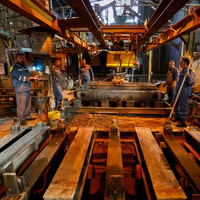
Iran's cement industry is grappling with the dual challenges of restricted natural gas supplies and reliance on environmentally harmful mazut as a backup fuel, exposing vulnerabilities in the country’s energy infrastructure.
Cement plants near metropolitan areas, barred from using mazut due to pollution concerns, have slashed production by 50%, while those in remote regions are navigating logistical hurdles to secure alternative fuels.
The disruptions come against the backdrop of a worsening energy deficit that has deeply impacted multiple industries.
Ali Akbar Alvandian, Secretary of the Cement Industry Employers' Association, highlighted the strain during a recent interview with ILNA news agency.
"Gas supplies to cement factories are limited, forcing some plants far from cities to use mazut. Those near urban centers, unable to utilize mazut, have had to halve their production," he explained.
Despite the setbacks, Alvandian claimed that the market remains stable, with October’s production levels surpassing those of the same period last year. Producers, he said, are striving to ensure consistent supply despite the energy challenges.
Iran's energy deficit is not new, but its scale has become more pronounced. The country’s natural gas production growth has slowed significantly, particularly from its South Pars gas field, which accounts for 75% of output and is now in decline. Sanctions have prevented Iran from attracting the foreign investment and technology needed to offset this decline. Furthermore, inefficiencies in production and distribution contribute to an annual loss of 28 billion cubic meters of gas—equivalent to one-tenth of the nation’s annual production.
The result has been a chronic shortage of power, with blackouts impacting residential, commercial, and industrial sectors. Summer months saw electricity rationing that halted operations at 70% of cement kilns, causing supply chain disruptions.
As winter approaches, the focus has shifted to natural gas, with cuts already affecting the steel and petrochemical sectors. This has compounded existing challenges for industries reliant on consistent energy supplies.
A power grid in Iran
For factories located far from urban centers, mazut has become a critical alternative to natural gas. Yet, even this stopgap measure is fraught with difficulties. According to Alvandian, plants are required to source mazut from ports on the Persian Gulf, incurring steep transportation costs exacerbated by a shortage of tanker fleets.
"If these challenges persist, production could be halted entirely," he warned.
The cement industry’s struggles mirror the broader economic pressures facing Iran. Inflation has remained above 40% for five years, while the national currency has lost half its value in just two years. With at least 30 million citizens living below the poverty line, energy disruptions further strain an already fragile economy. Industrial sectors, including steel and petrochemicals—key contributors to non-oil exports—have faced severe production losses due to energy shortages.
Cement exports have also declined, with clinker exports dropping by 17% in the first seven months of the Iranian year (starting in mid-March) compared to the same period last year. Domestic markets are now being prioritized, but reduced production levels could still lead to local shortages.
The government faces difficult choices as winter intensifies. Domestic gas consumption is expected to surge to 650 million cubic meters per day, exacerbating an existing deficit of 90 million cubic meters. Planned price increases for gas might bolster state revenues but are unlikely to curb household consumption significantly due to low base rates. Meanwhile, industrial users remain at the mercy of unpredictable energy supplies, jeopardizing output and employment.
Alvandian suggested shared power outages between households and industries as a potential stopgap, though he cautioned against extending such measures into winter.
"Further electricity disruptions would affect not only industries but also residential areas, leading to broader economic and social challenges," he added.
Iran’s energy crisis, rooted in years of underinvestment, inefficiencies, and sanctions, presents a formidable barrier to economic recovery. The cement industry’s struggles are emblematic of the larger pressures facing the country.
The State Department announced Monday that the United States will not participate in talks between Iran and three European powers scheduled for November 29 in Geneva, to discuss nuclear and regional issues.
“We are closely coordinating with our E3 partners regarding Iran’s full implementation of its nuclear safeguard obligations and holding Iran accountable for its failure to meet those obligations,” spokesperson Matthew Miller said in his daily briefing.
Deputy foreign ministers from France, Germany and the United Kingdom will meet with their Iranian counterpart Majid Takht-Ravanchi to discuss Iran’s nuclear program and other issues, both Tehran and London confirmed.
The meeting that was first announced on Sunday, takes place about a week after the Board of Governors of the International Atomic Energy Agency (IAEA) passed a censure resolution against Tehran for its lack of cooperation and compliance. The resolution was the initiative of the three European countries and the United States, as Iran continues high-level uranium enrichment and bars many UN nuclear inspectors from the country.
“We have made it clear that Iran must provide full cooperation with the IAEA without further delay. And we’ll continue to closely coordinate with the Governments of France, Germany, and the United Kingdom,” Miller said.
In response to the IAEA resolution, Iran announced plans to increase uranium enrichment, while some Iranian politicians called on top authorities to begin the process of developing nuclear weapons.
Asked what the US thinks about Iran’s reaction, Miller said, “I would just say we’re concerned with Iran’s announcement that it’s choosing the path of continued escalation instead of cooperating with the IAEA. Its continued production and accumulation of uranium enriched up to 60 percent has no credible civilian justification.”
Tehran currently possesses enough enriched uranium for four nuclear bombs, according to IAEA estimates. While uranium enriched to 60% purity cannot serve as fissile material, Iran could further refine it to weapons-grade levels within 2-3 weeks. This position is often referred to as a nuclear-threshold status, indicating that Iran could rapidly become a nuclear power if it possesses the expertise to assemble a functional bomb.
Miller also condemned remarks by Iran’s Supreme Leader Ali Khamenei, who on Monday called for the execution of Israeli Prime Minister Benjamin Netanyahu, after an arrest warrant was issued by the International Criminal Court recently.
“So those comments, I’d say, are unfortunately what we would expect from the leader of a country that is a state sponsor of terrorism. When it comes to tensions in the region, obviously those comments are not helpful,” Miller said about Khamenei’s remarks.
An IDF illustration of the alleged Iranian arms smuggling route
The Israeli military launched its latest airstrike on the Syria-Lebanon border on Monday targeting what it described as Iranian smuggling routes used by Hezbollah.
The Israeli military posted to X that a series of airstrikes over an unspecified time period attacked the route Iran has been using to supply Hezbollah’s elite unit 4400 with weapons with the oversight of Syria's Military Security.
The route is allegedly used for storing weapons in Syrian military warehouses prior to their transfer to Lebanon.
The Syrian Military Security Unit plays a key role in supplying weapons to Iran's proxies in the region, the Israel Defense Forces (IDF) said, adding that the strikes come as part of efforts against Hezbollah’s Unit 4400, which is the body responsible for transporting weapons from Iran and other regional allies to Hezbollah in Lebanon.
It was headed by Muhammad Ja’far Qasir, who was wanted by the US State Department before Israel assassinated him on October 1, 2024.
“The IDF remains committed to countering Iran’s efforts to arm its terrorist proxies across the region,” the tweet read.
They posted an animated video to the tweet that shows the alleged Iranian smuggling route that starts in Iran, makes its way into Iraq and through Syria into Lebanon.
The Israeli military said in its statement that the Iranian smuggling routes are not a new target but part of a long-term effort to disrupt the flow of weapons to Iran's armed allies which have been confronting the Jewish state for over a year.
Syria’s state news agency SANA said the Israeli strikes on Monday damaged bridges in the al-Qusayr area.
According to the Syrian Observatory for Human Rights, two people were killed and five injured in that attack.
A former Iranian minister of intelligence said that investigators have been unable to identify the perpetrators or methods behind the assassinations of several nuclear scientists, underscoring the country's intelligence gap with likely perpetrator Israel.
The remarks were among the most critical yet by a current or former top official on Iran's intelligence capabilities vis-a-vis a top national security dossier.
“In the assassinations of the four nuclear scientists ... we were unable to identify those who committed the crimes," Mahmoud Alavi was quoted as saying by Iranian media outlets. "Nor were we able to thoroughly study the methods of their assassinations."
He was referring to slain nuclear scientists Masoud Ali-Mohammadi, Majid Shahriari, Darioush Rezaeinejad and Mostafa Ahmadi Roshan.
"However, the case of (Mohsen) Fakhrizadeh was different. Everyone was identified. Nevertheless, we faced a vigilant enemy who, typically, would flee just half an hour before we could reach them,” added Alavi, a minister during Hassan Rouhani’s presidency.
Between 2010 and 2020, the five Iranian nuclear scientists were assassinated by various means but none of the killers have been apprehended.
Ali-Mohammadi was killed by a remote-control bomb attached to a motorcycle in Tehran on January 2010.
Shahriari and Ahmadi Roshan died when explosives attached to their vehicles detonated in attacks in 2010 and 2012. Rezaeinejad was shot and killed by motorcycle gunmen in Tehran in the summer of 2011.
Fakhrizadeh, an Islamic Revolutionary Guard Corps commander regarded as the chief of Iran's nuclear program, was shot dead by a remote-control machine gun in Damavand near Tehran in 2020.
Iranian nuclear scientist and member of IRGC Mohsen Fakhrizadeh
His comments cast doubt on the government’s earlier claims of cracking down on foreign espionage.
In 2012, the Islamic Republic executed Majid Jamali Fashi, accusing him of assassinating Alimohammadi. The conviction was based on video-taped confessions aired in a state-produced documentary called The Terror Club.
The program featured 13 individuals allegedly trained in Israel for espionage and sabotage, many of whom later recanted their confessions.
Maziar Ebrahimi, another person featured in film, described later how he was tortured into falsely confessing a leadership role in the team that killed Shahriari.
Released years later, Ebrahimi has since publicly denounced the confessions, accusing Iranian authorities of fabricating the charges. Now residing in Germany, he described systemic flaws in Iran’s judicial and intelligence processes during an interview with BBC Persian in 2019.
A spokesperson for Rouhani’s government Ali Rabiei distanced the administration from Ebrahimi’s case, saying it did not occur during their administration.
Rabiei conceded that some confessions were unreliable and improperly assessed, pointing to non-specialists’ involvement in critical counterintelligence investigations.
Unresolved case of Mohsen Fakhrizadeh
Fakhrizadeh, Iran’s leading nuclear scientist and a pivotal figure in its nuclear program, was assassinated on November 27, 2020, near Absard east of Tehran. Alavi said intelligence services identified the suspects’ movements but they repeatedly evaded capture.
“We tracked them to various cities—Arak, Hamedan, Sanandaj, and finally Saqqez—but ultimately lost them as they left the country,” he said.
International media reports described the assassination as an operation involving a remote-controlled weapon smuggled into Iran. The weapon was designed in Israel and assembled inside Iran and was part of an eight-month operation orchestrated by a 20-member team of Israeli and Iranian nationals, the Jewish Chronicle reported.
Espionage accusations
Iranian authorities have since announced arrests and indictments, but inconsistencies persist. Initial claims suggested five to six armed individuals were involved, while later reports cited indictments against 14 suspects.
Human rights organizations have identified several Kurdish detainees accused of assisting the operation and raised questions about the transparency and fairness of the investigations.
Despite sporadic arrests and indictments, Iran’s intelligence services have struggled to conclusively address these high-profile assassinations.
Judiciary spokesperson Asghar Jahangir recently announced the identification of eight individuals accused of spying for Israel, with three sentenced to death.
However, rights groups like Kurdistan Human Rights Network argue that these suspects were denied due process, including access to independent legal counsel during critical investigative stages.
The recurring failures to secure accountability may reflect broader systemic shortcomings in Iran’s security apparatus.
While officials have attributed the assassinations to Israeli operatives, some critics have pointed to internal weaknesses including flawed intelligence practices and politicized judicial procedures as contributing factors.