Iran’s car factory in Syria shuts down, reflecting broader setbacks
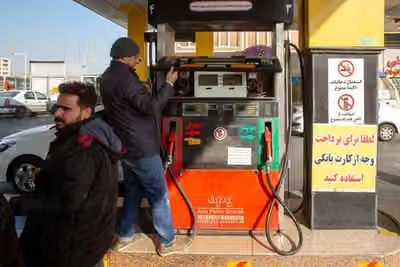
Iran's car manufacturing company, Saipa, which is based in Tehran.
An Iranian state-owned car assembly plant in Syria has closed after nearly 20 years, marking yet another blow to Tehran’s economic ambitions in the war-torn country, where it continues to maintain a significant military presence.
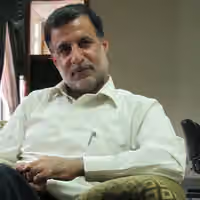
The head of Iran-Syria chamber of commerce, Saeed Aref announced that Saipa, the sole Iranian automaker active in Syria, has ceased production, and no other Iranian factories in the country have become operational, citing unresolved issues between the two countries.
"Iranian companies are still active in providing infrastructure for Syrian industries, exporting technical and engineering services, and carrying out essential and specialized infrastructure repairs," he added.
The announcement comes as Supreme Leader Ali Khamenei’s special representative, Ali Larijani, visited Damascus and Beirut, signaling ongoing efforts to strengthen Iran’s regional influence. However, Iran’s economic footprint in Syria remains disproportionately small despite its costly military involvement during the civil war.
The story of Saipa’s factory in Syria began during the Mohammad Khatami administration in 2004, with construction initiated as part of an ambitious bilateral project.
By 2007, the Pride model’s production line was inaugurated in Homs in the presence of Syrian President Bashar al-Assad. The project, dubbed Siveco, saw Saipa owning 80% of the company while the Syrian government held a 20% stake.
During Mahmoud Ahmadinejad’s presidency, Saipa’s Syrian operations became emblematic of the Islamic Republic’s broader industrial ambitions abroad, with plans to produce up to 15,000 vehicles annually.
A similar initiative by Iran Khodro aimed to establish a factory in Syria in 2009. Yet, these ventures struggled to achieve success as civil war began in 2011, and repeated attempts to reach profitability largely faltered.
Iran’s economic struggles in Syria are accentuated by its massive financial outlays during the civil war. In 2020, Heshmatollah Falahatpisheh, a former member of Iranian Parliament’s National Security and Foreign Policy Committee, estimated that Iran spent $20 to $30 billion supporting Bashar al-Assad’s regime.
"We may have given $20 to $30 billion to Syria, and we need to get it back. This nation’s money was spent there," he said. Others have put the figure at more than $50 billion.
Despite this significant investment, Iran’s share in Syria’s post-war economy remains minimal. Mohammad Amirzadeh, Vice President of Iran’s Chamber of Commerce, lamented in 2021 that weak economic diplomacy had reduced Iran’s share in the Syrian market to just 3%, compared to Turkey’s dominant 30%.
But the real reasons might be economic, as Syrians prefer to deal with free-market economies with competitive quality and price, rather than Iran's government-controlled and isolated economy.
The shuttering of Saipa’s factory epitomizes the Islamic Republic’s inability to capitalize on its investments in Syria. While Turkey and other players secure substantial shares of the Syrian economy, Iran faces diminishing returns despite its critical role in supporting Assad during the war.