Casting vote, Trump wishes Iran success but rules out nuclear weapons

US presidential candidate Donald Trump said Tuesday he does not intend to do damage to Iran but remains firm that Tehran can’t have nuclear weapons.

US presidential candidate Donald Trump said Tuesday he does not intend to do damage to Iran but remains firm that Tehran can’t have nuclear weapons.

A 16-year-old girl in Tehran took her own life following a confrontation with a school principal over wearing jeans instead of a required uniform during a field trip, her grieving father told a local news outlet.
In an interview with Tehran-based Rokna News, the father said the school told him that his daughter, Arezou, had left the premises without permission.
Later, he learned she had jumped from the sixth floor of a friend's residential building.
The father held the school responsible for her death through its overreaction, adding that the family has filed a formal complaint against the principal. The incident was not isolated and her hijab had been disputed by the school previously, he said.
The outlet cited the father's surname as Khavari, but in common news writing practice did not provide a first name.
“Last year, they also tried to prevent her enrollment, using excuses like having too many friends or letting a bit of her hair show,” he told Rokna News.
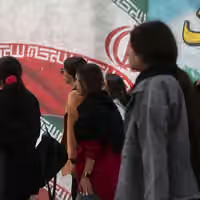
Her death follows the dramatic disrobing by a female student at Tehran’s Islamic Azad University, in an act a student news outlet and even the official Fars News agency said followed an altercation with Islamic dress code enforcers.
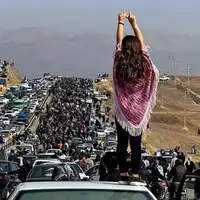
Efforts to enforce stringent dress codes for women have intensified since a September 2022 uprising. That movement, dubbed Woman, Life, Freedom, was ignited by the death of 22-year-old Mahsa Amini while in police custody for alleged hijab violations.
Despite widespread public resistance, the government has escalated measures to uphold mandatory hijab norms, leading to the closure of businesses and the impounding of vehicles linked to hijab infractions.
A state-backed hijab enforcement plan called Project Noor - "light" in Persian - was launched on April 13 and has led to increased deployment of paramilitary Basij units and plainclothes officers in public spaces.
Universities like Al-Zahra in Tehran have even implemented facial recognition at entry gates to ensure compliance.
During his campaign, Iranian President Masoud Pezeshkian criticized the initiative as a "Darkness Plan" and pledged to end morality police patrols and violence against women.
Despite this, in October, the Guardian Council approved a controversial new Hijab and Chastity bill, which remains under parliamentary review.

As Americans head to the polls on Tuesday, many in Iran are closely watching the election, with some hoping Harris will pursue rapprochement and ease economic hardship while others count on Trump to renew maximum pressure and degrade the ruling system.
Many who voted for Massoud Pezeshkian in the June presidential election did so largely due to his central promise to address economic issues through diplomacy and the lifting of US sanctions.
Noting Iranians' keen interest in the US election, former Foreign Ministry spokesperson and ex-ambassador to Baku, Seyed Abbas Mousavi, posted on X: "Our valuable experience over the past 45 years shows it hardly matters who wins the election. Unless Iran or the United States shifts its core foreign policy principles, there is little chance for lasting reconciliation or a comprehensive solution to Iran's problems."
Iranians are looking to the new US president to bring them prosperity and security—an expectation they might otherwise hold for their own president. However, they likely understand that Pezeshkian is in no position to resolve these issues. Even former President Hassan Rouhani once expressed hope that a US president could help alleviate Iran’s financial troubles. Ahead of Iran’s 2017 presidential election, Rouhani likened the world to a village, with the US president as its chief, suggesting that Iran’s problems could be addressed by engaging with this “village chieftain.”
However, many Iranians completely opposed to the Islamic Republic, prefer the presidency of Donald Trump, hoping that his tough stance toward Tehran can fatally weaken the political and military establishment and lead to its downfall.
Although Iranian officials often pin their hopes on a US president to help solve the country’s challenges, they are too proud—or ideologically restrained—to openly seek American goodwill. They prefer a resolution that doesn’t compromise their dignity. Rather than directly calling on the United States to lift sanctions, Iranian presidents, including former President Ebrahim Raisi and his successor Massoud Pezeshkian, have instead promised “to have the sanctions lifted,” carefully avoiding mention of who would actually lift them to sidestep acknowledging dependence on the US.
Iranians proudly assert that Iran is one of the world’s oldest nations. Whenever neighboring countries challenge its sovereignty—such as by claiming ownership of the three Persian Gulf islands—Iranian media, officials, and citizens remind them that while Iran boasts thousands of years of documented history, most of its neighbors lack even a century as established states. As a testament to this heritage, Shah Mohammad Reza Pahlavi held a grand celebration in Persepolis marking 2,500 years of Iranian monarchy, with leaders from over 100 nations in attendance.
Iranian officials, including former Presidents Mahmoud Ahmadinejad and Hassan Rouhani, have frequently reminded not only their regional counterparts but also US officials that Iran is home to a rich civilization spanning several millenia. Despite the Islamic Republic’s poor record on human rights, its leaders often highlight that the world’s first known human rights charter was inscribed in stone by none other than Cyrus the Great. Conveniently, however, they overlook the fact that while Iran is an ancient nation, the Islamic Republic itself is less than half a century old.
This distinction should alert the new US president to a key demand voiced by Iranians in the streets: the need to differentiate between Iran as a nation and the Islamic Republic as a regime. When responding to actions by the Islamic Republic, US and other Western officials should take care not to attribute those actions to Iran and its people, if they wish to avoid deeply offending them.
Over the past 45 years, whenever the Islamic Republic and the United States sought to blame each other for their strained ties, the US cited "Iran’s" 1979 seizure of the US embassy and the 444-day hostage crisis, while the Islamic Republic pointed to the US-backed 1953 coup against Prime Minister Mohammad Mossadegh.
Notably, the Islamic Republic overlooks that it outlawed Mossadegh’s supporters shortly after the 1979 revolution and quickly renamed a Tehran street dedicated to him by the people. It also tends to forget that in March 2000, former Secretary of State Madeleine Albright offered a statement of regret, though some argue her wording fell short of a full apology.
While Iranian officials frequently speak of “having the sanctions lifted,” the only concession they seem prepared to offer is a return to the 2015 nuclear deal, which is effectively defunct. They also avoid mentioning that US demands include ceasing support and funding for militant groups like Hamas and Hezbollah and ensuring that Iranian-backed proxies stop threatening US interests and allies in the region.
Before 1979, Iran was the United States' closest ally and largest trade partner in the Middle East. Returning to that level of friendship and cooperation seems nearly impossible now. The looming threat of a broader regional conflict makes resetting ties even more unlikely, especially with forces both inside and outside Iran determined to prevent any rapprochement.

Iran’s judiciary on Tuesday said a German-Iranian citizen died of a stroke last week before his scheduled execution, contradicting state media reports but providing few details.
The Judiciary spokesperson Asghar Jahangir said on Wednesday, “Jamshid Sharmahd's death sentence was set to be carried out, but fate offered no reprieve, and he died before the execution could proceed.”
Jahangir did not explain whether he suffered a stroke or a heart attack, nor did he specify the exact time of death: during transfer for execution, in his cell, or during interrogation.
State media reported the execution of the 68-year-old US-based German citizen on October 28. He was abducted by Iranian agents during a visit to the United Arab Emirates in 2020 and forcibly taken to Iran. In February 2023, Iran's Judiciary sentenced him to death on charges of endangering national security. Tehran says that Sharmahd was responsible for a 2008 attack on a mosque in Shiraz that killed 14 people and injured 200.
Later on Tuesday, a German foreign ministry official said Tehran is responsible for the death of Sharmahd. "Jamshid Sharmahd was abducted by Iran and detained for years without a fair trial, in inhumane conditions and without the necessary medical care. Iran is responsible for his death," Reuters quoted the German official as saying.
Following reports of his death last week, Germany recalled its ambassador to Iran and summoned the Iranian chargé d'affaires. Berlin also ordered all Iranian consulates to be shut down. The European Union also announced it is considering targeted and significant measures against Tehran.
German Foreign Minister Annalena Baerbock said, "Our diplomatic relations are already more than at a low point," after Berlin recalled its ambassador.
Baerbock urged Brussels to put Iran’s Islamic Revolutionary Guard Corps (IRGC) on the European Union's terror list.
Germany downgraded relations with Tehran in the 1990s following the assassination of Kurdish-Iranian dissidents in Berlin. Tensions eased a few years later following the election of reformist Mohammad Khatami, who embarked on a charm offensive to rebuild relations with the European Union.
Iran's Foreign Minister Abbas Araghchi, in response, wrote on X, “No terrorist enjoys impunity in Iran, even if supported by Germany.”
His daughter Gazelle Sharmahd, on X, had demanded proof of his execution and called for the immediate return of her father.

Iran’s Supreme Leader Ali Khamenei has remained unusually silent on the current US presidential election, despite having commented on nearly every past race over his 35-year tenure, frequently condemning the US political system.
Khamenei’s silence is particularly striking given that Donald Trump—a former president who withdrew from the 2015 JCPOA nuclear deal and imposed “maximum pressure” sanctions, nearly bankrupting the Islamic Republic and pushing it to the brink of collapse—is once again a strong candidate.
At this juncture, Khamenei is in an unprecedentedly weak position. Over the past year, Iran’s economic crisis has worsened, with the currency now worth just 1/10,000th of its value under the monarchy. His strongest regional proxies, Hamas and Hezbollah, have been significantly weakened. Israel has dared to launch an air strike with impunity and there is no end in sight to US sanctions.
Khamenei’s analysis of US elections through the novels of John Steinbeck and Howard Fast
Since Khamenei became Supreme Leader in 1989, the US has held eight presidential elections. Drawing on novels he has read, Khamenei has condemned the US for suppressing leftist groups and has repeatedly labeled both Democratic and Republican presidents as “fools” and “clowns.”

The first US presidential election during Khamenei’s leadership took place in November 1992, though he made no specific comments on it.
The second election, in November 1996, pitted Democrat Bill Clinton against Republican Bob Dole. During the campaign, Khamenei met with Iranian media leaders, where he sharply criticized American democracy. Referencing his favorite leftist author, Howard Fast, Khamenei analyzed the US elections. Drawing on Fast’s novels, likely The Immigrants, he condemned what he called the repression of leftists, socialists, and communists in the US, stating, “Some of his novels have been translated into Persian—read them to see the shocking accounts about leftists!”
In the same meeting, he encouraged attendees to read John Steinbeck’s The Grapes of Wrath, saying, “Read it to understand that the so-called center of democracy, praised by those with bad taste in Iran, couldn’t even tolerate leftists, as they believed Marxism challenged the American capitalist system.”
A month after the election, on December 6, 1996, Khamenei again discussed US elections with students, citing a leftist American author, probably Howard Fast, to analyze the election process.
The next US election during Khamenei’s leadership was on November 7, 2000, which saw George W. Bush win. By this time, Khamenei had shifted his approach, remarking in May 2000, “I’m not quoting any fanatical Muslim writer; I’m quoting Westerners themselves. I prefer not to name authors, but American writers explain how elections for city councils, Congress, and the presidency operate. Anyone observing it will see that public opinion has nearly no role.”

In July, he again addressed US elections in a meeting with officials, noting he had told President Mohammad Khatami that “in Western democracies, a group comes to the ballot boxes and votes as the party directs, and that’s the end of it!” He continued, “Here [in the Islamic Republic], people love their officials; it’s not just a voting relationship.”
In September 2000, speaking with Basij students, Khamenei referenced American books he’d read, saying, “Read these American books on media roles and the nature of elections—see how city and governor elections operate. When it comes to presidential and congressional elections, money plays the main role, while people are sidelined; there’s no true democracy.”
In December 2000, Khamenei addressed those upset with his criticism of American democracy: “These aren’t our words, nor are they biased or uninformed. They’re based on Western literature’s prominent figures who acknowledge it—yes, in public, they claim people’s votes count, but in reality, they don’t.”
In the early 2000s, as Khamenei ramped up his attacks on US democracy, he was tightening his grip on Iranian politics, media, and elections, increasing the focus on ideological and political loyalty and bolstering the influence of hardliners.
From accusing Americans of racism to critiquing Occupy Wall Street
In his 2012 Nowruz speech, Khamenei referenced Obama’s 2008 election: “The current US president came in with a message of change, implying the situation was so bad it required change.” Calling Americans “racist,” he said, “They didn’t want to vote for a Black man but did, hoping for change.”
Referring to the Occupy Wall Street movement, Khamenei said, “The Occupy Wall Street movement started in US cities. Is this a good situation? It’s simple math. Americans accepted change, meaning the situation is bad, but nothing has improved. America is struggling.”
A week before the election, he again discussed US politics with students, saying, “Isn’t it disgraceful that presidential candidates try to please Zionists and prove their loyalty? Each tries to show more obedience to the Jewish and Zionist communities, which have trapped them.”
Khamenei’s consistent view on US political parties
The next US election took place on November 8, 2016, with Donald Trump and Hillary Clinton as the main candidates. Khamenei had already weighed in on the upcoming election in his 2016 Nowruz speech, remarking, “In a few months, the US will change its administration, but there’s no guarantee the next one will honor past commitments. The candidates are competing in anti-Iran rhetoric.”
On May 14, 2016, he responded to Trump’s campaign threats to withdraw from the Iran nuclear deal, stating, “We won’t violate the agreement, but if they tear it up, we’ll burn it.”
Two weeks before the election, Khamenei commented on the US debates: “Look at their presidential election; it’s down to two people. Watch their debates and how they treat each other! One of these two will become president.”
After Trump’s victory, Khamenei remarked, “America is America; neither party has ever benefited us. We don’t mourn or celebrate.”
Khamenei’s last notable comment on US elections came on November 20, 2022, when he told citizens in Isfahan, “Since the revolution, every US president has fought us. Some have vanished into history’s trash heap, while others are still alive. From Carter, Clinton, and Obama to Reagan, Bush, and the ‘previous fool’—and now this ‘dazed and confused fellow’ who claims he’ll save Iran.”

Russia launched a Soyuz rocket early on Tuesday carrying 55 small satellites, including two from Iran, Russia's Roscosmos space agency reported.
The Soyuz-2.1 spacecraft lifted off from Russia's Vostochny Cosmodrome Tuesday to take satellites designed to monitor the space weather to the Earth's ionosphere, where the atmosphere meets space.
Roscosmos said that in total, 51 Russian satellites, one Russian-Chinese Device and a Russian-Zimbabwean satellite were put into orbit.
According to Iranian Ambassador to Russia Kazem Jalali, two Iranian satellites, the Kowsar, a high-resolution imaging satellite, and Hodhod, a small communications satellite, were among the satellites carried by the Soyuz.
"In continuation of the development of Iran-Russia scientific and technological cooperation, two Iranian satellites, Kowsar and Hodhod, will be launched to a 500 km orbit of earth on Tuesday, November 5, by a Soyuz launch vehicle,"Jalali said in a post on X Monday.
Iranian media says the Kowsar, which weighs 30 kilograms, has an expected lifespan of three years and the Hodhod, which weighs 4 kilograms and orbits at an altitude of 500 kilometers, can operate for four years.
The Iranian satellites are the first launched on behalf of the country’s private sector. IRNA says they were designed and built by the Omidfaza company, which began designing the satellites in 2019.
The heaviest satellites in the launch were two Russian Ionosfera-M satellites, which weigh 430 kg (948 lb) and their working orbit is at an altitude of 820 km (510 miles).
A Russian-Chinese student satellite Druzhba ATURK was also taken to space in the launch.
In February, Russia launched into space an Iranian research satellite that will scan Iran's topography from orbit, according to ISNA.
In September, Iran’s Revolutionary Guards announced the launch of a research satellite into orbit. Chamran 1 was launched aboard the Qaem 100 solid-fuel satellite launcher, also operated by the IRGC. Iranian media said the satellite was placed into orbit at an altitude of 550 kilometers, marking the IRGC's second orbital mission with this launcher.
While Iran insists that the Chamran 1 is purely a research satellite, designed to test hardware and software systems and demonstrate in-orbit maneuvering technologies, Western officials and experts say it is for military purposes.
"Iran’s space program is a cover for the regime’s longer range strike capabilities and a pathway to an Intercontinental Ballistic Missile (ICBM) that could be used to threaten the US homeland and the European continent," Behnam Ben Taleblu, a senior FDD fellow, told Iran International.
Satellite images suggested Israel struck a major Iranian missile plant during its latest strikes across Iran. The images from Planet Labs showed damage to the Shahroud Space Center which is an IRGC facility understood to be used to produce intermediate-range ballistic missiles that could be used to target Israel.
Trump made the remarks while speaking to reporters in Florida after casting his vote in the 2024 presidential election.
“My terms are very easy,” Trump said, adding that Iran "can't have nuclear weapons." "I’d like them to be a very successful country,” he added, but declined to detail specific plans for US-Iran relations should he return to office.
The candidate’s comments echo his stance during his presidency, highlighting the ongoing friction between Washington and Tehran over the latter's disputed nuclear program.
Tensions spiked in 2018 when Trump withdrew the United States from the 2015 Joint Comprehensive Plan of Action (JCPOA), an agreement aimed at limiting Iran's nuclear program in exchange for economic relief.
The withdrawal led to the reimposition of US sanctions on Iran, straining the country's economy and prompting Iran to step away from its nuclear restrictions.
Though Iran insists its nuclear program remains peaceful, enrichment levels have risen significantly, alarming both the United States and the International Atomic Energy Agency (IAEA). The IAEA has called on Iran to allow more inspections and transparency, while Tehran seeks sanctions relief as a condition for further diplomatic engagement.
Trump’s potential return has drawn both anticipation and concern about US-Iran relations as his approach to foreign policy, particularly on the Middle East, has been hawkish.