Family of Quds Force commander unaware of his whereabouts
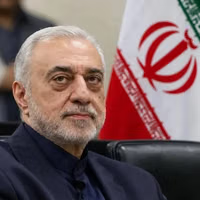
IRGC Quds Force Commander Esmail Qaani
Informed sources have told Iran International that even the family of Quds Force commander Esmail Qaani remains unaware of his current status, as the IRGC has yet to release any official statement regarding his fate.
Reports emerged on Saturday that Qaani might have been in Beirut following the death of Hezbollah leader Hassan Nasrallah and continued Israeli air strikes on position of the Iran-backed group. No one has heard about Qaani since October four and there are speculations that he might have been killed or injured in Israeli air strikes.
A targeted airstrike, which aimed to eliminate Hashem Safieddine, a senior Hezbollah leader and potential successor to Hassan Nasrallah, has raised speculation about Qaani’s possible presence at the bombed location. The New York Times, citing three unnamed Iranian officials, reported that Qaani had traveled to Lebanon last week to meet with Hezbollah officials in an effort to strengthen the group.
Reuters also reported on Sunday that according to Iranian officials Qaani has not been heard from since Friday. Senior Hezbollah official Mahmoud Qmati told Reuters: "I have no information, we are also searching for the truth of this matter."
While Israel’s Channel 12 suggested that Qaani might have been injured in the attack, there has been no confirmation from Iranian authorities. A Lebanese security source told Reuters that communication with Safieddine has been cut off since the strike, further fueling concerns about high-level casualties among Hezbollah leadership.
Qaani’s absence from key government ceremonies in Iran, including an event where Supreme Leader Ali Khamenei awarded a military badge to IRGC Aerospace Forces commander Amirali Hajizadeh, has only added to the growing uncertainty. Iran has not released any recent photos or videos of Qaani.
Meanwhile, in a sign of heightened tensions and amid fear of possible Israeli retaliation for last week attack, Iran's Civil Aviation Organization has canceled all flights from Sunday evening to Monday morning, citing "operational limitations." This follows a pattern seen in April when Iranian flights were suspended for nearly 48 hours after Iran launched missile attacks on Israeli positions.
At the same time, Israeli Defense Minister Yoav Gallant responded to recent Iranian actions with a stern warning. "Whoever thinks that a mere attempt to harm us will deter us from taking action should take a look at Gaza and Beirut," Gallant stated, referring to the October 1 Iranian missile strike on two Israeli air force bases. Gallant emphasized that no Israeli aircraft or squadrons were damaged in the strike.
As tensions escalate, both sides are preparing for potential further confrontations, with Iran threatening reciprocal action if Israel launches any new attacks. Iran closed its airspace Sunday night until Monday morning.
Gasoline supply in Iran faced abrupt changes on Sunday, with new limits imposed on daily refueling and fuel station allocations, sparking concern about potential price hikes.
The government that controls fuel products announced that vehicle owners using its rationing system of smart fuel cards are now limited to fueling "twice a day," with a maximum of 50 liters per session.
The new directive reduces the previous refueling limit of 60 liters to 50, although the monthly quota of 300 liters remains unchanged. However, officials did not provide any explanation or the reason for the daily refueling reduction, a move that has alarmed the public and some media outlets.
Under a plan announced in 2023, about 70% of citizens can receive 30 liters of gasoline per refueling session in small towns and 40 liters in large cities.
However, until Iran’s second attack on Israel last week, during which 181 ballistic missiles were fired at the Jewish state, the plan had not been implemented in the capital, where Tehran residents could still refuel up to 60 liters as before.
As Israel has vowed retaliation as a national duty, Iran's critical infrastructure, including refineries are now in the firing line.
Although Iran has one of the world's largest oil reserves, it suffers from gasoline shortages due to the limited refining capacity. President Masoud Pezeshkian raised the issue of higher gasoline prices during the election campaign, but after the victory, his cabinet’s statements were contradictory.
In August, Pezeshkian said in a speech: "There is no logic in buying gasoline at the free market dollar rate and selling it to the public with subsidies."
The remarks faced negative reactions from social media users.
Economic journalist Reza Gheibi, in an interview with Iran International, warned that "increasing gasoline prices" is the government’s ultimate goal. He predicted further measures, including cutting individual quotas and raising both free market and subsidized gasoline prices in the coming years.
Gheibi emphasized that “the current restrictions are a prelude to price hikes, which could trigger social unrest akin to the 2019 protests” that erupted following a 200% gasoline price increase. Those protests saw widespread anti-government demonstrations, which were met with crackdowns, with reports suggesting over 1,500 people were killed by security forces.
The timing of the new fuel restrictionscoincides with a major energy crisis in Iran. This summer, the country faced a 20,000-megawatt electricity deficit and a shortage of natural gas, forcing power plants to rely heavily on diesel and fuel oil, both of which have seen dramatic consumption increases. Fuel oil now accounts for 25% of power plants' fuel supply, and this figure is expected to rise to 50% by winter.
According to the Ministry of Oil, Iran's strategic diesel and fuel oil reserves would last only 10 days if no additional fuel is provided for industrial or transportation purposes, raising fears of a prolonged energy crisis. The country's gasoline reserves are also critically low, with only enough fuel to cover one week of domestic demand if consumption spikes during the winter months.
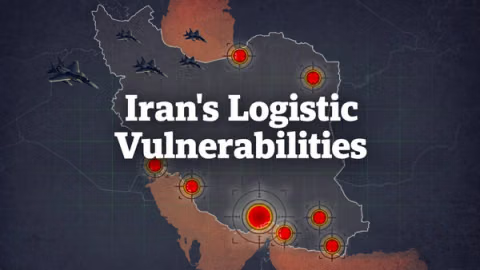
Israel’s reported consideration of targeting Iran's oil refineries as part of a potential retaliation could further cripple the country's energy sector. The loss of refineries such as Persian Gulf Star or Abadan would wipe out 30% of Iran's fuel production, exacerbating the shortages. A single strike on the Kharg oil terminal could cut off 90% of Iran’s oil export capacity, dealing a blow to the economy.
A loss of refinery capacity or further cuts in fuel supplies could plunge the country into hyperinflation, driving poverty levels even higher amid an inflation rate already exceeding 40%.
Israel’s former prime minister, Naftali Bennett, has called for the country’s leaders to launch an attack on Iran’s nuclear facilities as the Jewish state weighs its response to last week’s barrage of 181 ballistic missiles.
Bennet slammed US President Joe Biden who has called for a “proportionate” response to the attack as the administration continues its policy of appeasement.
"President Biden has said that Israel can retaliate against Iran, but must keep the response 'proportionate'. The president also urged Israel not to attack Iran’s nuclear program,” he wrote on X.
He called for Israel to attack Iran’s nuclear program, its leadership and Iran’s main economic interests such as energy, arguing that the Islamic Republic has not only twice attacked Israel this year, but has helped hundreds of other attacks by its proxies.
“All of these would be only a fraction of what Iran did to Israel. So indeed it won’t be “proportional”, it’ll be much less,” he said, calling to bring down the Islamic Republic before it acquires nuclear weapons.
“This will take some time, but this week’s response must start this process,” he said. “If we don’t take out the nuclear program now, I don’t know we’ll ever do it. The mullah regime has acquired SQ10, which means enough high grade uranium to produce 10 nuclear bombs. The regime is racing towards producing the detonator device itself, while the world can no longer really track this,” he warned.
Earlier this year, the UN’s nuclear chief, Rafael Grossi, also warned that Iran is “weeks not months” away from a nuclear weapon while the country continues to bar at least one third of the UN’s inspectors.
“We might wake up to a test bomb exploding in Iran’s desert. At that moment the Middle East will become a nuclear nightmare. We have the justification and the ability. It’s time to act now,” Bennett added.
On the eve of October 7, when Iran-backed Hamas invaded Israel, Bennett also highlighted the wide reach of Iran’s proxies which have been armed and trained by Iran sitting across Israel’s borders and beyond.
Since October 7, Iran’s proxies in Lebanon, Syria, Iraq and Yemen have all launched attacks on Israel in allegiance with Hamas in Gaza.
“Iran has been terrorizing Israelis for over 30 years. It sent its terror-octopus tentacles —Hamas, Hezbollah, Islamic Jihad and more to surround and attack Israel. Iran’s regime funded, trained and armed these savage terrorists,” Bennett said.
Hezbollah alone, Iran’s largest proxy, has sent over 8,000 projectiles towards Israel since October 8. Since then, at least 63,000 Israelis have been displaced and tens of thousands more Lebanese displaced in Hezbollah-controlled southern Lebanon.
Israel has since launched a ground invasion in recent days into southern Lebanon, targeting Hezbollah's terror network including tunnels, weapons storage and launchers, in a bid to push back the group designated by countries including the US and Europe, as it tries to send its citizens home.
“A few days ago Iran directly shot 190 ballistic missiles to Israel, including city centers such as Tel Aviv. In April Iran lobbed some 350 projectiles towards Israel. Without Israel’s remarkable technology these missiles could have killed thousands of innocent people,” Bennett pointed out.
In April, Iran launched its first direct attack on Israel following an alleged Israeli airstrike on the Iranian consulate in Damascus which killed a senior Quds Force commander and multiple high ranking IRGC officials.
“So what would be a proportionate response? For Israel to murder, rape and burn thousands of innocent Iranians? We don’t do that,” Bennett added. “For Israel to shoot 10,000 rockets indiscriminately on Iranian cities? We don’t do that either. Therefore, Israel can do much less than what Iran’s regime did to us.”
Gabriel Noronha, the US State Department’s former Iran advisor, told Iran International: “A lot of what’s going to happen in Israel’s response is messaging to Iran on its nuclear program.
“Israel’s response to the April attack was a pinprick attack to an Iranian site, sending the message that there is the capability to hit these sites,” he said, Israel’s retaliation to the inaugural aerial bombardment in April hitting military sites including four small nuclear research facilities and the nearby Natanz uranium enrichment site.
Last week’s assassination of Hezbollah leader Hassan Nasrallah in an underground intelligence headquarters, “said Israel can hit depth, no matter how deep the bunker is,” said Noronha.
“My theory is in this case that Israel is doing a layered response, hitting a lot of Iran’s missile supply chain, warehouses, factories, oil infrastructure, maybe a refinery, but I think they will leave room to be able to escalate further. I suspect they’ll hit something like a centrifuge assembly factory.”
In June, the UN said that "while the [nuclear] Agency had not been able to verify the total stockpile of enriched uranium in the country since February 2021, it estimated that Iran maintains a total enriched uranium stockpile 30 times the amount allowable under the Plan of Action — including increased quantities of uranium enriched to 20 percent and 60 percent."
While the UN continues to urge Iran to readmit inspectors barred from the country, its nuclear chief says the chances are now unlikely.
Iran's currency, the rial, has dropped by more than 5% in two weeks, following Israeli strikes against Hezbollah in Lebanon, Iran's missile attack on October 1, and Israel's threat of retaliation.
On Sunday, October 6, the rial was trading at 630,000 to the US dollar, down from 592,000 on September 20, when Hezbollah began experiencing mass casualties from exploding pagers and walkie-talkies. This was followed by an Israeli airstrike that killed Hezbollah leader Hassan Nasrallah, prompting Iran to launch a massive ballistic missile attack on Israel. Israel's subsequent threat of retaliation has left Iran on edge, further weakening its already battered currency.
Gold prices also rose in Tehran in tandem with a rising dollar and other major currencies.
An Israeli attack could target Iran’s energy sector, potentially causing domestic chaos and a significant reduction in oil exports—the financial lifeline of Tehran's Islamic government.
Iranians are concerned about a potential Israeli attack, although it seems targets will be mainly military and political. An attack on Iran's refineries could lead to serious difficulties as the winter approaches.
Since 2018, when the US withdrew from the JCPOA nuclear deal and imposed sanctions on Iran’s oil exports and international banking, the rial has lost 15 times its value. In the past three years alone, it has depreciated by more than 50%.
This sharp devaluation has coincided with soaring inflation, now hovering between 40-50%, pushing tens of millions of Iranians into poverty and creating a potentially volatile public mood.
The Iranian government has been quietly signaling an interest in new negotiations with the West this month to reduce sanctions, but so far, the US and its European allies maintain that only a genuine change in behavior will lead to talks."
Iranian hardline newspapers are ramping up threats against Israel, detailing an extensive list of potential targets Iran will strike if Israel retaliates for last week's ballistic missile barrage.
An IRGC source told Tasnim News "if Israel takes any steps, there will be no hesitation in carrying out Iran's retaliatory strike," adding that several types of counterattacks are ready to be executed depending on the nature of Israel's retaliation.
Last week, Iran launched two waves of ballistic missiles towards the Jewish state, the second direct attack on Israel this year as aggression between the two archenemies escalates to crisis levels.
Tehran-based Hamshahri newspaper, understood to be reflective of the sentiment of the hardline faction in Iran, on Sunday outlined Iran's potential targets in the event of an escalation. Among the 35 strategic locations named in the newspaper’s infographic are critical infrastructure and military facilities in Israel, understood to be part of the government's messaging to its nemesis.
Key targets identified include the Hagit Combined Cycle Power Plant and the Orot Rabin Power Plant in Haifa, both essential to Israel's energy grid. Additionally, the Bazian Oil Refinery, Israel’s largest, and the Ashdod Oil Refinery, the second-largest, are highlighted as vital points in the country’s energy production and distribution.
Israel's gas infrastructure was also cited, with the Tamar Gas Field and the Leviathan Gas Field listed as potential targets. These facilities play a major role in Israel’s domestic energy needs and export capacity, and any disruption would significantly impact the economy.
Military sites are also among the targets, including Nevatim Air Base and Ramat David Air Base, crucial for Israel’s air defense. Civilian locations such as Ben Gurion International Airport in Tel Aviv and Ramon Airport in Eilat are also on the list.
A BBC report on Wednesdayalso noted that Iran's next volley of missiles could shift focus from military bases to Israeli residential areas. The report further highlighted that Iran's IRGC Navy, with its fast missile boats, could attempt to sow mines in the Strait of Hormuz, interrupting the flow of up to 20% of the world’s daily oil exports, or launch swarm attacks on US Navy vessels. Additionally, US military bases scattered throughout the region are also potentially vulnerable to Iranian strikes, according to the report.
Last week's attack caused damage in various parts of Israel, including at airbases. The Israeli military reported that despite the damage, no aircraft or critical infrastructure were hit, and the Israeli Air Force continues to operate at full capacity.
Israel is yet to respond to Tuesday’s attacks, with Israeli Prime Minister Benjamin Netanyahu having vowed retaliation for Iran's missile strike, saying Tehran would "pay for it."
The US, a critical ally, has called for a "proportionate" response as Israel weighs its options.
Iranian authorities are restricting the flow of information about last month's coal mine explosion in Tabas which killed at least 51 workers as the country fails to control a spate of disasters blighting the industry dating back years.
Iran’s security agencies have threatened labor activists and the families of Tabas coal miners for sharing information about the miners and the conditions at the Tabas mine, Iran International has learned.
Activists on social media have also been coerced into deleting their posts related to the disaster.
The explosion, which occurred on September 21, was caused by a methane gas leak deep within the mine according to state TV. Rescue operations were hampered by high levels of methane gas, with many miners trapped in Block B, where conditions were particularly hazardous.
On Saturday, Ali Nesa'i Zahan, the prosecutor of South Khorasan Province and lead investigator in the case, confirmed that "negligence regarding the lack of safety at this mine has been established, and this failure is attributed to the mine's officials," as reported by the state-run ISNA.
He added that the investigation is ongoing, with the next step being to assess the degree of negligence and identify "which individual or individuals are responsible," with the findings to be submitted in writing to the judge.
"Ultimately, those found responsible will be summoned to the court and held accountable," he said, noting that sharing images or other details of suspects during the investigation is prohibited.
A day after the disaster, Iran's attorney general, Mohammad Movahedi Azad, warned that “no entity is permitted to comment on potential negligence until a final verdict is issued by the investigating judge.”
The Islamic Republic's suppression of information about the Tabas explosion is part of a broader pattern of limiting public discourse on sensitive issues within the country.
Iranian authorities have frequently used intimidation tactics to silence families and activists. Families of the victims of Ukraine International Airlines Flight PS752, which was shot down by the Islamic Revolutionary Guard Corps (IRGC) on January 8, 2020, also faced threats, including murder and torture, aimed at preventing them from speaking out.
Likewise, in 2023, Amnesty International highlighted the Iranian government's campaign of harassment against the families of those killed during the 2022 Woman Life Freedom uprising “preventing them from demanding justice.”