• العربية
  • فارسی
Brand
  • Iran Insight
  • Politics
  • Economy
  • Analysis
  • Special Report
  • Opinion
  • Podcast
  • Live TV
  • Iran Insight
  • Politics
  • Economy
  • Analysis
  • Special Report
  • Opinion
  • Podcast
  • Live TV
  • Theme
  • Language
    • العربية
    • فارسی
  • Iran Insight
  • Politics
  • Economy
  • Analysis
  • Special Report
  • Opinion
  • Podcast
  • Live TV
All rights reserved for Volant Media UK Limited
volant media logo

After UN visit, Iranian president signals imminent nuclear talks with EU leaders

Sep 27, 2024, 15:00 GMT+1Updated: 15:47 GMT+0
Iran's President Masoud Pezeshkian walks, on the sidelines of the 79th United Nations General Assembly at UN headquarters in New York, US, September 24, 2024.

Concluding his three-day visit to New York, Iranian President Masoud Pezeshkian announced that discussions on the nuclear deal with European countries will be revisited soon.

"It was also decided to hold a meeting in Europe. We discussed the JCPOA (Joint Comprehensive Plan of Action). We expressed our concerns to Europe, and it was agreed that the foreign ministers would review this matter again," Pezeshkian told domestic reporters at the Tehran airport on Thursday.

The Iranian President also took a moment to blame the US for "tearing up" the agreement -- claiming that most of the European leaders were "upset about it."

The Joint Comprehensive Plan of Action (JCPOA), signed in 2015 between Iran and world powers, sought to limit Iran's nuclear activities in exchange for sanctions relief. However, in 2018, then-US President Donald Trump withdrew from the agreement, citing concerns that it did not address Iran’s missile program.

Pezeshkian also appeared to emphasize the Iranian state's goal to "resolve" the nuclear issue through "dialogue."

Attempts to revive the deal over the years have seen indirect talks, with European diplomats often mediating between US and Iranian officials, though these efforts have largely failed.

In August, Iran’s Foreign Minister declared the JCPOA "beyond revival," stating, "Under the new government, our focus is not on restoring the nuclear deal but on lifting the sanctions."

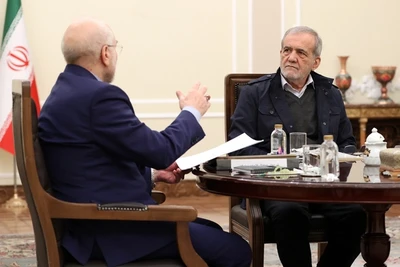
Despite this, President Pezeshkian has shown a desire to re-engage with Western powers, pledging to work towards reviving the agreement and lifting the sanctions imposed following the US withdrawal. The country's Supreme Leader, Ali Khamenei, opened the door to future talks in August.

In his first press conference in Tehran, Pezeshkian reiterated that Iran is not seeking nuclear weapons but is instead focused on fulfilling its scientific and technical needs. He stressed Iran’s continued adherence to the JCPOA framework, stating, "By tearing up the JCPOA, the West forced us into actions we did not intend to take. If they don't continue, we won’t either. If they uphold their commitments, we will fulfill ours as well." During his speech at the UN General Assembly (UNGA), Pezeshkian also expressed Tehran's readiness to negotiate with JCPOA partners.

However, doubts remain over the future of the deal. French President Emmanuel Macron said on Monday that he does not believe any new proposals can revive the nuclear agreement in the near future.

Speaking on France Inter radio, Macron cautioned, "I would still be very cautious. I don't think there will be new proposals right now to save the nuclear deal." He added that the political situation in Iran, where widespread protests have erupted, has "changed the situation a lot" and further weakened the chances of reaching a new agreement.

Western powers have also expressed concerns over uranium traces found at three sites in Iran. Last week, they stressed that it is "essential and urgent" for Iran to provide explanations. Iran has agreed to a visit from the UN nuclear watchdog this month to address these concerns. However, another unresolved issue involves Iran’s refusal to allow several UN inspectors access to its nuclear sites.

In June, the IAEA’s 35-nation Board of Governors passed a resolution calling on Iran to increase cooperation and reverse its barring of these inspectors, technically referred to as "de-designation." Despite this, Rafael Grossi, head of the IAEA, confirmed in a recent interview that Iran’s government has refused to lift the ban. "They won’t do that," Grossi said. "As I said to one of your colleagues, that ship has sailed."

Meanwhile, in July, the White House National Security Council spokesperson indicated that the Biden administration is not prepared to resume nuclear negotiations with Iran under its new administration.

In an interview with Tehan-based Entekhab, international relations expert Rahman Ghahramanpour expressed a nuanced view on the prospects of negotiations with the US. He noted, "At present, the chances of open, direct, and comprehensive negotiations with the US are slim, but this does not mean that negotiations will not occur." Ghahramanpour further remarked that both sides seem to have agreed to engage in discussions on the nuclear issue at a lower level, with hopes of a more favorable environment emerging after the US presidential elections.

He also suggested that the resumption of talks with Europe will likely be approached with "medium priority," citing the fact that Deputy Foreign Minister Majid Takht Ravanchi is leading the upcoming meeting with France.

Most Viewed

Iran weighs attacks on military targets in Europe – FT
1

Iran weighs attacks on military targets in Europe – FT

2

Canada deports former Iranian official linked to 2019 protest crackdown

3
ANALYSIS

The 60-day deadline is over. Now what does Trump do with Iran?

4
OPINION

For Iranian journalists, exile can last a lifetime

5
INSIGHT

Forced to serve in the IRGC, now fighting to stay in Canada

Banner
Banner
Banner

Spotlight

  • Luxury Tehran property asking prices surpass Munich and Sydney

    Luxury Tehran property asking prices surpass Munich and Sydney

  • For Iranian journalists, exile can last a lifetime
    OPINION

    For Iranian journalists, exile can last a lifetime

  • Seven months on, January protests still shape Iranians’ lives
    VOICES FROM IRAN

    Seven months on, January protests still shape Iranians’ lives

  • Forced to serve in the IRGC, now fighting to stay in Canada
    INSIGHT

    Forced to serve in the IRGC, now fighting to stay in Canada

  • Iran’s ‘infiltration’ bill sparks backlash over sweeping reach

    Iran’s ‘infiltration’ bill sparks backlash over sweeping reach

  • To survive maximum pressure, Iran kept pumping and broke its oil company
    ANALYSIS

    To survive maximum pressure, Iran kept pumping and broke its oil company