Female detainees assaulted in Tehran prison for protesting executions
Outside the gate of Evin Prison, Tehran
A group of female political prisoners in the women's ward of Tehran's Evin Prison were assaulted by prison guards on Tuesday, after staging a protest against the execution of Iranian dissident Reza Rasaei.
Rasaei, who was executed earlier that morning in western Iran, had been arrested during the nationwide 2022 protests. His execution sparked widespread global condemnation including protests by political prisoners at Evin.
According to information obtained by Iran International, the protest at Evin women’s ward began when the prisoners received news of Rasaei's execution. They gathered in the prison courtyard, chanting slogans against the death penalty. The protest was met with a violent response from prison authorities, led by Hadi Mohammadi, the deputy officer in charge. Guards, acting on the deputy’s orders, violently dispersed the protesters, severely beating several women.
Among the injured was Nobel Peace Prize laureate Narges Mohammadi, who suffered a “respiratory attack and intense chest pain, causing her to collapse and faint,” after being beaten by prison guards along with several other inmates, according to a statement released by her family on Thursday.
“The women's ward was flooded with armed guards, and an order was issued to assault the protesters. Several women who stood in front of the security forces were severely beaten. The confrontation escalated, resulting in physical injuries for some prisoners and nervous breakdowns for others,” the statement said.
Nobel Peace Prize laureate Shirin Ebadi has sounded the alarm over the safety of political prisoners in Evin Prison, including Narges Mohammadi and journalist-activist Sarvenaz Ahmadi.
"The lives of Narges Mohammadi, Sarvenaz Ahmadi, and all political prisoners in various prisons are in danger. They are paying the price for the insatiable totalitarianism of the Islamic Republic,” Ebadi said in a post on Instagram.
Political prisoner Varisheh Moradi, who is facing charges that could result in the death penalty, was also among those injured during the assault. After being beaten by the officers, she sustained a serious wrist injury, and bruises across various parts of her body.
Sarvanaz Ahmadi collapsed from a panic attack, while Samaneh Asghari, Reyhaneh Ansarinejad, and Sepideh Qoliyan were kicked and spat on by officers. Sarina Jahani and Mahboubeh Rezaei suffered severe beating, leaving them with splinted hands and intense pain. Nasrin Khazari Javadi, Houra Nikbakht, and Rana Korkur fainted during the assault, requiring oxygen treatment. Parivash Moslemi was also severely beaten, causing extensive bruising and pain.
Despite sustaining injuries, at least 15 of the prisoners have been denied medical care and have not been transferred to the hospital for treatment.
UN High Commissioner for Human Rights condemns Iran’s executions surge
This incident occurred amidst an alarming increase in executions in Iran, drawing international concern. Despite global condemnation of Rasaei’s execution, at least 29 more people were executed just a day later, on Wednesday.
On Friday, the UN High Commissioner for Human Rights, Volker Turk, expressed extreme concern over reports that Iranian authorities had executed 29 people in the last two days. "This represents an alarmingly high number of executions in such a short period of time," said UN Human Rights Office spokesperson Liz Throssell.
Though the death toll could not be independently verified by the United Nations, the reported executions bring the total number to at least 345 this year, including 15 women.
Throssell also highlighted the disproportionate impact of these executions on minorities, including Kurds, Hawassi Arabs, and Baluch, and condemned the use of the death penalty for drug-related offenses. "Imposing the death penalty for offenses not involving intentional killing is incompatible with international human rights norms and standards," she stated.
The crackdown on Evin’s prisoners and the broader surge in executions reflect the ongoing human rights crisis in Iran, despite the election of President Masoud Pezeshkian in July. Since his election, at least 87 people have been executed, raising further concerns about the future of human rights under his administration.
Last year Amnesty International reported that of all recorded executions globally, Iran accounted for 74% with at least 853 people put to death.
As the US presidential election draws closer, Iran-linked groups are intensifying their efforts to influence the outcome, according to a new report from Microsoft.
The Microsoft Threat Intelligence Report, released on Friday, details how these groups have been setting up and launching influence campaigns aimed at swaying voters, particularly in swing states, while also conducting operations to gather intelligence on political campaigns, potentially laying the groundwork for future interference.
The report revealed that an Iranian group named Storm-2035 has launched covert news sites targeting both left-leaning and conservative US voters, using AI to plagiarize content and promote divisive political messages.
Another group called Sefid Flood has been preparing since March for potentially extreme influence operations, including “intimidation or inciting violence against political figures,” aiming to incite chaos, undermine authorities, and sow doubt about election integrity.
IRGC-linked hackers targeting senior officials before US election
Moreover, Microsoft reported that Mint Sandstorm—a group run by the Islamic Revolutionary Guard Corps (IRGC) intelligence unit—attempted to hack the account of a senior US official involved in a presidential campaign.
The incident involving what Microsoft called a “high ranking official” happened in June, just weeks after a breach discovered on the account of a county-level US official.
"A group run by the IRGC intelligence unit sent a spear-phishing email to a high-ranking official of a presidential campaign” and “another group with assessed links to the IRGC compromised a user account with minimal access permissions at a county-level government,” the report said, directly naming Iran.
Additionally, in May, Peach Sandstorm—another group linked to the IRGC—compromised the account of "a county-level government employee in a swing state." Microsoft noted that this group has been active since September 2023, primarily targeting US government organizations in swing states.
US intelligence officials recently admitted that Iran had ramped up the use of clandestine social media accounts with the aim to use them to try to sow political discord before the polls.
Iran has denied the allegations, with a statement from the UN Mission in New York to Reuters saying that the country’s cyber capabilities were "defensive and proportionate to the threats it faces" and that it had no plans to launch cyber-attacks.
"The US presidential election is an internal matter in which Iran does not interfere," the mission told Reuters in response to the allegations in the Microsoft report.
Microsoft also noted that the latest incident is part of an increase in activity trying to glean intelligence on US political campaigns and attempting to target swing states.
The successful breach in May of a county-level employee's account, Microsoft said, was part of a "password spray operation" in which hackers use common or leaked passwords en masse until they can break into one. However, no other accounts were breached.
Another Iranian group had launched “covert” news sites, Microsoft added, using AI to lift content from legitimate sources in order to target US voters across the political spectrum. It named Nio Thinker, a left-leaning site, and a conservative site called Savannah Time, which both share similar formats but without any contact details.
The US intelligence warned in July that, in addition to Iran, Russia and China were also conducting clandestine operations ahead of the upcoming elections. The three "rogue" states have been recruiting people in the US to spread propaganda, though the Iranian government denies the allegations.
As the elections near, the US remains on high alert for Iranian attacks. The 2024 annual threat assessment warned that "ahead of the US election in 2024, Iran may attempt to conduct influence operations aimed at US interests, including targeting US elections, having demonstrated a willingness and capability to do so in the past."
The assessment noted that during the US election cycle in 2020, Iranian cyber actors obtained or attempted to obtain US voter information, sent threatening emails to voters, and disseminated disinformation about the election.
"The same Iranian actors have evolved their activities and developed a new set of techniques, combining cyber and influence capabilities, that Iran could deploy during the US election cycle in 2024," the report added.
In the 2020 election campaign, the FBI reported that Iranian operatives impersonated members of the right-wing Proud Boys group as part of a voter intimidation effort. Two men were charged.
Later that year, Iranian hackers breached a website that a municipal government in the US used to publish election results, though the attackers were caught before carrying out any nefarious activity, US cybersecurity officials said.
Offering a $10m reward for information on their identity and whereabouts, the US said the six officials are linked to Iran’s Islamic Revolutionary Guard Corps (IRGC) and its Cyber-Electronic Command (IRGC-CEC).
One of the men named was Hamid Reza Lashgarian. head of the IRGC’s cyber-electronic command and a commander in the IRGC-Qods Force.
The suspects have also been linked to the hacking group CyberAv3ngers, which in October, publicly took credit for cyberattacks against Israeli PLCs.
It is part of an ongoing cyber-war launched by Tehran. In February, the US imposed sanctions on the same six individuals for their “deliberate targeting of critical infrastructure.”
A Treasury Department official condemned the attacks as “unconscionable and dangerous,” emphasizing that the US “will not tolerate such actions and will use the full range of our tools and authorities to hold the perpetrators to account.”
In April, the US imposed sanctions on four men and two companies accused of conducting cyber-attacks for the Iranian military. The US Treasury Department said they were involved in "malicious cyber-activity" to the benefit of Iran's Islamic Revolutionary Guards Corps' Cyber-Electronic Command (IRGC-CEC).
Under Secretary of the Treasury for Terrorism and Financial Intelligence, Brian E. Nelson, said: “Iranian malicious cyber actors continue to target US companies and government entities in a coordinated, multi-pronged campaign intended to destabilize our critical infrastructure and cause harm to our citizens."
State Department spokesman Matthew Miller also said in a statement that Washington “will not tolerate malicious cyber activities victimizing US companies”.
The US Justice Department and FBI simultaneously unsealed an indictment against the four men accusing them of participating in a coordinated hacking initiative starting around 2016 through to April 2021, targeting American firms and crucial government departments.
In June, Microsoft President Brad Smith revealed that the company detects around 300 million cyberattacks targeting its customers daily, with a majority originating from China, Iran, North Korea and Russia.
As Iran steps up its cyber war globally, cybersecurity firm Check Point revealed last month that the Iranian hacker group MuddyWater has expanded its operations to countries such as Azerbaijan, Portugal, Turkey, Saudi Arabia, and India, using newly developed malware.
MuddyWater, also known as APT34 and OilRig, has been active for several years, focusing on cyber-espionage against private and governmental organizations in the Middle East and Western countries.
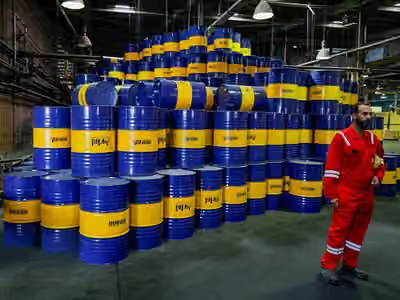
Iran has sent small shipments of crude oil to new destinations such as Bangladesh and Oman, according to shipping sources and data, the latest sign of Tehran pushing to sustain output at close to its highest in five years.
Oil sales are Iran's major revenue source and the country has been looking for ways to sidestep US sanctions on its crude exports that former president Donald Trump re-imposed in 2018 over Tehran's nuclear program.
Iran, which is exempt from output quotas set by the Organization of the Petroleum Exporting Countries (OPEC), is striving to maximize production and exports, amid a serious, five-year-long economic crisis.
Oil Minister Javad Owji said in July that Iran was selling crude oil to 17 countries, including those in Europe, according to the semi-official Mehr News Agency. The details could not be corroborated. Iran’s main oil buyer is China that defies US sanctions.
In one new trade, the Golden Eagle tanker sailed near the port of Chittagong in Bangladesh earlier this year after receiving oil from another vessel that loaded it from Iran’s Kharg Island according to available evidence based on shipping data, Claire Jungman, from US advocacy group United Against Nuclear Iran, told Reuters.
The Golden Eagle offloaded parts of the cargo to smaller tankers in ship-to-ship transfer operations around Chittagong in April, said Jungman, whose organization tracks Iran-related tanker traffic via satellite data.
The shipment to Bangladesh was separately confirmed by another oil export tracking source.
An official with state-owned Bangladesh Petroleum Corporation, which operates the country's main refinery, said it did not buy the cargo and it was difficult to establish who was the buyer.
The Golden Eagle's Liberia-based owner and manager listed in shipping databases could not be reached for comment.
Iranian officials did not immediately respond to a request for comment.
Violation of sanctions
Iran’s oil exports had dropped to as low as 250,000 barrels per day in 2019-2020, after the United States imposed full sanctions in May 2019. However, after President Joe Biden came to office and started nuclear talks with Tehran, Chinese refineries began buying ever larger shipments of illicit Iranian oil.
Critics say that the Biden administration, hoping to revive the 2015 nuclear deal with Tehran, stopped enforcing Trump’s “maximum pressure” sanctions. By some estimates, Iran has sold around $70 billion of additional oil in the past three years.
Syria, Oman
Tehran's oil output has topped 3.2 million barrels per day this year, the highest since 2018, according to OPEC figures, after posting one of OPEC's biggest output increases in 2023 despite U.S. sanctions still being in place.
Iranian crude exports have reached new highs this year, with March-May being the strongest three-month period since mid-2018, according to Petro-Logistics, a Geneva-based firm which tracks tanker shipments.
"But volumes seem to be plateauing now," said Virginie Bahnik of Petro-Logistics.
At least eight cargoes of oil - mostly from Iran - were heading to Syria with some already discharged, shipping sources said. Shipments to Syria, however, were below their peak some years ago as Iran seeks other export destinations.
Iranian oil deliveries into Syria have averaged 57,190 bpd in 2024 compared with a high of 147,000 bpd in 2022, according to export analysis from UANI’s Jungman. However, it is not clear if Iran is paid for the oil, or the shipments are assistance to its ally, the Assad government and possibly Hezbollah.
A separate tanker delivered a cargo believed to be Iranian crude oil into the Omani port of Sohar in June after loading the consignment via a ship-to-ship transfer with another vessel that picked up the shipment from Iran's Kharg Island earlier this year, UANI's Jungman said, citing shipping data.
The ship tracking source also confirmed the arrival of this cargo into Sohar.
Sohar Port and Oman’s Maritime Security Centre did not immediately respond to requests for comment.
Iran has also begun bringing cargoes into China's northeast Dalian port, adding another new destination for its crude, in addition to elsewhere in China.
Tanker trackers and dealers say that traders re-brand Iranian oil destined for China as originating from elsewhere, such as Malaysia, Oman or the United Arab Emirates.
Iranian oil exports have now reached a peak and have stabilized around 1.5 million bpd, since February, said Homayoun Falakshahi, senior crude oil analyst with Kpler.
As the initial excitement over Kamala Harris’s emergence as the presumptive Democratic nominee wanes, increased scrutiny is being directed toward her past positions, policies, and advisors.
On July 31, Senator Tom Cotton (R-Arkansas) and Congresswoman Elise Stefanik (R-New York) sent a letter to Vice-President Harris, inquiring about her national security advisor, Philip H. Gordon, and his possible ties to Iran’s influence network in the US, known as the Iran Expert Initiative. This network was exposed in a joint investigation by Iran International and Semafor last September.
The letter from Cotton and Stefanik followed a similar letter by Senator Jim Risch (R-Idaho) and Congressman Michael McCaul (R-Texas) on July 30 to Secretary of State Anthony Blinken, expressing concerns about Iran's influence operations in the US and threatening to subpoena the State Department if it failed to respond to their May 6 requestregarding Robert Malley’s alleged sharing of classified documents.
These efforts to verify the relationship between Iran’s Expert Network and a senior advisors like Philip Gordon are part of a broader investigation that began in October 2023 and cannot be dismissed as mere partisan rabble-rousing.
Until the Cotton-Stefanik public letter, Gordon's career and influence were mostly unfamiliar to those outside Washington, DC. On August 2, 2024, Politico article offered some background on Gordon for European readers, yet it failed to offer a thorough account of his career and national security vision.
Gordon’s influence on Harris’s policy is evident in her televised remarks after meeting Prime Minister Benjamin Netanyahu on July 25, where she condemned the humanitarian crisis in Gaza and urged Israel to accept the US-backed ceasefire plan. This aligns with Gordon’s long-standing advocacy for de-escalation and multilateral engagement in the Middle East. However, skepticism persists around Gordon’s recent post on "X," where he reassured the public of Harris’s unwavering support for Israel against Iran and its proxies, reflecting doubts rooted in his extensive diplomatic history.
Given Harris's limited foreign policy experience before becoming vice president, intense scrutiny of Gordon's background is essential for both the press and politicians. Analysts viewed Harris as a “neophyte” in foreign policy as she prepared for the vice presidency. Over the past four years, Gordon likely offered the vice president strategic counsel and education on US diplomacy's nuances. Assessing how Gordon’s perspectives might have shaped Harris’s approach and how they might influence her policies if she becomes president—and potentially appoints him as her national security advisor, a role not requiring Senate confirmation—is vital.
Understanding Gordon’s extensive intellectual and diplomatic career requires piecing together his various roles, interviews, articles, op-eds, and books, as no comprehensive biography of his exists. This thorough examination is essential to grasp his current national security stance, which notably aligns with pro-Iran “engagement” and “incentives” advocates.
Philip H. Gordon: From a Europeanist to an expert on Middle East
Philip H. Gordon is a distinguished diplomat and scholar, a European languages polyglot, with a PhD from Johns Hopkins University (1991) on Gaullist Legacy and France’s Security Diplomacy (1993). Known for his mild-mannered demeanor, Gordon has held key diplomatic roles under Presidents Clinton, Obama, and Biden. Unlike many diplomats who maintain a nonpartisan approach, Gordon is noted for his strong partisan alignment in foreign policy. This contrasts with figures like Victoria Nuland and Brett McGurk, who have served across party lines while maintaining a more neutral stance in their careers. For instance, McGurk, now serving as the White House’s Middle East Coordinator—a position Gordon once held under Obama—has worked under both Republican and Democratic presidents. He resigned in protest during the Trump administration, showcasing his commitment to his principles despite political pressures and accusations of "careerism."
Gordon acquired much of his expertise on the Middle East during his sabbaticals from the Bush and Trump administrations. In a 2004 interviewpromoting his book “Allies at War,” he argued against military confrontation with Iran and advocated for a mix of sanctions and incentives to encourage Iran's cooperation on its nuclear program. He also contributed to the “2005 US Compact with Europe,” which proposed a US commitmentto allow EU investment in Iran in exchange for halting its nuclear fuel cycle. Mentioning Iran 24 times, the document can be seen as a precursor to shaping Obama's policy toward Iran. In his 2007 book “Winning the Right War,” Gordon proposed a “New Deal for the Middle East,” advocating withdrawal from Iraq and Afghanistan, an Arab-Israeli détente (distinct from Trump’s Abraham Accords), and engaging Iran through sanctions and incentives.
During the Arab Spring and the Iran nuclear negotiations, Gordon was appointed Special Assistant to the President and White House Coordinatorfor the Middle East, North Africa, and the Gulf Region. While the specifics of his role in the 2013-2015 negotiations remain unclear, his expertise in European diplomacy, Middle Eastern affairs, and intelligence was probably helpful. Gordon excelled at processing piles of detailed daily briefings from the CIA, Pentagon, and State Department and was an effective liaison between the White House and negotiators in Oman and Vienna, leveraging long-standing relationships with key figures like Anthony Blinken and Rob Malley; his colleagues and soccer buddies from the late 1990s. His policy recommendations on Iran, outlined in Winning the Right War, influenced the November 25, 2013, “Joint Plan of Action,” which later became the framework for the 2015 Iran nuclear deal(JCPOA).
Philip Gordon, Standing First to the Right, Anthony Blinken Standing Second to the Right, Rob Malley Sitting to the Right circa early 2000s- source X
During his busy sabbatical from government service, Gordon researched and authored "Losing the Long Game: The False Promise of Regime Change in the Middle East" (Macmillan, 2022), a work that mirrors the arguments and tone of his earlier book, "Winning the Right War." Revising US foreign policy from 1945 onwards, with specific emphasis on the confrontational approaches adopted by both the Bush and Trump administrations, "Losing the Long Game" underscores Gordon's concerns about "escalation," "American credibility," and the necessity of "engaging" with various Middle Eastern actors, regardless of their rogue status from the US perspective. The book in effect consolidates the vision previously articulated in "Winning the Right War," advocating for a more innovative foreign policy that emphasizes diplomatic engagement and de-escalation.
The similarities between the vision outlined in Gordon's "Losing the Long Game" and Biden’s 2022 National Security Strategy are striking. Both emphasize de-escalation and diplomatic engagement, contrasting sharply with Trump's confrontational approach to the Middle East. Gordon's vision, as detailed in "Losing the Long Game," aligns closely with the principles in Biden's strategy, highlighting the need to avoid unnecessary escalation and maintain American credibility through engagement.
When Biden assumed office in 2021, several Iranian Revolutionary Guards-affiliated national security strategists publicly discussed how Iran could exploit the Biden administration’s de-escalation approach, characterized by reluctance to confront Iran directly, to the advantage of the Islamic Republic.
Gordon's vision, as articulated in his writings and public statements, emphasizes diplomatic engagement and multilateralism. Gordon has been part of an exclusive group of advisors to "democratic" presidents. Judging by his writings before and after assuming high office, one can infer that he advocated for restraint and multilateral diplomacy over unilateral military intervention, particularly in the cases of Syria and Ukraine. However, this approach may overlook the possibility that hardline strategists within Iran's regime could interpret such diplomacy as a sign of weakness. Many observers argue that the U.S. withdrawal from Afghanistan, guided by a similar vision, was perceived by adversaries like Russia’s Putin and Iran’s Khamenei as a sign of American weakness. Historians, perhaps thirty years from now, may be able to establish from the archives the pivotal role Gordon played in shaping Obama’s response to key events such as Putin’s annexation of Crimea in 2014, or Obama’s strategy in addressing the rise of ISIS and Russia’s intervention in Syria, or Biden’s policy towards the Taliban and the regime in Tehran.
As Kamala Harris is now in a tight race with Donald Trump, the prospect of Philip H. Gordon becoming her administration’s national security advisor warrants scrutiny. The scrutiny over Gordon's connections and influence is amplified by the current political climate, with Kamala Harris's presidency a distinct possibility and the broader implications of U.S. foreign policy decisions in a volatile global landscape. Republican lawmakers' inquiries and demands for transparency reflect a broader concern about ensuring that U.S. national security policies are not unduly influenced by foreign entities, particularly those linked to adversarial regimes like the Islamic Republic of Iran.
Philip H. Gordon’s Work History
Bachelor of Arts in French and philosophy from Ohio University, 1984
PhD, 1991, European Studies and international Economics from Johns Hopkins University’s School of Advanced International Studies
Senior Fellow, The International Institute for Strategic Studies (IISS), London, UK, 1990-1993
Senior Fellow, The Brookings Institution 1994-1998
Director for European Affairs on President Clinton’s National Security Council at the White House, 1998-2001
Senior Fellow, The Center on the United States and Europe, the Brookings Institution, 2001-2009
Assistant Secretary of State for European and Eurasian Affairs, May 2009-March 2013
Special Assistant to the President and White House Coordinator for the Middle East, North Africa, and the Gulf Region on President Obama's National Security Council from March 11, 2013, to April 17, 2015
Mary and David Boies Senior Fellow in U.S. Foreign Policy at the Council on Foreign Relations (CFR) starting on March 31, 2015, until January 2021
Assistant to the President and National Security Advisor to the Vice President: Since March 21, 2022-Present
Industrial production in Iran faces a crisis, as manufacturers report that frequent power outages have often halted operations. This is particularly striking given that Iran has one of the world's largest oil and gas reserves.
The country face severe power shortages every summer and gas shortages every winter. Each year, policymakers opt to cut industrial power to keep household lights on. The shortfall reaches up to 14,000 MW, or 20%, during the summer.
Iran International reported last month that due to high summer temperatures, Iran faces a huge energy deficit, but the situation has not improved since early July.
Industrialists argue that it is truly perplexing for energy policymakers to choose the easiest route of cutting power to factories and steel plants rather than developing infrastructure or purchasing electricity to meet the country’s shortfall. They question how policymakers plan to compensate for the lost production, cover the insurance and costs incurred by power outages, and address customer commitments and the financial losses due to production delays.
A steel mill producing valuable exports for Iran's cash-strapped economy.
Hamidreza Ghaznavi, Secretary-General of the Entrepreneurs Association, reacting to the frequent power cuts, told Khabar Online on Thursday, "The Ministry of Industry, Mine, and Trade (Ministry of IMT) must resolve the power cuts affecting industries. However, there is no vocal support for the industrial sector."
Varied impact on different sectors
In response to how much current capacity is affected by power cuts, Ghaznavi noted, "Some industries have been shut down for two months. Others operate only at night, and some alternate between two weeks of operation and two weeks of shutdown." He explained that while different industries face varying challenges, the steel and textile sectors are particularly hard-hit. He stressed that although all manufacturers are struggling, these sectors are in worse conditions.
Policy failures and economic consequences
Ghaznavi criticized the Ministry of IMT for not sufficiently protecting production. He noted that reducing electricity consumption in the public sector could increase the supply to the industrial sector, but this approach has not been effectively implemented. He pointed out that there are many ways to reduce power consumption, such as implementing penalties, but these measures are not being enforced to prevent the deteriorating conditions in factories.
To prioritize residential energy needs, the government has imposed limits on energy supplies to the industrial sector, causing annual losses estimated at $6-8 billion.
An electricity power plant in Iran
Official statistics reveal that 13% of Iran's generated electricity is lost during transmission and distribution due to an outdated grid. Experts belive losses reach 30%. This loss is equivalent to the total electricity consumption of the steel industry, which generates export revenues. Moreover, many of Iran's power plants are inefficient gas or steam types. Rather than modernizing the grid or converting to more efficient combined-cycle plants, the government has opted for measures like adjusting office hours or imposing restrictions on industrial power supply.
Dire outlook for Iranian economy
Ghaznavi emphasized the dire situation, urging the Ministry of IMT to take more action on power cuts and support investments. He noted that a resolution was passed to encourage factories to adopt solar power and clean energy, but this has yet to be implemented. There has been little support for factories to transition to solar energy, and no immediate actions have been taken to facilitate this shift.
Despite the recurring power cuts to industries, the CEO of the Iran Power Generation, Transmission, and Distribution Company recently announced that the country’s electricity consumption demand reached an astonishing 79,872 megawatts, a record-breaking figure in Iran's electricity industry history. According to Mostafa Rajabi Mashhadi, only 128 megawatts shy of breaking the 80,000 megawatt mark, the figures are astonishing. This level of demand is equivalent to the electricity consumption of both Egypt and Spain combined.
Instead of addressing the fundamental energy imbalance, authorities have resorted to cutting off electricity and gas to industries—a short-term solution that fails to resolve the country's energy deficit. Ghaznavi stressed that people need jobs for their livelihoods, and factories need to operate to meet market demands. If prices rise due to shortages, those who have had reliable power might find themselves unable to afford necessities, he added.
Two members of the Australian House of Representatives have strongly condemned the execution of Reza Rasaei, an Iranian dissident prisoner put to death on Tuesday.
Keith Wolahan and Aaron Violi, who have been political sponsors for 34-year-old Rasaei, emphasized the need for ongoing political efforts to ensure freedom for the Iranian people and to prevent further political executions.
"We need to continue this political fight to ensure that the Iranian people have the freedom they deserve and that political executions no longer occur under the Islamic Republic regime," Violi stated in a message to Iran International.
Wolahan condemned Rasaei's execution as "cruel and cowardly," emphasizing that the IRGC is aware the Woman Life Freedom movement is far from over, “or else they wouldn’t be using this form of execution as a weapon of fear against people.”
"We want the IRGC to know that we are not looking the other way; we have not forgotten," Wolahan added.
Rasaei was arrested during the 2022 anti-government protests in Kermanshah, a western province of Iran, and sentenced to death by a Revolutionary Court on charges allegedly connected to the death of an IRGC intelligence officer during the Woman, Life, Freedom uprising from September to December 2022.
The "Woman, Life, Freedom" movement has been a significant force in Iran and among the Iranian diaspora, advocating for women's rights and broader political freedoms. Violi reiterated the movement's enduring relevance, stating, "Woman, Life, Freedom is a movement that continues; it’s about the freedom of the Iranian people here in Australia and Iran."
Violi further called upon the Australian government, parliament, and fellow politicians to "stand with the Iranian people." He urged them to support the struggle for human rights and to take a firm stance against the oppressive actions of the Iranian regime.
The execution of Reza Rasaei has sparked international outrage.
US Acting Special Envoy for Iran Abram Paley also strongly condemned Iran's execution of Rasaei and "its attempt to distract the world from its continued human rights abuses."
Rights groups, including Amnesty International, also condemned Rasaei’s, highlighting that it occurred while media attention was elsewhere.
“While global and domestic media attention have been focused on regional tensions with Israel, the Iranian authorities have carried out the abhorrent arbitrary execution in secret of a young man who was subjected to torture and other ill-treatment in detention, including sexual violence, and then sentenced to death after a sham trial,” Diana Eltahawy, Amnesty International’s Deputy Director for the Middle East and North Africa said in a statement.
“This execution lays bare once again how Iran’s criminal justice system is rotten to the core and highlights the Iranian authorities resolve to use the death penalty as a tool of political repression to instill fear among the population. It also dispels any illusions of human rights progress with a new president assuming power last week,” Eltahawy added.
Despite global condemnation, only a day after Rasaei’s execution on Tuesday, 36 people were executed in Iran on Wednesday. Iran is one of the world’s leading executioners accounting for 74% of all recorded executions in 2023.