Iran's president picks top economists amid pressure to revive economy

Iran’s new president, Masoud Pezeshkian, has appointed two experienced economists to key positions amid intense political pressure to address the country’s deep economic crisis.
Iran’s new president, Masoud Pezeshkian, has appointed two experienced economists to key positions amid intense political pressure to address the country’s deep economic crisis.
On Sunday, Pezeshkian named Ali Tayyebnia, a long-time economic planner and manager, as his top economic advisor. Tayyebnia, who served as Minister of Economy during President Hassan Rouhani’s first term, earned a solid reputation before the United States reimposed economic sanctions in 2018.
Throughout Pezeshkian’s campaign and after his victory, many in Tehran believed Tayyebnia would be appointed First Vice President, a role that can carry significant influence depending on the officeholder. However, Tayyebnia announced in late July that he could not take on critical responsibilities due to personal reasons.
Pezeshkian’s second appointment on Sunday was Hamid Pourmohammadi, an economist and veteran manager in Iran’s predominantly state-controlled economy, as head of the Planning and Budget Organization. This organization is crucial for long-term economic planning and budget oversight.
Like Tayyebnia, Pourmohammadi is seen as a reliable expert, who held managerial position with both Mahmoud Ahmadinejad's government and with other administrations. Tayyebnia is closer to Iran's so-called reformists rather than the hardliner “revolutionary forces” that held power until President Ebrahim Raisi’s death in a helicopter crash in May and the subsequent elections.
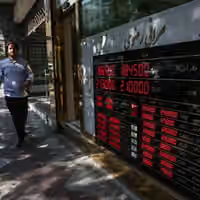
Iran’s economy has been in crisis since 2018, but the Raisi administration, which relied heavily on political appointments from among hardliners, worsened the situation. The national currency, the rial, lost 50% of its value under Raisi, contributing to a persistent annual inflation rate of around 50%. Even conservative politicians and media criticized Raisi’s administration for mismanagement, calling for significant changes. However, the hardliners did the opposite, purging universities and institutions of reputable educators and managers.
While Tayyebnia’s reputation is solid by the standards of Iran’s clerical government, Pourmohammadi was implicated in a major corruption case in 2011 involving corruption in clandestine efforts to circumvent UN oil export sanctions imposed due to Iran’s nuclear program. He was arrested as a main suspect but later released on bail, though the fate of nearly $3 billion remains unknown. Some others involved served lengthy prison terms or fled the country. In the Islamic Republic, legal cases involving well-connected insiders often disappear into obscurity without clear resolution.
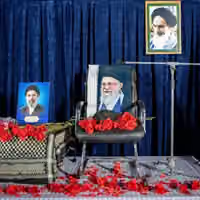
Pezeshkian faces pressure to improve the economy, with Tehran hoping for renewed negotiations with the United States that could lead to reduced sanctions. However, the ultimate decision-maker on the nuclear program and foreign policy is Supreme Leader Ali Khamenei. The president’s ability to improve the economy is limited by the resources available, and a significant portion of oil revenues is allocated to the military, the nuclear program, and support for regional proxy forces across the Middle East—policies over which the president has no control.
Years of state control over the economy have also led to a deeply inefficient system plagued by corruption. Even without sanctions, creating a competitive global economy would be a significant challenge.