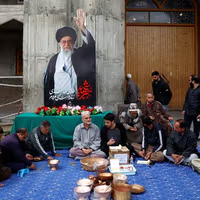
Iranians gather for the funeral procession of assassinated Hamas chief, Ismail Haniyeh and his bodyguard Wasim Abu Shaaban, in Tehran, Iran, August 1, 2024. Iranians attend the funeral procession of assassinated Hamas chief, Ismail Haniyeh in Tehran, Iran, August 1, 2024.Two clerics hold posters of assassinated Hamas chief, Ismail Haniyeh during his funeral procession, in Tehran, Iran, August 1, 2024.
Iran's Islamic government held a symbolic funeral for Hamas leader Ismail Haniyeh who was killed in the early hours of Wednesday at his guesthouse in Tehran.
The ceremony began in Tehran University at 8:00 in the morning local time and Supreme Leader Ali Khamenei led the prayer. Haniyeh's body will be taken to his host country Qatar for burial.
His killing, attributed to Israel has shocked the Iranian government and observers world wide who see the assassination as a humiliation for the Islamic Republic.
Amid growing concerns over transparency and foreign influence, US lawmakers are intensifying their scrutiny of the Biden administration's handling of Iran-related affairs.
On Tuesday top lawmakers overseeing US foreign policy threatened to subpoena the State Department following the agency’s failure to provide information about suspended Iran envoy Robert Malley. Meanwhile, on Wednesday other US lawmakers raised concerns about potential Iranian influence within the Biden administration, specifically questioning Vice President Kamala Harris’s national security advisor, Philip Gordon.
In a letter to Secretary of State Antony Blinken, US Senate Foreign Relations Committee Ranking Member Jim Risch and House Foreign Affairs Committee Chairman Michael McCaul expressed deep frustration with the State Department's lack of transparency regarding the suspension of Robert Malley's security clearance. They condemned the Department's failure to respond to repeated inquiries since June 2023 as "deeply troubling" and unacceptable.
The lawmakers demanded the Department "provide fulsome answers" to their queries by no later than close of business on August 2, 2024. They warned that should the Department miss this deadline, they would be "compelled to pursue compulsory processes to secure any documents, materials, and testimony" relevant to their investigation from members of the State Department.
Risch and McCaul emphasized that they sent a letter on May 6, 2024, requesting immediate answers but have since received more information from the press than from official channels. They stated, "We have been made aware that there may be a classified response to our letter but have yet to receive it. This vague assurance, however, failed to include any information on when we could expect your reply or whether it would address all of our questions." Risch had previously stated that it was likely they would not get any answers unless they issued a subpoena.
In late May, Semafor reported, quoting people familiar with a Congressional probe into Malley's handling of classified information, that Biden’s Iran envoy transferred documents to his personal devices “with classifications ranging from sensitive but unclassified to classified,” and may have shared some with unauthorized people, “to advance his diplomatic efforts.” Among the documents downloaded by Malley on his personal devices, Semafor reported, were "detailed notes of the diplomat’s encounters with Iranian officials in the months leading up to his suspension.
Malley was appointed by President Joe Biden in early 2021 to revive the 2015 Iran nuclear deal, advocating for sanctions relief in exchange for nuclear restrictions. Despite efforts, the deal has not been reinstated since Trump's 2018 withdrawal. In April 2023, Malley was placed on leave and had his security clearance suspended. Iran International first reported the incident two months later, but the State Department blocked all attempts to find more information about Malley’s case.
Separately, on Wednesday US Senator Tom Cotton and US Congress Member Elise M. Stefanik Elise M. Stefani wrote to Vice President Kamala Harris regarding her national security advisor, Philip Gordon's connections to Ariane Tabatabai, a senior Department of Defense official involved in an Iranian government operation to expand Tehran’s influence in the United States.
In 2023, Iran International and Semafor investigation uncovered the Iran Experts Initiative (IEI) - a scheme devised by Iran’s foreign ministry in 2014 to bring together a network of scholars outside Iran to advocate Iran's foreign policy and nuclear strategy. A few were been named in the report, including Ariane Tabatabai, who entered the State Department after Biden was elected.
Cotton and Stefanik cited Mr. Gordon's past collaborations with Ms. Tabatabai and his associations with the National Iranian American Council (NIAC), an alleged Iranian influence organization.
"We write to express concern about your national security advisor Mr. Philip Gordon’s connections to Ms. Ariane Tabatabai," Cotton and Stefanik stated in their letter. They added that Ms. Tabatabai was "reportedly involved in an Iranian government operation to expand Tehran’s soft power in the United States."
Cotton and Stefanik requested answers to several questions, including whether Mr. Gordon underwent security screening, his awareness of Ms. Tabatabai’s connections, and what actions Vice President Harris plans to take to address Iranian sympathizers within the administration. They set a deadline of August 9, 2024, for a response.
Details surrounding the operation that led to the killing of Hamas leader Ismail Haniyeh in Tehran remain unclear. Neither Iran nor Israel, which is suspected of being behind the operation, has provided specifics.
Yet, there are numerous reports that may provide clues for experts to speculate on how the operation was carried out – and whether it involved advanced weaponry or a sophisticated drone strike.
Where and when?
In one of its statements, the IRGC announced that the attack resulting in Haniyeh's death occurred at two in the morning and stated that he was killed by "a projectile from the air" while stationed at one of the "special residences for war veterans in northern Tehran."
Hours later, the Iran-aligned Lebanese network Al-Mayadeen reported that the missile used to attack Haniyeh's residence was launched not from within Iran, but from another country.
Since then, however, Israel’s Channel 12 reported that Iranian officials were coming to the conclusion that the projectile was actually fired from within the country’s borders.
Where did Haniyeh reside in Tehran?
Although the Iranian state’s Fars news agency reported that Haniyeh was staying at a special residence for war veterans in northern Tehran, little is known about the building.
Some unofficial sources inside Iran, have suggested that Haniyeh could have been killed near the Saadabad Palace – a historic royal complex located in the northern part of Iran’s capital. Boasting hundreds of acres, the complex has been used by the Islamic Republic for various official events for many years.
Some reports have also suggested that the Basij al-Zahra camp in the northwest of this complex was Haniyeh’s residence.
The building in Saadabad complex where Haniyeh was staying.
During President Akbar Hashemi Rafsanjani's administration, leading up to the Islamic Summit Conference in Tehran in 1991, a building was reportedly constructed at Saadabad Palace to accommodate special guests. This facility might have been used to host distinguished visitors, although specific details about Haniyeh’s residence there are not well-documented.
Was there an explosion?
Some local witnesses reported hearing an explosion in the Saadabad area early Wednesday morning.
State-run media outlet Tejarat Online published a story that suggested that the explosion's sound was "so loud that it triggered all the car alarms and was heard throughout northern Tehran, with smoke and dust from the explosion covering the area."
According to sources connected to Hamas, the building targeted in the attack was also occupied by his bodyguard, Ziad Nakhalah, the leader of Islamic Jihad, along with a Hamas delegation.
So far, however, there have been no reports indicating that these individuals were harmed.
In addition, no reports have emerged about other residents of the building being injured, leaving the door open to assume that despite the precision of any operation to kill Haniyeh, the explosion's power and intensity were likely limited.
Missile vs drone?
Although the IRGC's statement referred to "a projectile from the air," the origin of the projectile remains unclear.
Sky News Arabia reported that based on its Iranian sources, that the building Haniyeh was in, was targeted by a missile fired from a nearby building.
Aerial projectiles can be launched from either fighter jets or military drones. For such strikes, military aircraft would typically utilize the airspace of neighboring countries. While using the airspace of other countries without authorization and conducting operations near border areas is challenging, it is not impossible.
In Israel’s April attack on the 8th Tactical Airbase in Isfahan, American officials confirmed that Israeli aircraft launched three missiles from outside Iran's borders targeting a radar site protecting the Natanz nuclear facility. Iranian officials, however, attributed the incident to enemy drones at this military base.
According to Israeli Channel 14 military correspondent Hallel Bitton Rosen, however, the attack was not carried out by launching a missile, but with another weapon that exploded close to him.
Drawing on Israel’s past operations, the country has a history of conducting drone attacks on Iranian soil.
In February 2023, the Wall Street Journal reported that Israel was responsible for a drone attack on a Defense Ministry workshop complex in Isfahan and an explosion at a munitions center in the city. Iranian officials described the attack as "unsuccessful" and stated that it caused only limited damage.
What are some experts saying?
Israel has not claimed responsibility for the attack, but one Israeli and two US officials told Axios that Israel was behind the strike.
About two hours before Haniyeh’s death, Richard Goldberg, a senior advisor at the Foundation for Defense of Democracies, appeared to allude to the attack, saying "The Israeli Air Force is demonstrating its range tonight."
After the news of the killing of the Hamas leader broke, Goldberg, in reference to Israel striking Iran previously, posted on X: "If you can hit a radar next to a nuclear site, you can hit a house in Tehran. Ayatollah is exposed."
Major Andrew Fox, a researcher at the Jackson Institute and a former British paratrooper, told Iran International English that the attack might have been carried out with a missile launched from outside Iran. According to him, the Caspian Sea, given its proximity to Tehran, is a suitable option for this operation.
Fox, drawing on his experience and emphasizing that such missiles are guided with precise laser technology, said: "A soldier on the ground targets the laser pointer exactly at the point where he wants the missile to hit, guiding the missile to the impact point."
The expert also noted that Israel has missiles designed to use the kinetic energy from the speed and weight of the warhead for lethality. This explains why, in some missile attacks, fewer casualties and less noise are observed compared to those with explosive warheads.
Ronen Solomon, an Israeli intelligence and security analyst, highlighted the proximity of Baku and Tel Aviv, as well as Azerbaijan’s common border with Iran. He suggested that the use of Azerbaijani airspace for the attack is highly likely due to the short distance and the presence of Israeli weapons in the region.
The US was not aware of or involved in the reported assassination of Hamas leader Ismail Haniyeh, the US deputy ambassador to the UN said in an emergency meeting of the UN security council.
Robert Wood asked the UNSC members that can influence Iran to use their influence on the country to de-escalate and reduce tensions in the region.
"Every member of this council should call on Iran to stop arming, advising and financing terrorist groups and to rein in the actions of proxies and partners who threaten regional peace and security," Wood said.
The US is "very worried" about reactions to the assassination of Hamas leader Ismail Haniyeh, the US deputy ambassador to the UN Robert Wood told Iran International on the sidelines of a security council meeting.
The emergency meeting has been convened at Iran's request.