Pezeshkian welcomes Houthi actions against Israel, maritime navigation
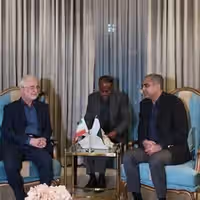
In a meeting with Mohammed Abdul-Salam, the spokesman for Yemen's Houthi Ansarullah movement, Iranian President Masoud Pezeshkian praised the group's recent actions against Israel and maritime navigation.
"Your actions have clearly put pressure on the Zionist regime and its supporters," Pezeshkian said.
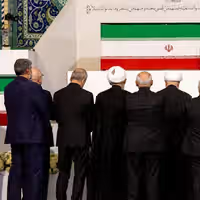
The meeting took place as Abdul-Salam visited Tehran to attend the swearing-in ceremony of the president-elect. The Iranian president further emphasized the need for collaboration among Islamic countries, stating, "We must work with Islamic countries to end the oppression of Muslims."
A person mourns as he embraces the picture of his loved one killed at a soccer pitch by a rocket Israel says was fired from Lebanon, in Majdal Shams, a Druze village in the Golan Heights, July 29, 2024.
The sounds of grief and images of white caskets as parents buried their children, killed by an Iran-made rocket launched from Lebanon into a remote Druze village, underscore the region's uncertainty and fears of a wider war.
A deadly rocket strike on Saturday in Majdal Shams village in the Israeli-occupied Golan Heights killed 12 children playing soccer, becoming the latest victims in a suspected Hezbollah attack on Saturday.
12 children and youth killed by a Hezbollah rocket in Majdal Shams on July 27, 2024 (Photo: Israeli Ministry of Foreign Affairs)
The Druze are an Arabic-speaking ethno- religious group who adhere to the Druze faith, residing in Israel, Lebanon, Syria and Jordan.
The scale of the massacre is the largest civilian loss in Israel since October 7. Druze and Israelis are still mourning and coming to terms with the immense loss, said Anan Wahabi, a lecturer at the University of Haifa, specializing in national security.
Wahabi is also a Druze-Israeli.
“It was unprecedented attack that killed the innocent and beautiful children. Their only guilt was just to come and to try and play football,” he said.
The complex situation of the Golan Heights Druze has been highlighted in the most tragic way possible. Wahabi said those in the area had longstanding Syrian identity in the past, but now have a growing affiliation with Israel, especially the younger generation, some of whom serve in the Israeli military. They are not forced to serve and volunteer should they enlist.
The people of Golan Heights are residents of Israel and an increasing number are choosing to become Israeli citizens. Since the Syrian civil war, and October 7, Israeli citizenship by Druze in that area, jumped significantly. In contrast, other Druze in Israel, serve in the military and police, including the war against Hamas with many reaching high ranks in the IDF and government.
After the 1967 Mideast war, Israel captured the Golan Heights from Syria - and effectively annexed it in 1981.
For the Druze, their identity and history is complex and multifaceted.
“I must tell that the first identity is the Druze identity for them, and we have our own flag. Secondly there is the national identity. We've gotten a lot of messages from all parts of the Israeli society giving condolences and standing with us in this very hard time,” said Wahabi.
The Druze in Syria are angry said Wahabi, calling Hezbollah, which translates to the party of God in Arabic to the party of the devil, instead. He said the Druze in Lebanon are not speaking up and are trying to avoid confrontation, with the Iran-backed Shiite military organization that dominates the country.
"We could hear voices, from the Syrian Druze calling Hezbollah, Hezbsheytan; the party of the devil."
No escaping Geopolitics:
But there is no escaping the geopolitics of the region no matter the ethnic or religious identity.
IDF Spokesman Rear Adm. Daniel Hagari said in a press conference from the scene the rocket that struck Majdal Shams was an Iranian-made Falaq-1. The rocket identified as having had 53 kg load of explosives.
US intelligence officials said there is no doubt that Hezbollah carried out the attack, however, what is not clear is if the children were the target or if they misfired.
Israeli officials were quick to offer support to the community and pointed the blame at Tehran.
Prime Minister Benjamin Netanyahu promised a “harsh response” during a visit to Majdal Shams Monday.
Hezbollah denied responsibility but said it had launched strikes on what it said were military targets in nearby areas.
"A Jewish child murdered on the Gaza border on Oct. 7 and a Druze child murdered on the Golan Heights are the same. These are our children," Defense Minister Yoav Gallant said Monday while with the Prime Minister in Majdal Shams.
A turning point?
Some experts believe the deadly incident involving youth could be a turning point in the conflict.
The FDD’s Behnam Ben Taleblu said Israel’s response will likely be severe, referring to it as “deterrence by punishment.”
“The question is really where and when,” said Taleblu.
Taleblu said a number of factors, like America’s upcoming presidential elections, will determine just how far Israel can go in their response.
“If Israel does look to restore deterrence, it may be a short lived deterrence. Iran, Hezbollah and many of these other actors think there's a longer leash here because the US may want to avoid a military conflict or may want to avoid even the potential for escalation as it gets closer to the election,” said Taleblu.
On Monday, the US declared support for Israel but also cautioned its Middle East ally about escalation with the Iranian-backed Hezbollah.
French President Emmanuel Macron urged Iran’s President Masoud Pezeshkian on Monday to “avoid regional military escalation,” according to Élysée Palace.
The Alma Research and Education center based in Northern Israel published an assessment, saying that Hezbollah finds itself in a“Win-Win” situation, where it benefits regardless of the outcome.
The report, by Alma founder Sarit Zehavi, states Hezbollah has a desire to draw Israel into a full-scale conflict with the aim of consolidating power in Lebanon.
"An occurrence of such a large-scale tragedy resulting in several casualties has the potential to provoke a substantial and notable reaction from Israel. Within the upcoming hours and days, we shall ascertain whether this event truly marks a pivotal moment," as written in the Alma report.
Iran's state media says 70 foreign delegations from different countries and international organizations will attend the swearing-in ceremony.
Iranian officials are emphasizing the attendance of many foreign dignitaries as a sign of the Islamic Republic's recognition in the world.
However, except a representative from the EU and a delegation from China that does not include top officials, the other foreign guests represent neighboring countries as well as a few friendly government in Africa and Latin America.
So far Tajikistan’s President Emomali Rahmon and Armenian Prime Minister Nikol Pashinyan and Enrique Mora, the Chief of Staff of EU foreign policy chief Josep Borrell, are among the highest ranking guests.
Archive photo of an Iranian hospital with mothers and their newborns.
Iranian officials are denying claims that a controversial law, which restricts prenatal screenings and limits access to diagnostic test kits for congenital anomalies, has led to an increase in birth defects.
The law, enacted three years ago, has been criticized by experts and human rights groups for violating women's rights to sexual and reproductive health and endangering women's health and lives.
In an interview with the Tehran daily, Etemad, Amir Hossein Bankipour, a former MP and head of the joint commission responsible for passing the law, denied any increase in birth defects over the past 33 months.
He stated, "The numbers remained the same despite the controversy stirred on social media."
Etemad further reported that since the law's enactment, "The Ministry of Health has yet to provide any statistics on birth defects, merely asserting that despite a reduction of 200,000 pregnancy screenings during the law's enforcement, no increase in fetal abnormalities has been observed."
Typically conducted during the first trimester, these tests are employed to identify and assess the risk of various congenital conditions, such as Down syndrome and chromosomal anomalies like trisomy.
Under the "Supporting Family and Regenerating Population Act", screening procedures may only be initiated at the request of the parents or a specialist doctor and only if substantial evidence necessitating the screening is provided. In such cases, families must independently cover the associated costs.
Nevertheless, a ban announced last year has rendered it impossible to access screening kits for congenital anomalies in Iran.
The Health Ministry’s Food and Drug Administration announced it will no longer issue permits for medical kits that serve as diagnostic tools used primarily in prenatal screening and general disease detection.
That includes the production or importation of pregnancy-associated plasma protein-A (PAPP-A), free beta human chorionic gonadotropin (Beta-hCG) and enzyme-linked immunosorbent assay (ELISA) tests.
Khamenei's punitive push to increase population growth
Although recent statistics are unavailable, officials in 2015 reported that the annual rate of children born with birth defects ranged between 50,000 and 70,000. Etemad’s article also suggests a figure of approximately 60,000.
In 2005, based on a fatwa by Supreme Leader Ali Khamenei and several other religious authorities, the "Therapeutic Abortion" act was passed by parliament and approved by the Guardian Council. The law prevented the birth of children in Iran who either endangered the mother's life, had a short and burdensome life expectancy, or possessed chromosomal abnormalities.
Then, fifteen years later, Khamenei publicly changed his stance, commenting on the necessity of increasing the population, stating that limiting the population was a "mistake" and asking God for forgiveness.
Following his remarks, members of parliament introduced the controversial law, which also mandates that government and state entities actively promote marriage and childbearing, imposes penalties for non-compliance, and prohibits any activities endorsing birth control.
Additionally, it bans government health services from offering family planning services, including contraceptives, vasectomies, and tubectomies.
Birth rate continues to decline, despite state's efforts
In a commentary published last year in Etemad, Abbas Abdi noted that the current administration and parliament have invested at least 250 trillion rials ($500 million) annually to increase the birth rate.
Analysts have argued that Khamenei's desire to boost the country's population is underpinned by a strategic aim to bolster Iran's geopolitical influence and sustain the regime's power through demographic manipulation.
Despite these extensive efforts to promote an increase in fertility rates, Iran's Civil Registration Organization has reported a decline in birth rates for the year 2023.
According to official statistics, births fell from 1,075,381 in 2022 to 1,057,948 in 2023.
Critics of the population increase policy argue that the Islamic Republic has failed to enhance living standards, with official statistics showing that over a third of the population lives below the absolute poverty line, and many more endure increasing hardship despite holding multiple jobs.
Nonetheless, Khamenei advocates for Iran's population to reach at least 150 million by 2050, emphasizing this as a purportedly necessary measure to prevent an aging demographic.
The Islamic regime in Iran is weaker than ever before and the country is ripe for a revolution, Iranian exiled Prince Reza Pahlavi told CBN News on Monday.
The 63-year-old prince, in his capacity as a top opposition leader, has long been campaigning for the establishment of "a secular democracy" in Iran and the end of the Islamic Republic's 46-year rule, which started with the 1979 Islamic Revolution that overthrew the Pahlavi monarchy.
In his latest interview with the US-based Christian Broadcasting Network (CBN), Pahlavi said, "When you have a regime that is completely delegitimized when you have people who no longer believe in the system, even if they did at some point and they want out, that makes this system vulnerable."
He further cautioned the United States and Western powers not to be deceived by the election of Iran's new president, Masoud Pezeshkian, referring to him as a “lackey.”
Criticizing the legitimacy of the widely boycotted Iranian presidential elections, Pahlavi remarked, "We call this the circus of elections in Iran." He added, "In all these years, it really didn't matter who was presented because all the shots are ultimately called by Khamenei, the supreme leader."
Official figures released by Iran's Interior Ministry put the turnout in the first round of the elections held on July 28 at 39.92 percent, the lowest recorded since the establishment of the Islamic Republic in 1979.
In February this year, a study by Iran's Ministry of Culture and Islamic Guidance revealedthat approximately 73 percent of Iranians advocate for the separation of religion from state, indicating an unprecedented demand for a secular government.
Referring to this figure, Pahlavi said: "The regime's own figures demonstrate that at least 73% of the population want another form of government."
The confidential study, leaked to foreign-based Persian media outlets, highlights a sharp increase in secularism, with demands for secular governance rising from less than 31 percent in 2015.
The significant change seems to have taken place since large anti-government protests in 2022 and 2023 when the "Woman, Life, Freedom" movement began, representing the most serious challenge to the Islamic Republic in 45 years.
In one of the most important findings of the study, 85 percent said Iranians have become less religious compared to 5 years ago. Only 7 percent said they have become more religious and around 8 percent said they can see no difference in this regard between now and 5 years ago.
A conservative Iranian economist has warned the government to handle its foreign currency reserves with care, considering the possible presidency of Donald Trump and the likelihood of increased US economic pressure.
More than three weeks after the election of President Masoud Pezeshkian, the specifics of his economic plan remain unclear. His top officials are expected to be announced by Tuesday or Wednesday at the latest. However, it is already known that experienced economic manager Ali Tayyebnia has declined the position of presidential deputy.
Meanwhile, the battered Iranian currency, the rial, remains weak and faces the danger of another sudden fall against major currencies, which would exacerbate the annual inflation rate hovering above 40%.
Kamran Nadri, an Islamist economist, has warned the government to be careful about injecting dollars into the market to support the rial. He has expressed his agreement with remarks by former central bank chief Abdolnaser Hemmati who warned in recent days that dollar injections have failed to strengthen the rial, currently trading at 590,000 per one US dollar.
After Pezeshkian’s election, the rial showed some signs of improvement, but now it appears that the temporary reprieve was due to government intervention in the currency markets.
Iranian economist and banking expert Kamran Nadri
Nadri maintained that the government’s oil revenues have improved since 2021, either because of lax sanctions enforcement by the Biden administration or Tehran’s efforts to boost shipments to China. As a result, the government’s currency reserves are stronger, but that is not a reason for hasty interventions to support the rial.
Iran’s daily oil exports were around 250,000 barrels per day after the Trump administration imposed full oil sanction in 2019, but as soon as the President Joe Biden assumed office, the volume increased. In recent months, Iran has been exporting around 1.5 million barrels daily, mostly to China, using illicit methods to hide the shipments.
Nadri, who is an expert in ‘Islamic banking’ warned, "Given the increasing likelihood of Trump's presidency in the United States, we must proceed more cautiously. This means we should anticipate potential issues with oil sales and avoid using all of our current foreign exchange reserves."
Pezeshkian has released a brief outline of his economic objectives, where he acknowledges the serious impact of sanctions, stating that with current budgetary restrictions it would not be possible to alleviate the hardship people endure. Even if an agreement with the United States is reached soon, it will take about two years for its positive economic impact to become noticeable, Pezeshkian’s plan stated. Therefore, Pezeshkian believes that the government should rely on controlling expenditures in the first two years of his presidency.
One of the main areas of budgetary outlays is expenditures on the nuclear program, the military and Iran’s proxy forces throughout the Middle East. However, these are Supreme Leader Ali Khamenei’s red lines. Pezeshkian has already shown his readiness to continue support for the likes of Hamas and Hezbollah, while the Houthis in Yemen are engaged in daily conflict with Western navies in the Red Sea. As a result, Iran must equip and pay tens of thousands of militias in at least five countries, including Syria and Iraq. Essential domestic expenditures have already been cut to the bone, with around 30 million people having descended below the poverty line.
The only remaining savings can come from reducing energy subsidies, which means increasing prices for gas, electricity and gasoline. This is what most experts expect Pezeshkian’s administration to do, risking protests and upheavals, like what took place in November 2019, when gasoline prices were raised and nationwide protests broke out, killing 1,500 civilians.
The president’s plan also mentions cutting the volume of dollars provided at lower rates to importers, a scheme that is a cesspool of corruption. But imports with more expensive dollars means higher consumer prices, something the Islamic government has tried to avoid not to risk a backlash by the population.
Pezeshkian also acknowledged in his brief draft economic plan that the country’s government-controlled banks are in deep trouble with tens of billions of dollars’ worth of uncollectible loans, mostly to inefficient government enterprises and individuals with strong political connections. However, this would necessitate major reforms in both the political and economic systems, a tall order for a president who has vowed not to introduce big initiatives.