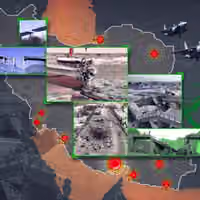
Israel launches retaliatory strikes against Iran-backed Houthis
A huge fire caused by the Israeli airstrike on Yemen's Hodeidah on July 20, 2024.
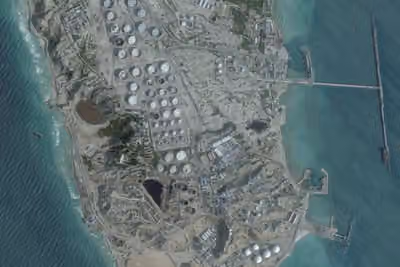
The Israeli military launched airstrikes against the positions of Iran-backed Houthis in Yemen's Hodeidah, the IDF confirmed on Saturday, one day after a fatal Houthi drone attack against Tel Aviv.
A huge explosion rocked an area near the US embassy in Tel Aviv early Friday, killing one and injuring 10 others. Yemen's Houthi rebels claimed responsibility for the unprecedented attack, saying they used a new explosive drone.
On Saturday, IDF fighter jets struck military targets of the Houthis in the area of Hodeidah Port in Yemen "in response to the hundreds of attacks carried out against the State of Israel in recent months," the Israel Defense Force said in a statement.
The Israeli airstrikes targeted gas and oil depots and a power station in the area of Yemen’s Red Sea port of Hodeidah, The New York Times reported, citing two regional sources.
Israeli Prime Minister Benjamin Netanyahu said the port struck by Israeli fighter jets in Yemen was used as an entry point for Houthi militia to receive Iranian weapons.
Netanyahu said the strike, some 1,800 km (1,120 miles) from Israel's borders, was a reminder to enemies that there was no place that Israel could not reach.
Israeli defense minister Yoav Gallant (left), Prime Minister Benjamin Netanyahu (center) and IDF Chief of Staff Halevi overseeing the IDF operation against Houthis on July 20, 2024.
Israeli Defense Minister Yoav Gallant also said, “The fire that is currently burning in Hodeidah is seen across the Middle East and the significance is clear. The Houthis attacked us over 200 times. The first time that they harmed an Israeli citizen, we struck them. And we will do this in any place where it may be required.”
Al Arabiya says 12 Israeli aircraft, including an F35, targeted the port. Israeli officials say surface-to-surface missiles were also used in the air raids.
Israel acted alone on Saturday, with no American military involvement, four US officials told The New York Times. However, the country updated its allies prior to carrying out the strike, an unnamed Israeli military official told Reuters.
The US "fully recognizes and acknowledges Israel's right to self-defense," even though it "was not involved in the Israeli strikes (on Yemen), nor did it coordinate or assist Israel with the strikes," the White House National Security Council said.
Several people have been killed and injured in the Israeli airstrikes on Hodeidah port, Houthi-affiliated media reported citing the group's Health Ministry.
"A number of citizens were seriously burned as a result of the Israeli enemy raids on Hodeidah," the Ministry said.
Iran's Foreign Ministry spokesman strongly condemned Israel's airstrikes on Yemen, warning about the danger of escalating tensions and the spread of war in the region as a result of Israel's "dangerous adventurism".
Nasser Kanaani also noted that Israel and its sponsors including the US government are "directly responsible for the dangerous and unpredictable consequences of the adventurist attacks on Yemen."
On Saturday night, the IDF confirmed there have been initial reports of explosions in the Israeli port city of Eilat, adding that the reports are "under review".
This came after the Houthis' military said their armed forces "will respond to Israel's blatant aggression and will not hesitate to strike the vital targets of the Israeli enemy." It added that Tel Aviv will be an "unsafe" area from now on.
The Houthis' spokesman Mohammed Abdulsalam also said the Israeli raids won't stop the rebels' attacks "in support for Palestinians".
"Pressuring Yemen to stop supporting Gaza is a dream that will not come true for the enemy. This brutal aggression will only increase the determination, steadfastness, persistence, and continuation of the Yemeni people and their valiant armed forces in supporting Gaza," Abdulsalam said.
The Iran-backed rebels have seriously disrupted international commercial shipping in the Red Sea by attacking cargo ships and tankers since November. The US and Britain have retaliated several times against Houthi military targets without deterring the militia ruling over more than half of Yemen.
The situation escalated early Friday when the Israeli defense system, for the first time, failed to intercept a Houthi drone directed at Tel Aviv.
"An initial inquiry indicates that the explosion in Tel Aviv was caused by the falling of an aerial target, and no sirens were activated. The incident is under thorough review," the Israeli military said in a statement.
It was not clear how a relatively slow-moving drone evaded extensive Israeli air defenses. In April when Iran fired nearly 350 drones and missiles, 99% were intercepted and no real damage was reported.
The Houthis' drone attack on Tel Aviv came after the Israeli military confirmed it had killed a senior commander of the Iran-backed Hezbollah militia in southern Lebanon.
In Friday comments which were published by the IDF following the attack on Houthis, the IDF chief of staff Herzi Halevi said Israel is indeed "operating against Iran."
"Everything is connected. It's all Iran. This UAV is Iranian. The Houthis took it, upgraded it, made its range longer, and this is Iran, and the funds for the tunnels here is from Iran, and we are operating against Iran with great determination. In the end, it’s an octopus, it has many arms, you struggle with one arm here, you struggle with others there, and we must understand this matter. It demands excellence against each one. You have to really excel and be very effective in combat," he told Israeli troops in Rafah. "A professional operation here influences all of Iran’s proxies."
Amid calls for President Joe Biden to drop out of the presidential race, criticism of his Iran policy has erupted beyond the Republican National Convention, fueled by major flashpoints such as Houthi aggression and Iran's nuclear program.
At 81, President Biden is under mounting pressure from his own party to step aside following a poor debate against Republican nominee Donald Trump, which sparked concerns about his age and viability ahead of the November election.
In response, Biden has defiantly countered these calls, insisting he remains the preferred candidate among Democratic voters. As recently as Wednesday, he affirmed his commitment to the 2024 race, stating, "I am all in."
Joe Biden’s approach, often labeled as lenient by critics, has been under fire for some time, but now, with elections looming, the criticism has reached a fever pitch.
Recent developments have brought the issue to the forefront, making it more relevant than ever for US politicians and Iranians as well.
Early Friday morning, an Iranian-made drone launched by Yemen’s Houthi rebels detonated in Tel Aviv, claiming the life of one person near a US embassy branch. The incident, the first Israeli casualty amidst a spate of Houthi drone attacks on Israel in recent months, has US lawmakers clamoring for the State Department to reclassify the Iran-backed militant group as a Foreign Terrorist Organization (FTO). This label would pave the way for more robust US sanctions and targeting.
Ritchie Torres (D-NY) took to X to voice his critique, stating: “The message of the Houthis, an Iranian proxy armed with Iranian drones, couldn’t be clearer: ‘Death to America. Death to Israel. Curse upon the Jews.’ The time has come for the US State Department to designate the Houthis as a ‘Foreign Terrorist Organization.’”
Congressman Mike Lawler (R-NY) expressed his dismay on X: “This latest Iran-backed Houthi drone attack against civilians in Tel Aviv is shocking. Iran and the Houthis must be held accountable.”
The sentiment was also echoed by Rep. Randy Feenstra (R-Iowa), who strongly condemned the attack on Israel by the Houthis, describing them as terrorists funded by Iran with no regard for human life.
President Trump had placed the Houthis on the FTO list. Still, President Biden quickly reversed this decision, arguing that branding the Houthis as terrorists would throw a wrench in the delivery of crucial humanitarian aid to Yemenis in desperate need.
Another development fanning the flames of criticism on Friday came straight from the Biden administration's admissions. US Secretary of State Antony Blinken issued a stark warning, stating that Iran could produce material for a nuclear bomb in a mere week or two if it chose to do so. This statement only intensified the scrutiny of Biden's Iran policy.
Rep. Elise Stefanik (R-NY) attributed this escalation to what she described as President Joe Biden’s “failed leadership,” arguing that it has encouraged US enemies. "We must return to President Trump’s peace through strength strategy," she asserted, advocating for a more assertive approach.
Senator Ted Budd (R-NC) criticized the Biden-Harris administration's approach, attributing Iran's proximity to obtaining nuclear weapon material—just one to two weeks away—to what he described as their "weakness and appeasement." Budd emphasized the need to "return to a policy of maximum pressure" to address the escalating threat.
Another wave of criticism erupted last week during the Republican National Convention from July 15-18, where prominent speakers lambasted President Joe Biden’s Middle East policies. Accusations of appeasement and "putting America last" echoed through the convention hall as Republican members of Congress, along with several former officials and diplomats, took aim at the Biden's Iran policy. They argued that the Democrats’ policies since 2021 have not only made the US unsafe but also weakened its standing on the global stage.
Additionally, the US presidential candidates' tone during the campaign plays a pivotal role in shaping this narrative.
During the final leg of his presidential campaign in 2020, Joe Biden pledged to revive the Joint Comprehensive Plan of Action (JCPOA). Critics argue that this stance emboldened Iran, prompting it to adopt a stricter negotiating position and accelerate its uranium enrichment, believing it had gained a strategic advantage. Consequently, negotiations stalled as Iran's expectations soared, leading to an impasse in diplomatic efforts.
This is something the Biden administration has acknowledged. In a 2022 interview with Foreign Policy, former US Special Envoy for Iran Robert Malley admitted that the US and Iran came very close to reviving the 2015 nuclear deal multiple times. However, Iran stepped back each time, introducing new demands often unrelated to the nuclear negotiations, leading to repeated setbacks in reaching a final agreement.
The Biden administration released $16 billion in frozen funds to Iran for reported humanitarian purposes such as food and medicine. Critics, however, argue that this move indirectly bolsters Iran's military and proxy activities by freeing up other resources.
Critics contend that the administration’s lax enforcement of sanctions has allowed Iran's oil sales to skyrocket. Since Biden took office, Iran's oil exports have surged from around 300,000 barrels to 1.5 million barrels per day, primarily driven by increased sales to China. This surge has generated approximately $80 billion for Iran, providing significant financial resources to support its military and proxy groups across the Middle East, including Hamas and Hezbollah.
A deadly drone attack in Tel Aviv by Iran-backed Yemeni Houthis marks a dangerous escalation, representing a broader conflict between Iran and the West, according to a prominent Middle East expert.
One person was killed and at least ten people injured in the drone attack, which happened around 3 a.m. local time Friday.
Evidence from the aftermath shows it was an Iranian-made drone Samad- 3 model sent by Houthi rebels that struck very close to the US consulate, which was the site of the former US Embassy in Tel Aviv.
Until Friday, Houthi drones or missiles directed at Israel had all been intercepted. Israel's military is investigating why it missed the drone. However, the Houthis have seriously disrupted international commercial shipping in the Red Sea by attacking cargo ships and tankers since November. The US and Britain have retaliated several times against Houthi military targets without deterring the Iran-backed militia ruling over more than half of Yemen.
US warplane taking off to attack Houthi targets in February 2024.
Alex Selsky, an advisor to the Middle East Forum, said the explosion proves that this is not a war between Israel and Iran's proxies, but rather a broader conflict that is being fought in Israel. He said Israel is a symbol of the United States and the West in the Middle East, and pays a price for it.
"It proves again and again that it's not only about Gaza, it's not only about Lebanon, and it's not only about Israel. It's about the United States and the West. Because no such attack can be executed without minimum coordination, maximum instruction from Iran. And no such thing can be done without Iran being backed by its biggest allies: Russia and China," said Selsky.
Selsky, who was also a former advisor to Israeli Prime Minister Benjamin Netanyahu, said the timing of the attack and location are significant.
The strike happened just as former President Donald Trump, gave his keynote address at the fourth and final night of the Republican National Convention (RNC) Thursday evening in Milwaukee just five days after an assassination attempt that could have ended his life. Then the drone attack taking place near the US consulate in Tel Aviv.
Selsky said ultimately no one knows for sure if that was all intentional but when you connect the dots a pattern does appear.
Beni Sabti, an expert on Iran from the Israeli National Security and Strategy Institute (INSS) said the drone attack in Tel Aviv exposes a weakness in Israeli defensive strategy policy, that may embolden its adversaries if action isn't taken.
The cornerstone of Israel's national security strategy is its 'defensive strategy,' reflecting its preference to manage conflicts as much as possible.
"It's the time that Israel has to show itself and its capabilities and its quality," Sabti told Iran International.
He made an analogy to a soccer match, saying you can't always be on the defense when you're playing, you have to also attack to win the game.
"You cannot only defend. You have to go to the source to neutralize it, even if it's in Yemen. If you don't want to deal directly with Iran, then we need to deal with the shooter. If we don't go to the head, we have to deal with the fingers or the hands that are doing it," he said.
In April Iran launched a massive barrage of 350 missiles and drone at Israel. Israeli air defenses and allies warplanes shot down 99% of the projectiles, but it was the first time that the Islamic government in Iran dared to directly target Israel. There was a limited Israeli retaliation against one target in Iran and since then no escalation took place.
The IDF posted to X on Friday "regardless of who pulls the trigger, we know who is the loading the gun."
Israeli officials are hinting of a possible response on Yemeni territory with a retaliatory attack under consideration, according to the Jerusalem Post.
An official comment has not been made yet by Prime Minister Benjamin Netanyahu, but IDF Spokesperson Daniel Hagari posted to X addressing the latest attack.
“We are fighting a multi front war. Hamas in Gaza, Hezbollah in Lebanon, the militias in Iraq and Syria, as well as the Houthis in Yemen, all the Iranian proxies, and Iran itself.”
A spokesperson for the Houthis, Yahya Saree, said they would continue to attack Israel, according to Reuters.
There are fears of wider regional conflict with Israel exchanging daily missiles and artillery fire from Hezbollah since the war in Gaza.
Trump's former aide John Bolton told Iran International that a reported Iranian plot to assassinate the former president during the US election campaign would be surprising, as anyone in that situation would take it "personally."
The former US national security adviser and long-time proponent of regime change in Iran told the ‘Eye for Iran’ podcast that despite the reported plot, there’s no indication Tehran had any involvement with Trump’s assassination attempt in Pennsylvania on Saturday.
Iran has vowed revenge for the killing of Qasem Soleimani, the commander of the Islamic Revolutionary Guard Corps (IRGC), who was killed in a US air strike in January 2020 on orders from then-President Trump.
Many of the Trump administration officials, as well as the former US president himself, were threatened by high ranking Iranian officials, including the Supreme Leader Ali Khamenei in January 2021.
Threats continued to come as late as February 2023, when Amir Ali Hajizadeh, the IRGC Aerospace Commander, appeared on Iranian TV to say, “God willing, we will kill Trump, Pompeo, [Frank] McKenzie, and the military commanders who ordered [Soleimani’s assassination].”
"We've known of the threat against President Trump... but this [plot] is surprising" Bolton told podcast host Negar Mojtahedi on Wednesday.
"This seems to be the first indication of the regime in Tehran actually taking some step toward going after Trump. And to do it in the middle of a presidential election campaign where Trump was at least competitive as they began planning a possible assassination, I do find surprising," Bolton added.
When asked about Iran's apparent silence to the news of Trump's attempted assassination, Bolton said it was "at least indirect confirmation" that Tehran was seeking to target the US president.
"Maybe the regime is trying to come up with creative new ways to go after its enemies... I think it's appropriate to take it seriously and it's potentially not simply a threat."
Iran has secretly agreed to support Al-Qaeda fighters in Afghanistan and fund the group's operations in the Middle East, according to Afghanistan United Front (AUF), an opposition group.
The AUF’s report detailed an October 2021 meeting in Tehran, where IRGC Quds Force commander Esmail Qaani, Al-Qaeda leader Saif al-Adel, and a senior Taliban representative agreed on cooperation between Al-Qaeda and IRGC-affiliated groups in the Middle East and Africa. This marked the first recorded in-person meeting of these senior officials. The agreement involved the Taliban providing training space and tools for Al-Qaeda fighters in Afghanistan, while the IRGC covered their expenses and funded operations.
The alleged meeting took place just two months after the Taliban overran Afghanistan and the US hastily withdrew from the country after a 20-year military and political presence.
According to UAF, Qaani congratulated the Afghan Taliban and Al-Qaeda on their success in Afghanistan, stating, "We all have done a great job; now we need to chase the Americans out of the Middle East as well."
The report noted that the first important point they agreed on was that all Al-Qaeda branches, affiliate groups, and the IRGC in the Middle East and Africa would collaborate, with both sides working to broker peace among them.
“The first peace was brokered between the Houthis and Al-Qaeda in the Arabian Peninsula, which still holds, and coordination with Hezbollah and groups in Iraq and Syria is now operational" the report said. “The second point was that the Afghan Taliban should provide space and tools for training the Al-Qaeda fighting force."
“The last point was that the IRGC is willing to pay for all their expenses in Afghanistan and their overseas operations in the Middle East as well,” the document added.
The report by the AUF, led by Sami Sadat, former commander of the Afghan army's special forces and based in the US, sheds light on the funding and extensive cooperation between the IRGC, Al-Qaeda, and the Taliban, extending to the Arabian Peninsula. Previous reports have also revealed Iran's close ties with Al-Qaeda.
In February, the US State Department told Iran International that Tehran has permitted Al-Qaeda to facilitate terrorist activities and transfer funds and fighters since 2009 while also harboring its leaders within its borders.
In January 2021, then US Secretary of State Mike Pompeo publicly accused the Iranian government of permitting Al-Qaeda to establish a "new home base" within its borders, asserting that "Al-Qaeda today is operating under the hard shell of the Iranian regime's protection."
In February 2023, the UN reported that Seif al-Adel, the apparent new leader of Al-Qaeda, was residing in Iran, a claim later confirmed by US authorities.
Former US President Donald Trump blamed the Biden administration for Iran edging close to nuclear weapons at the fourth and final night of the Republican National Convention (RNC) Thursday evening.
He made his keynote address, appearing somber and bandaged, accepting the GOP presidential nomination at the RNC convention in Milwaukee just five days after an assassination attempt that could have ended his life.
When it came to Iran, from its advancements on the nuclear front to its proxies multi-front campaign against Israel, the presidential candidate didn't hold back, taking strong aim at President Biden and his administration.
"Iran is very close to having a nuclear weapon, which would have never happened. This is a shame...the damage that this administration has done," said Trump to a cheering crowd.
Iran has enriched enough uranium to 60% purity for at least three bombs, according to the International Atomic Energy Agency (IAEA). Iran could convert uranium enriched to 60% to bomb-grade fuel in just a matter of days.
Iran's nuclear gains under Biden's administration, according the FDD's Behnam Ben Taleblu, are irreversible and his approach has led to a "credibility crisis."
"The contradictory approach under Biden of trying to de-escalate and establish deterrence has led to a credibility crisis exploited by US adversaries," he said.
Trump reiterated his claim that Iran was on the verge of agreeing to negotiate a new deal to more strictly curb its nuclear program before Trump lost the 2020 election.
He also said that the Oct 7 atrocities would have never happened on his watch.
"Iran was broke. Iran had no money. Now Iran has $250 billion. They made it all over the last two and a half years. They were broke," said Trump.
Trump's logic being that if Iran is financially struggling, the clerical establishment would find it tough to finance its proxies committing acts of terror.
“I told China and other countries if you buy from Iran, we will not let you do any business in this country.”
In April, President Joe Biden signed into law new sanctions aimed at reducing the flow of Iranian oil to China, which purchases about 90 percent of Iran's oil exports.
A bipartisan group of over 40 US House lawmakers called on the Biden administration to “expeditiously implement” stringent new Iran sanctions targeting the country’s oil exports to China in June.
The FDD's Taleblu told Iran International that the data is clear, under Trump's policy, the Islamic Republic, struggled to pay its proxies like Hamas and Hezbollah.
"Trump's Iran policy drove down both Iranian oil revenues and exports. Through his strategy of cost imposition Tehran struggled to pay its proxies and even keep some of its propaganda stations afloat," said Taleblu.
Trump's statement that the attack on Israel would not have happened with him as president is not new.
Speaking on Iran International's podcast Eye for Iran, which aired before the final night of the RNC, Trump's former National security advisor, John Bolton, said nobody knows what would have happened.
"It's one of those Trump statements that's neither provable nor disprovable. Nobody knows because he wasn't president," said Bolton.
Jason Brodsky, the policy director of United Against Nuclear Iran said Trump understands how to make US adversaries fear the American president.
"There is an important strategic logic to that dynamic. This is something that President Biden has struggled with. This can be seen after Biden warned Iran with “Don’t,” Tehran still launched the first direct attack on Israel since 1979," said Brodsky.