Government announces 10% higher turnout amid rejection by opposition
Announcing the final election results, the government reported 10% increase in turnout compared with the first round on June 28.
Many Iranians opposed to the Islamic government began reacting on social by dismissing the high turnout number.
On Friday, dozens of videos were shared from Iran showing largely empty polling stations, while Supreme Leader Ali Khamenei remarked that the first round turnout was disappointing.
Iranian-American activists hold ‘No to Islamic Regime in Iran’ placards
The Biden administration’s decision to allow Iran to hold votes on US soil sparked controversy on Friday, as Iranian-American activists gathered outside some polling stations to protest against those entering to cast their votes in Iran’s presidential election.
The campaign to boycott Iran’s election has been stronger than ever this year, leading to a record low turnout in the first round of the election. The turnout appears to have improved in the runoff according to official figures.
Outside Iran, the turnout is usually much lower than inside the country. But this time it has been even lower, and the opposition to those voting has been much stronger.
Witness reports and video clips published on social media show Iranian protesters gathering in front of Iran’s Interests Section (IIS) in Washington D.C. and confronting those going in and out. Similar videos have emerged from other polling stations in the neighboring states of Virginia and Maryland.
At least one station (in Tysons, VA) is reported to have been shut down following protests.
The US government had granted permission for 35 polling stations across the country, according to data published on the IIS website. The decision to allow voting for Iran’s election was criticized by activists who say the Biden administration should have followed the Canadian government and refused to allow stations to be set up in the United States.
It is unclear how many of those stations have in fact been set up and collected votes. In the first round, Voice of America conducted a study and found that out of 33 polling stations, 18 likely held voting. This was confirmed through Voice of America contacting 12 hotels and observing 6 stations based on social media images.
The main polling station was the IIS office in Washington DC. Iran International’s Ardavan Roozbeh, who spent the day outside the premises, said Iranian officials seemed to have purposefully scheduled many consular appointments for election day to drag Iranians to IIS to create a “participation illusion.”
“About 50 people were queuing from 8am, holding their passports and other documents,” Roozbeh said. “It seemed like they were queuing to vote, but they were just there for consular services and had no option because their appointment was scheduled for that day.”
The IIS represents the Islamic Republic in the US and offers consular services to Iranian-Americans.
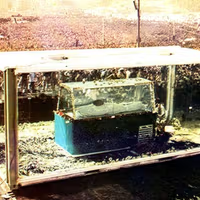
Photo shared by The Baloch Campaign of minibus incident in Iran's eastern Sistan-Baluchestan province July 5, 2024.
A minibus sent to collect votes from Sunni worshippers at a grand mosque in Saravan, in Iran's eastern Sistan-Baluchestan province, was set on fire, according to rights groups.
An ethnic rights advocacy group, the Baloch Campaign, reported that the bus "left the area without collecting any votes." Apparently, the blaze was put out enabling the vehicle to drive away.
This incident follows last week's violence when unidentified assailants attacked a vehicle transporting election boxes in Sistan-Baluchestan Province just minutes after voting concluded in the first round of presidential elections at midnight on June 29.
The assault reportedly resulted in the deaths of two security personnel and injuries to several others, according to Iran's state news agency IRNA. Additionally, one of the assailants was also killed.
Sistan-Baluchestan experienced significant unrest during the nationwide protests following the death of Mahsa Amini in custody, recording the highest number of casualties among Iran's 31 provinces.
The province remains a hotspot for protests fueled by unemployment, water shortages, and security policies perceived as targeting the Baluchi minority.
While no official result has been declared yet, the IRGC-affiliated Tasnim News says Masoud Pezeshkian has taken the lead over his ultraconservative contender Saeed Jalili in Iran's runoff presidential election.
Raja News, a media outlet close to Jalili, also reports that Pezeshkian is expected to win with nearly 16 million votes.
Citing "statistical analysis and field estimates", Raja News said almost 13 million people have voted for Jalili.
The figures, however, are not official, and Iran's Interior Ministry is expected to announce the final results in coming hours.
Political prisoners in Tehran’s notorious Evin Prison and Ghezel Hesar Prison in Karaj abstained from voting for the runoff presidential elections, just as they did last week.
“More than a hundred political prisoners [in Evin prison] refused to participate in this unfair and unjust process, standing firm in their pro-freedom ideals,” former political prisoner Mehdi Mahmoudian wrote on X.
Nobel Peace Prize laureate Narges Mohammadi, reformist politician Mostafa Tajzadeh, and former MP Faezeh Hashemi Rafsanjani are among the prisoners who boycotted the elections. Others include Abdollah Momeni, Mohammad Najafi, Alireza Beheshti Shirazi, Reza Shahabi, Rasoul Bodaghi, Behzad Ghorbanian Nejad, Amir Salar Davoodi, Vida Rabbani, Sepideh Gholian, Golrokh Iraee, and Maryam Yahyaavi.
In recent weeks, numerous dissidents, from those in prison to those active on social media, have publicly declared that the upcoming election is a manipulated facade rather than a genuine democratic process.
Amirsalar Davoudi, a lawyer incarcerated in Evin Prison, denounced the election as a "selection" in a letter from prison. He refused to participate, asserting that the Islamic Republic follows a path of "lies and deceit."
Former political prisoner Abolfazl Ghadiani also called for a boycott of the election. He emphasized that solving Iran's problems requires transforming the "ruling religious dictatorship" into a "democratic secular republic" through "civil and political resistance."
Ghadiani’s stance reflects a broader sentiment among activists who believe superficial electoral changes are insufficient and that only a complete overhaul of the political system can address the country's root issues.
According to Iran's interior ministry, over 30 million Iranians have voted in the runoff presidential election, considerably higher that the nearly 40% participation in the first round on June 28.
Polls closed at midnight but voters queuing outside polling stations in some constituencies including Tehran were allowed to enter and wait for their votes to be taken.
As in many previous elections, many voters often turn up at polling stations in the late afternoon and evening hours to avoid the daytime heat. The interior ministry extended the voting time in three stages after 18:00 local time by two hours.
A high turnout in the later hours of the polls has usually benefitted the candidate backed by the reform faction of the Islamic Republic, in this case Masoud Pezeshkian facing hardliner Saeed Jalili.
There are no exit polls in Iran. Results are expected to be announced by morning.
None of the two candidates has claimed a major incident of vote rigging but some irregularities have been reported.
Supreme Leader Expresses Hope in High Turnout
Supreme Leader Ali Khamenei cast his vote soon after the opening of the polls. "I heard that the people's enthusiasm and interest is more than before. I hope this is true. It will be heartwarming if it is,” the 85-year-old Iranian leader who has always insisted that a high turnout is proof of the legitimacy of the Islamist government said.
Khamenei admitted in a speech Wednesday that the turnout in the first round had been “less than expected but attributed it to people’s “lack of time” rather than their disenchantment with the government and refusal to participate in its elections.
Turnout
According to the Interior Ministry over 30 million votes were cast by the official end of the polling time at midnight. Any official tally around 50% will be questioned in coming days as eyewitness reports throughout the day spoke of empty polling stations.
An anti-government graffiti in Tehran says, "You are finished - Stop begging for your honor."
In the first round, just under 40 percent of Iran's around 61.5 million eligible voters went to the polls, casting 42.4 percent of their votes for Pezeshkian and 38.6 percent for Jalili. 4.3 percent of the remaining ballots were blank, void, or for the two other candidates.
Citizens from various cities and towns across Iran including the capital Tehran have sent dozens of videos and photos of empty polling stations to Iran International TV or posted them on social media.
Various political groups and activists as well as many ordinary Iranians, both outside and inside Iran, continued to urge the electorate to boycott the elections which they consider neither fair nor free and “engineered” to prevent Khamenei from “usurping” their participation and using it as proof of the legitimacy of his rule.
Dissidents Protests in Major Cities Across the World Outside Polling Stations
As in the first round of the elections, dissidents protested in major cities outside Iranian embassies and polling stations including in London, Stockholm, Sidney, and Bonn. Minor clashes were reported in some places between the protesters and those who had turned up to vote.
Pezeshkian Supporters Accuse Government of “Dissuading” Voters with Text Messages
Last Friday, the interior ministry sent a text message to all Iranians a few hours before the official closing of the poll in which it quoted Khamenei as saying every vote was a vote for the ruling establishment. The ministry sent this and similar text messages to all citizens in the afternoon of the runoff polls again.
Many, including former Foreign Minister Mohammad-Javad Zarif who has relentlessly campaigned for Pezeshkian, have interpreted the text message as a deterrent to the voting of those who fear their votes being used as proof of the legitimacy of the Islamic Republic.
Former President Mohammad Khatami who is widely considered as the leader of the 'reformists' had abstained from voting in the March parliamentary elections but voted in the first round. He voted again in the runoff but refused to speak to the state television after voting.
The leader of the Green Movement Mir-Hossein Mousavi and his wife Zahra Rahnavard who have been under house arrest since 2011 refused to accept a ballot box to be taken to their home to vote. Mehdi Karrubi, also a Green Movement leader under house arrest since 2011 voted at his home and urged Iranians to vote for Pezeshkian.
Photos of former President Mahmoud Ahmadinejad who after being barred from standing in the 2017 elections has assumed the role of an opposition figure were posted on social media indicating that he was abroad and not voting. The photos that showed him at a mosque in Istanbul, Turkey, emerged on social media after an account linked to him announced Friday that he was not endorsing any of the two candidates.
As in the first round of the elections, most prominent imprisoned dissidents including the reformist Mostafa Tajzadeh and Nobel Peace Laureate Narges Mohammadi refused to vote in prison.
As in the first round, prominent political prisoners in various prisons refused to vote.