EU Broadens Restrictive Measures Against Iran

The EU Council announced the expansion of its restrictive measures against Iran on Tuesday in response to the country's military support for Russia's war on Ukraine and armed groups in the Middle East.

The EU Council announced the expansion of its restrictive measures against Iran on Tuesday in response to the country's military support for Russia's war on Ukraine and armed groups in the Middle East.
The expanded measures will allow the EU to target individuals and entities involved in supplying, selling, or transferring Iran's missiles and UAVs when supporting Russia’s war of aggression against Ukraine, being used by armed groups and entities to undermine peace and security in the Middle East and Red Sea region, or breaching United Nations Security Council Resolution 2216 (2015).
"This framework, adopted in July 2023, currently prohibits the export of components used in the construction and production of Unmanned Aerial Vehicles (UAVs) from the EU to Iran, and provides for travel restrictions and asset freeze measures against persons responsible for, supporting or involved in Iran’s UAV’s program," stated the Council.
"In view of Iran’s continuing military support of Russia’s war of aggression against Ukraine as well as of non-state armed groups in the Middle East and the Red Sea region, and following the Iranian drone and missiles attacks against Israel on 13 April 2024, the Council decided that the EU’s ability to impose restrictive measures will now cover not only UAVs, but missiles too."
Initially, Iran denied supplying drones to Russia but later acknowledged that it had provided a small number before Moscow initiated its war on Ukraine in 2022.
Following Hamas' attack on Israel on October 7 and the subsequent Israeli offensive in Gaza, Iran has stepped up its efforts against American and Israeli interests, deploying armed groups throughout the Middle East that it supports, arms, and trains.

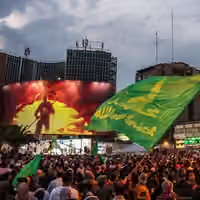
The Iranian government has allocated at least 360 trillion rials ($600 million) to its propaganda activities in the current calendar year (March 21, 2024 – 20 March 2025) amid a deep economic crisis.
The figures in this budget might seem small when converted into US dollars but considering that many private and public sector employees earn under $200 per month, it is easy to see the scale of the spending. On the other hand, the total propaganda budget constitutes a large part of the country's annual budget which is being paid out partly by printing money. This fuels a more-than-%50 annual inflation that has impoverished tens of millions of people in the past five years.
One more thing to consider is that many of the propaganda organizations also receive funds other than their official annual budget.
The reformist daily Etemad in a report last week tried to make sense of a hodgepodge of scattered numbers to arrive at a total budget figure for propaganda. This is not an easy task in Iran, as the government allocates money for propaganda in every line item, often under obscure designations. The total figure of 360 trillion rials, therefore, might be just the tip of the iceberg.
However, some numbers were clearly mentioned. For example, 1.10 trillion rials ($1.8m) of the propaganda budget is allocated to President Ebrahim Raisi's provincial visits. At the same time, while 5 trillion rials was allocated for May 10 runoff parliamentary election, mostly spent on advertising the highly staged-managed vote, to urge people to participate. The result was an eight-percent turnout.
Over 800 billion rials has been allocated to the committee that follows an international legal case about the killing of former IRGC Qods Force Commander Qasem Soleimani by the United States in 2020. Meanwhile the government is to spend 20 trillion rials on the publicity for Iran's membership In the BRICS and Shanghai pacts.
Furthermore, Iran will spend 269 billion rials to help the office of the country's Cultural Attache' in South Africa. That is in addition to another 2.8 trillion rials for its Islamic Center in South Africa.
According to Iran International TV, 77 trillion rials will be spent by the Islamic Propagation organization, a body that works in parallel with the Culture Ministry in an inexplicable duplication of efforts.
Iranian analyst Mehdi Khalaji told Iran International that the Etemad report reveals only the tip of the iceberg about propaganda spendings by the Iranian government. He said Iran runs a financial empire for ideological activities in Iran, the Middle East and other countries.
While Etemad argues that Iran's extensive spending on propaganda has yielded no tangible effects, Khalaji counters that such expenditure has contributed significantly to the survival and continuity of the Islamic Republic, its powerful clerical system, and the expansion of Shiite soft power in the region.
Khalaji highlights the influence of the clerics in Iran, noting that they control one third of all land in Iran through religious endowments. Meanwhile, the Etemad report details the budget allocations for propaganda, including 9 trillion rials dedicated to enforcing the anti-US legislation passed after former US President Trump withdrew from the 2015 nuclear deal. Additionally, nearly five trillion rials fund the state broadcaster IRIB, which also taps into the country's oil revenues from the National Development Fund. Furthermore, 10.5 trillion rials are allocated to "institutions under the Interior Ministry," which include unofficial security forces that suppress protests, and 8.5 trillion rials support pilgrimages to religious sites in Iran, Iraq, and Syria.
Meanwhile, the government will contribute 500 billion rials to help Amir Al-Momenin Seminary in Tehran as well as 1.5 billion to help the Al-Mahdi religious education center. Some other items in the propaganda budget include:
According to Etemad, these budgets have been allocated to organizations whose functions are not clear to the public and never disclose their financial statements. It is also not clear who is spending all that money, where and for what purpose, as there are no checks and balances in place to control the financial status of those organizations.

A video surfaced on social media on Sunday, showing a woman being beaten and violently arrested by a regime’s hijab enforcement police officer in Iran.
The footage shows the officer forcefully pushing the woman into a car after beating and detaining her.
The woman, whose face is not visible, can be heard saying amid the assault, “Okay, let go of me… you’ve broken my neck."
In the statement issued Tuesday morning, police said that the "defendants," including the woman whose arrest is seen in the video, must "obey the law and arrest warrant and avoid any kind of unaccustomed behavior."
Media outlets have reported that the arrest of this woman was due to her opposition to the mandatory hijab.
The statement said that the officer who apprehended the woman was arrested by order of the police commander of the relevant province and is now under investigation. The officer has reportedly been suspended from service pending appropriate measures.
In response to this statement, Iranian social media users have dismissed the news of the officer's arrest as fake.
Citing numerous past incidents, one user commented: "In a few days, there will be additional news saying the person who filmed this scene was arrested."
The Police Information Center did not provide any clarification or information on the charges against the woman or the reason for her arrest.
Other instances of hijab enforcement officers violently arresting and beating women have been reported across multiple cities in Iran recently.
This comes as part of Iran’s renewed and intensified crackdown on unveiled women, following the introduction of the Noor Plan in April at the directive of the country’s Supreme Leader Ali Khamenei.

Iranian journalist and activist Masih Alinejad called on Western leaders to challenge dictatorships worldwide and urged revolution as the only way to end authoritarianism, at the Copenhagen Democracy Summit on Tuesday, organized by activists.
The dissident, now living in exile, appealed to Western leaders to act together to impose sanctions on Iran and the Islamic Revolutionary Guard Corps (IRGC). Referring to the agenda of the summit, mainly focused on the war in Ukraine, she said: “You’re not getting anywhere if you don’t stop the Islamic Republic.”
Iran, as Russia’s ally, has helped to build up a Russian arsenal since the invasion of Ukraine in 2022, namely Shahed-136 "suicide drones." Russia has used hundreds of the drones against Ukraine's civilian and infrastructure targets. Iran’s involvement in the war has strained relations with the West, resulting in sanctions and the freezing of Tehran's nuclear deal.
“People across the globe are the victims of Islamic ideology, the Islamic Republic. If we want to end the war, then we have to end the Islamic Republic. That's the only solution,” Alinejad stated.
To illustrate the brutality Iranian government forces use against protesters, Alinejad pointed to some Iranians in the audience who were injured or raped during the Woman Life Freedom movement, including young activists who lost an eye or a hand as a result of brute use of force by security agents.
During the monthslong nationwide demonstrations that were sparked by the death in custody of Mahsa Jina Amini in September 2022, more than 550 protesters were killed, including dozens of underage protesters.
In 2021, the US Department of Justice brought conspiracy charges against Iranian agents who attempted to kidnap Alinejad from New York and take her to the Islamic Republic. In 2023, the Justice Department filed charges in a murder-for-hire plot directed against her by the Iranian regime.
On Tuesday, Politiken Newspaper announced that Danish police advised them to move the planned event with Masih Alinejad to a safer location.
“Upon advice from Danish police, we have decided to move the planned Politiken event with her from a Copenhagen cinema with winding corridors and people weaving around each other and multiple cinema halls to Politiken’s House,” the newspaper wrote.
As the World Liberty Congress, Alinejad who is the president of the group, asked world leaders to join forces in the same way authoritarian regimes support each other.
“The dictators from China to Russia, Iran, and Venezuela are working together, helping to provide surveillance technology information for each other,” Alinejad said.
“Unfortunately, the United Nations has become a place to unite dictators, so we initiated our organization,” she added.
Alinejad defined the World Liberty Congress as an alternative to the United Nations and noted that it tries to connect democracy advocates around the globe. So far, it has “united more than 200 dissidents from 56 countries under the autocratic rule.”
Among her latest initiatives, she also pointed to United Against Gender Apartheid, which aims to promote the recognition of gender apartheid as a crime that falls within the same category as racial apartheid.
“In the 21st century, gender apartheid is not a crime under international laws,” she stated. “Women from Afghanistan and Iran want to ask the world leaders to expand the definition of apartheid to include gender as well.”
Through this campaign, women share details of the oppression they feel under these authoritarian governments, usually in the form of storytelling, while recording themselves.
According to the Global Economic Forum's 2023 Global Gender Gap Report, Iran ranks 143rd out of 146 countries in terms of gender equality.
"Pakistan, Iran, and Afghanistan are at the bottom of both the regional and global ranking tables," wrote the report.
During her speech, she also raised the issue of the Political Prisoners Support Campaign, which aims to attract international attention and advocate for those who are behind bars in non-democratic countries.
“There are more than 1 million political prisoners across the authoritarian regimes. Alexi was only one of them who got killed.”

Iranian labor activist Mohammad Davari was arrested and transferred to Adelabad Prison to begin a three-year sentence on charges of "insulting Supreme Leader Ali Khamenei."
In December 2023, Judge Mahmoud Sadati, who presided over the first branch of the Islamic Revolutionary Court in the city of Shiraz, issued Davari's sentence.
Alongside the prison term, Davari faces a travel ban with passport cancellation, a prohibition on online activities, and a mandatory two-year residence in Bardsir County, Kerman.
Additionally, he was sentenced to an extra one and a half years for "propaganda against the system in favor of hostile groups online."
UN experts have long reported the absence of fair trials and judicial independence in Iran. Cases sent to the Islamic Revolutionary Courts are overseen by the regime’s security forces and intelligence apparatus.
Under Article 134 of the Islamic Penal Code, the Court handed down the maximum sentence of three years for "insulting the Supreme Leader".
Despite Khamenei’s public assurance in 2016 that criticism of him is acceptable, the charges leveled against Davari highlight the Iranian regime's intolerance toward dissent and its repressive measures against those who speak out.
Political activist Fatemeh Sepehri, vocal in her criticism of Khamenei, has been subjected to psychological torture and remains imprisoned since her arrest during the Women, Life, Freedom protests in 2022. Despite serious health issues and multiple surgeries, including open-heart surgery, Sepehri continues to be held

At this year’s opening of the Geneva Summit, Iran International’s journalist Pouria Zeraati issued a call to Western leaders, urging them to craft a new policy to back the Iranian people and confront the "terrorism stemming from the Islamic Republic of Iran."
“In this path, we all have a key role to play…so that the Iranian people’s great revolution, which began in September 2022, will become triumphant – and you, in the Western world, will no longer be threatened by a regime that is against basic human values,” Zeraati said.
Now in its 16th year, the Geneva Summit for Human Rights and Democracy is a leading annual event organized by a coalition of 25 NGOs. It convenes activists globally on the eve of the UN Human Rights Council's main session to bolster international awareness of human rights issues.
This year, Iran International was named the winner of the 2024 Geneva Summit Courage Award for "fearlessly” uncovering the daily “abuses of the Islamic Republic of Iran."
Accepting the award alongside Zeraati on Wednesday, is Iran International’s executive editor, Aliasghar Ramezanpoor.
In his speech in Geneva on Tuesday, Ramezanpoor paid tribute to the “brave people of Iran” who he said “support Iran International’s work” by sharing their stories with the network.
“The truth comes from the people of Iran. It is in their voice. And the telling of it comes at great risk to their lives. I applaud their courage, which continues to inspire me and my colleagues in the work we do,” Ramezanpoor said.
Echoing a similar sentiment, Zeraati referenced the Iranian populaces’ persistent anti-regime sentiments.
“In the past two years, the people of Iran have made their demands explicitly clear on the Iranian streets. We need to hear their voices loud and clear,” he said.
Citing the Iranian people's contributions to the news outlet's coverage, often serving as citizen journalists, and documenting incidents to share them in the absence of an independent press in Iran, Ramezanpoor said that “their contribution during the Mahsa movement significantly enhanced our coverage of the unrest."
The Mahsa movement refers to the nationwide anti-regime protests that erupted in Iran after Mahsa Jina Amini died at the hands of the so-called morality police in 2022. In its crackdown on demonstrators, security forces killed at least 550 protesters, including dozens of children.
In that vein, Ramezanpoor and Zeraati emphasized the necessity of keeping international attention focused on the repression of protesters by authorities in Iran, the abuse of political prisoners, and the death penalty.
“Although often powerless to prevent such horrors, the need to talk truth to power has real meaning for people without power,” Ramezanpoor said.
The award is being given to Iran International almost 50 days after Zeraati was stabbed by unknown assailants, outside of his London home.
While British police stated it was premature to determine a motive for the crime, Zeraati's occupation, along with other threats to Iran International, prompted the involvement of the counterterrorism unit in investigating the attack.
“It was an attack on journalism. It was an attack on freedom of speech and an attack on our core liberal values in the West,” Zeraati stated. “This act of terror to silence and imitate us abroad gives a small glimpse of what the brave people of Iran face on an everyday basis.”
For many years, Iran International has faced threats from the Iranian government. Danger to the network’s employees escalated last year, with domestic security services unable to guarantee employee safety.
The network temporarily relocated its London offices to Washington, D.C.. Before the incident, Iran's intelligence minister had declared Iran International a terrorist organization, paving the way for all manner of actions against its journalists and broadcasters.
Ramezanpoor, who was convicted by the Iranian regime in absentia for “propaganda against the government,” stated at the summit: “I am happy to report that the ongoing attempts to stop us from broadcasting have not worked - we’re still on the air.”