Nationwide Strike By Gold Retailers Sweeps Across Iran

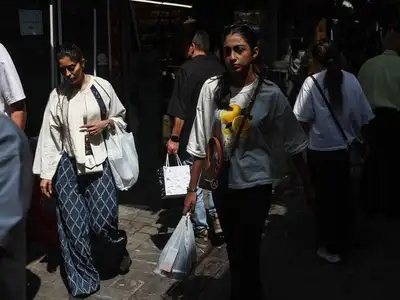
Gold jewelers across Iran have shuttered their shops, joining a merchants' strike that has now spread to multiple cities, including Tehran, Tabriz, Hamedan, Mashhad and Isfahan.

Gold jewelers across Iran have shuttered their shops, joining a merchants' strike that has now spread to multiple cities, including Tehran, Tabriz, Hamedan, Mashhad and Isfahan.
Videos obtained by Iran International show that Islamic Republic agents have sealed the shops of protesting gold jewelers in the religious city of Mashhad on Monday.
The primary grievance driving the strike is the reactivation of the Comprehensive Trade System coupled with the introduction of a Capital Gains Tax.
These measures are part of the government's broader economic strategy to streamline market operations and enhance regulatory oversight, claims President Ebrahim Raisi's administration.
However, the implementation has not been smooth, with gold and jewelry business owners expressing concerns. The new system mandates that all manufacturers and sellers, both wholesale and retail, must register their transactions, a requirement that has exacerbated anxieties within the sector over potential financial burdens.
The discontent among gold merchants intensified Sunday, as protests continued in cities like Shiraz, Yazd, Isfahan, Mashhad, Urmia, Zanjan, Qom, and Ardebil.
In a related but separate event, merchants in Bandar Abbas also held demonstrations to protest the recent hike in the value-added tax (VAT) rate, which was increased from 9% to 10% at the start of the current Iranian year in March 2024.
Experts have voiced concerns that the tax increases, which are passed on to consumers, might further fuel inflation, which has already reached an annual rate of over 50%, as reported by the Central Bank of Iran.

Several prominent ayatollahs in Iran have voiced strong criticism regarding the financial corruption of officials and clerics with close ties to Supreme Leader Ali Khamenei.
Their remarks mainly target the government's handling of issues related to compulsory hijab and financial misconduct. They question why individuals like Tehran Friday Prayers Imam Kazem Sedighi, who confessed to appropriating a $20-million land in Tehran, remain unprosecuted and at large.
However, many such critics, fearing reprisal, opt to direct their criticism not at the Supreme Leader, but towards other officials, such as Judiciary Chief Gholamhossein Mohseni Ejei, appointed by Khamenei, who is perceived as merely executing the Supreme Leader's directives.
The most prominent cleric speaking about corruption was Grand Ayatollah Abdollah Javadi Amoli , who warned the government, or in fact Khamenei, that "the problem of hijab cannot be solved using bayonets."
Speaking about the violent crackdown on Iranian women who defy compulsory hijab, Javadi Amoli said teasingly: "Adjusting the headscarf to cover more of the hair does not guarantee chastity and will certainly not prevent financial corruption."

Meanwhile, Khabar Online website quoted the ayatollah as having said in an older tweet: "Sometimes people write to me and ask why I do not say anything about the hijab." He continued that the problem of hijab cannot be solved with harsh measures. "The only thing that kind of measures can do is to encourage people to adhere to the appearance of the hijab rules. Otherwise, the problem remains unresolved."
In another development, Jamaran news website quoted Muslim scholar Ayatollah Yadollah Douzdouzani Tabrizi as having said in reference to the land grab by Tehran Friday Prayer Imam Kazem Sedighi who apologized to Khamenei for his wrongdoing: "We cannot make such mistakes and simply apologize to make it up to others."
He reminded that whatever clerics do or say is done or said in the name of Islam. He warned that taking one wrong step by a cleric will go a long way to discredit Islam. The ayatollah said this as part of peaching to his pupils at his ethics class at the seminary.
Elsewhere, in a letter to Judiciary Chief Gholamhossein Mohseni Ejei, the centrist Ntional Development Party, asked him why he is silent in the face of organized violations of the law. According to the letter: "The re-emergence of the ‘morality police’ in the streets simultaneously with the missile attack on Israel means taking advantage of an international issue to further a domestic factional matter."
The party told Ejei: "You have deeply hurt the sentiments of our nation by equating adherence to compulsory hijab with chastity, and by urging the police to treat Iranian women who defy compulsory hijab as if they were dealing with enemy agents."
The letter further stated that "It is a shame that while the country is facing its worst economic crisis in 45 years and it is at war with Israel, authorities have assigned the police force to confront the women. What makes you think that it is part of your responsibilities to harass people's wives and daughters in the streets?"
Khabar Online published a statement by Ahmad Abdollahi, a cleric at the "Promotion of Virtues and Prohibition of Vice Headquarters as saying that: "Some 2,000 women who have been arrested for hijab, have said in interviews with officials that the introduction of the morality police has had no positive impact on the way Iranian women dress."
Along the same lines, Ayatollah Mostafa Dousti Zanjani pointed out that "The people are against the government's order to enforce compulsory hijab," adding that this has been counterproductive. The Friday Prayers Imam of Gorgan Kazem Nourmofidi also said that "In the same way that the government failed to force Iranian women to remove their headscarves in the 1930s, it is impossible to force Iranian women today to wear headscarves."

In another letter from prison, Nobel Peace Prize laureate Narges Mohammadi is criticizing the harsh conditions faced by elderly female political prisoners in Tehran’s infamous Evin Prison.
Mohammadi, known for her human rights advocacy, referred to the detention of 21 Iranian women over the age of 60.
Evin prison – a primary site for political detainees – has long been known for its serious human rights abuses against dissidents.
In her letter, Mohammadi highlighted the broader issue of systemic neglect and harsh treatment of political detainees, stating that the conditions of the prisoners epitomize both the “cruelty of the Islamic Republic” and the “indomitable” spirit of women fighting for liberation.
"Society has moved past the despotic religious regime and aspires to a new plan for freedom and equality," she wrote.
Last month, Iran International reported that over 60 female political prisoners endure security and judicial pressures, with many experiencing medical neglect and age-related health complications.
Sources revealed that several prisoners were detained under unclear circumstances – and that conditions in the women’s ward are dire with prisoners deprived of basic rights, such as medical care, the ability to protest, correspondence, and family visits.
The ongoing neglect of medical needs for political prisoners has also led to multiple deaths in custody, attributed to torture, pressure, and medical negligence, further demonstrating the authorities' disregard for the health and well-being of detainees.

The head of the UN nuclear watchdog, Rafael Grossi, arrived in Tehran on Monday with the objective of repairing strained relations and bolstering cooperation and transparency between the agency and Iran.
“I proposed a set of concrete practical measures for the revitalization of the 4 March 2023 Joint Statement with aim of restoring process of confidence building and increasing transparency,” the IAEA Chief tweeted after a meeting with Iran’s Foreign Minister Hossein Amir-Abdollahian.
The IAEA delegation’s visit comes at a time the agency has admitted to having lost crucial "continuity of knowledge" regarding Tehran’s nuclear activities.
Before his departure, Grossi highlighted the increased accumulation of enriched uranium by Iran, a matter that raises alarms about potential weaponization.
The country is said to be enriching uranium to up to 60% purity, close to the 90% of weapons grade, and has enough uranium enriched to that level to make “several” nuclear bombs if it chose to do so.
Those concerns, underscored by Grossi’s own admission that the IAEA cannot fully ensure that Iran does not have additional, undisclosed centrifuges, potentially hidden from the agency's oversight.
Atomic Energy Organization of Iran chief Mohammad Eslami, meanwhile, voiced his hope that despite the media’s “negative” portrayal of Iran’s nuclear program, the IAEA can fulfill its role as an international entity independently, free from political influence and pressure.
Following Grossi’s last visit to Iran in 2023, the two parties issued a joint statement, among which Tehran had promised to continue its cooperation and provide further information and access to address outstanding safeguards issues related to three specific locations. Additionally, Tehran had agreed to allow the IAEA to implement additional verification and monitoring activities on a voluntary basis.
Since then, Iran has reneged on its promises and has deactivated surveillance devices, barred senior inspectors, and refused to disclose new nuclear facilities.
While international concerns about Iran’s nuclear program have continued to mount, Iran has often avoided being censured by the IAEA board for its non-compliance.
Grossi is also likely to attend an Iranian nuclear conference while on his two-day tour in Iran – sparking criticism.
“Such a visit risks legitimizing Tehran’s development of nuclear technology outside IAEA safeguards and Iran’s provocative nuclear advances, while minimizing the regime’s non-compliance with its nonproliferation obligations," nuclear expert Andrea Stricker said.

Iran’s Interior Minister says the Islamic Republic has deported about 1.3 million foreign nationals over the past year as part of its ongoing crackdown on illegal migrants.
Minister Ahmad Vahidi is urging the need for “legislative reform” to prevent the entry of unauthorized individuals, stating, "To block the entry of unauthorized foreign nationals into Iran, it is necessary to amend the relevant laws in the parliament."
Vahidi also said several of the deported individuals had managed to re-enter Iran, hinting that more stringent measures may be necessary to keep refugees out of the country.
Numbers from 2022 suggest that Iran houses one of the world’s largest refugee populations – with about 3.4 million reportedly living in the country.
Although specific details regarding the nationalities of those deported remain unclear, the majority of refugees in Iran are of Afghan origin.
The influx of Afghan migrants increased following the Taliban's return to power in the summer of 2021.
Iran’s own reports suggest that about 5 million Afghans currently live in Iran, though it’s unclear how many Afghans currently reside in Iran illegally. Estimates from the UNHCR say that around 780,000 registered Afghan refugees live in Iran.
Previously, Iranian officials have expressed their intent to deport at least half of the 5 million, citing a lack of necessary documentation for residency in the country.
Last year, the UNHCR renewed its non-return advisory to Afghanistan, advising against forcibly returning Afghan nationals, including those who are asylum seekers whose claims for asylum in Iran have been rejected.
Neighboring Pakistan has taken similar and extensive actions to deport Afghan refugees residing in the country.

Iran’s Supreme Leader Ali Khamenei has delivered yet another anti-US and anti-Israeli speech, implicitly also attacking Saudi Arabia, saying that "Anyone who extends a hand of friendship to America and Israel is an oppressor."
The May 6 speech that was meant to be a guide for Iranians planning to go to Hajj pilgrimage turned out to be mainly about regional issues linked to the possible rapprochement between Saudi Arabia and Israel.
Khamenei obviously hoped that Riyadh would abandon plans to establish ties with Jerusalem after the Gaza war, but this was not what exactly happened due to mediation by the United States. Secretary of State Antony Blinken and CIA Chief William Burns's engaged in active diplomacy that took them to the region several times during the past months.
Referring to a term coined by his predecessor Ruhollah Khomeini, "Distancing from the infidels," which strained ties between Iran and Saudi Arabia and resulted in the death and injury of tens of pilgrims due to the chaos caused by Iranian government agents in Mecca during the Haj pilgrimage in 1987, Khamenei described this year's Haj agenda for Iranian pilgrims as "distancing from the criminal Zionist enemy and its supporters."
This marked a return to the hostile rhetoric that was softened by Khamenei when Iran resumed its ties with Saudi Arabia in early 2023 after seven years, in a China brokered deal between the two countries.
In his speech, while targeting Saudi officials and others, Khamenei contradicted himself by calling for "unity and communication among Muslims." This overlooks the fact that his and his predecessors' hostile remarks about the Saudis contributed to one of the most significant divides among Muslim nations in the contemporary history of the region. At one point, Khomeini expressed in anger that even if he were to make peace with his arch enemy, the United States, normalizing ties with Saudi Arabia would remain absolutely impossible.
Khamenei has also lashed out at Saudi Arabia several times making angry comments against the plan to establish ties between Riyadh and Jerusalem.
On a religious note, Khamenei's comments annoys Iranians who see the pilgrimage as a religious responsibility and do not want to make themselves pawns in yet another political game played by Khamenei.
Khamenei called Haj an opportunity for Iranian Muslims to communicate with other Muslims. This comes while his hostile policies and hate speech has left very few friends for Iran from among Muslim nations. At the same, once again contradicting himself, he called on Iranian pilgrims to ignore national, ethnic and religious differences among Muslims.
Meanwhile, while calling for friendship among the believers of Abrahamic religions he excluded the Jewish State by calling Israel "a blood sucker" and "a rabid dog." A few minutes later he attributed "blood sucking" to "Western civilization" adding another dimension to his hateful speech.
He said the United States was equally responsible for what happened in Gaza because of its all-out support for Israel. He further called Israel an enemy of Muslims and said the United States was its accomplice.
Khamenei also reiterated that Iran would lend its unwavering support to the people of Palestine and will not wait for others to join. He called on Iranian and non-Iranian pilgrims to support Palestinians. He also called on the pilgrims to rebel against tyrant rulers.
Iran is sending 87,550 pilgrims to Saudi Arabia this year starting from May 14 for 25 days.