Israel Showed It Can Protect Itself, Iran Is Isolated - Germany
German Foreign Minister Annalena Baerbock says Israel has shown that it is strong and can defend itself by repelling an Iranian attack overnight together with allies.
"The worldwide condemnation and the important support of the USA, Great Britain and also from the region shows two things very clearly: Iran is isolated with its aggressive behavior, with which it wants to destabilize an entire region, and Israel's capabilities have shown that Israel is strong, Israel can protect itself."
"The Iranian regime has knowingly led the entire Middle East to the edge of the abyss. Last night, the Iranian regime fired over 300 rockets, drones and cruise missiles at Israel. We condemn the direct Iranian attack on Israeli territory in the strongest possible terms. Germany stands in full solidarity with Israel.
Chancellor Olaf Scholz also warned Iran against further attacks on Israel on Sunday as the escalating conflict in the Middle East overshadowed the start of his three-day tour of China.
"We will do everything to stop a further escalation," Scholz told reporters. "We can only warn everyone, especially Iran, against continuing this way."
The Israeli Foreign Ministry, addressing the people of Iran via its Farsi page on X, emphasized that its conflict is with the Islamic Republic, not the Iranian people.
The same message was also echoed in English on the ministry's official page.
In response to Iranian claims of causing significant damage, the ministry also posted a video of a fighter jet landing safely at Nevatim Airbase, dispelling the allegations as operations at the base continued unimpaired.
Additionally, a video surfaced from the Iranian parliament where members were seen celebrating the attack on Israel and chanting "Death to Israel!" The Israeli foreign ministry responded stating, "One thing is clear: We are strong, resilient, and we will never give in to terror. Those who harm the people of Israel will pay the price."
The escalation followed an April 1 attack on the Iranian embassy in Damascus, which Iran attributes to Israel, resulting in the deaths of two IRGC generals among others.
Iran's permanent mission to the UN wrote on X that the aerial bombardment was "Conducted on the strength of Article 51 of the UN Charter pertaining to legitimate defense, Iran’s military action was in response to the Zionist regime’s aggression against our diplomatic premises in Damascus."
In a warning to the US which had supported Israel's defensive efforts on Sunday morning along with the UK, France and Jordan, the post said that while the operation was complete, it warned: "The matter can be deemed concluded. However, should the Israeli regime make another mistake, Iran’s response will be considerably more severe. It is a conflict between Iran and the rogue Israeli regime, from which the US MUST STAY AWAY!
Iranian President Ebrahim Raisi has hailed the IRGC's attack, warning that Iran's response to any retaliation by Israel will be "significantly heavier."
“Last night, your zealous and courageous children in the Islamic Revolution Guards Corps (IRGC), with the cooperation and coordination of all the defense and political sectors of the country, turned a new page in the history of Iran’s authority and taught a lesson to the Zionist enemy,” he said in a statement.
Foreign Minister Hossein Amirabdollahian said on Sunday in a post on X that Iran has no intention of prolonging its "defensive operations" but it will not hesitate to safeguard its legitimate interests against any new aggression.
Iran's foreign ministry summoned on Sunday the ambassadors of Britain, France, and Germany to question what it referred to as their "irresponsible stance" regarding Tehran's retaliatory strikes on Israel. The three European countries have condemned Iran's attack.
The director for Western Europe at Iran's foreign ministry accused the three countries of "double standards" as they opposed earlier this month a Russian-drafted UN Security Council statement that would have condemned Israel's attack on Iran's consulate in Syria.
"Iran's military action against the Zionist regime's (Israel) bases is well within the framework of the right to legitimate defence stipulated in Article 51 of the United Nations Charter and it is in response to a series of crimes, including the recent attack on the embassy compound in Syria," the official added.
In a coordinated effort, Iranian state media and supporters of the Islamic Republic have launched a disinformation campaign regarding the damages of the attack.
The campaign aims to project an image of Iranian military dominance by portraying the attack as a resounding success, stoke fear among the Israeli population through exaggerated reports of damage and casualties, and fabricate international backing for Iran's actions.
For example, the state-run newspaper Iran posted a video on social media platform X, claiming it showed Iranian missiles hitting Israel's Negev Airbase. However, fact-checking efforts revealed the footage to be unrelated, depicting a fire incident from months ago in the United States.
The daily falsely reported that Israel's Nevatim Airbase was rendered inoperable. Countering this claim, the Israeli military released a video of an F-35 landing at the base after the attack, demonstrating its continued functionality.
Israeli Air Force F-35 Lightning 'Adir' fighter jet lands at a location given as Nevatim Airbase after an aerial defense mission, in Israel, in this screen grab taken from a handout video released on April 14, 2024
Further exposing the disinformation tactics, fact-checkers debunked a video circulated by "Jamejam," affiliated with Iranian state broadcaster IRIB. The video, purporting to show Iranian missiles passing Israel’s Iron Dome defense system, was actually footage of a Ukrainian attack on Russian ships at Sevastopol port earlier in the year.
Iranian regime’s direct retaliation against Israel from Iran’s soil establishes beyond any doubt that the ruling clerics are reeking in desperation in the face of Israel’s humiliating April 1 strike.
Israel, escalating its attacks against Iranian targets in Syria, raised the bar and hit a building in Iran’s embassy compound in Damascus, killing seven IRGC officers, who were key in Tehran’s proxy operations. For 13 days, Khamenei was facing a Hobson’s choice.
Khamenei’s regime has been suffering from an unprecedented crisis of legitimacy and credibility in recent years and it seeks to reassure its “armed supporters” within and without the Iranian borders of its enduring rigor and robustness. The retaliation seems to have been a desperate face-saving attempt by Khamenei against all odds.
From the outset the operation was doomed to fail as the low-tech Iranian drones and cruise missiles had to traverse a 1000-mile distance between the two countries. It was inevitable that the behemoth of the Israeli, American, and British regional and satellite surveillance capabilities would detect and track down this cavalcade of slow-moving projectiles en route to the Israeli air space. Thus, the bulk of the Iranian swarm, except for a handful few, amply became an easy prey for American, British, Israeli, and Jordanian air defenses that managed to intercept and shoot them down with agility and precision. Based on early estimates by the Israeli Defense Forces, few of the said projectiles did reach the Israeli air space and even fewer managed to effectuate an impact on any target on Israeli soil. The Iranian regime’s propaganda machine has already staged out jingoistic carnivals on major Iranian city streets that seek to replay the militant Islamic youths’ parades of the Iran-Iraq War (1980-1988) years.
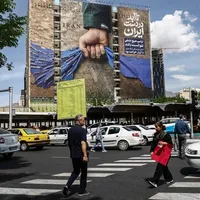
An anti-Israel billboard is seen from a street in Tehran, Iran April 14, 2024.
In fact, the gap between the Iranian regime and people at large has been widening at levels reminiscent of the last couple of years of the Iran-Iraq War when the Iranian masses could no longer bear chronic shortages in basic goods, food, high fuel costs, and commodities. The poverty index in the country has reached heights never seen before in contemporary Iranian history and the regime’s lack of legitimacy has even reached the traditional working classes that supplied the bulwark of the volunteer fighters during the Iran-Iraq War. Khamenei’s regime has even lost that critical support base in the recent years.
Since 2018 when US President Donald J Trump pulled out of the nuclear deal with Iran (JCPOA), the Iranian economy has been in a ruinous downward spiral. The ruling clergy and their praetorian IRGC have been struggling to preserve their regime from economic collapse at the hands of runaway inflation, rampant government rentier corruption, a twenty-year drought, widening international sanctions, and dwindling oil revenues. Over the past 6 years the regime has had to face off mass nationwide protests that have called for the regime’s ouster. From November 2019 nationwide brutal crackdown to the unprecedented suppression of the 2022 Woman, Life, Freedom uprising, the regime’s security forces have committed countless crimes against humanity toward civilians. The magnitude of this brutal suppression has led to a fact finding mission mandated by the UN Human Rights Council.
A regime that once professed to be the patron of all “oppressed peoples” is now only in power through its security and military industrial complex. Since 7 October 2023 Hamas attacks on Israel, Iran’s Shia Imperium has unleashed the arsenal of suicide drones, rockets, and missiles (ballistic and cruise) of its armed proxies from Iraq, Lebanon, Syria and Yemen upon Israel, the US bases, as well as the maritime navigation in the Red Sea.
For years, the Islamic regime engaged Israel via its armed proxies, primarily and chiefly, the Hezbollah of Lebanon, Hamas, and the Islamic Jihad of Palestine. The humiliation of having two his top generals killed by Israel on April 1 was, however, a tremendous blow to Khamenei’s brand as a truly anti-Israeli leader amongst Iran’s friends and foes alike. He could no longer hide behind its proxies and had to confront Israel directly.
Irrespective of the miserable failure of the Iranian retaliation against Israel, the Israeli war cabinet has effectively called Khamenei’s bluff by vowing to respond to the Iranian retaliation. As Iran and Israel have no common borders, the war of attrition with Israel will inevitably be an all-out asymmetrical war through proxies. The question is whether Russia and China would continue to economically bail out the Iranian regime. Only time and the continuing strategic value of Iran in the West-East rivalries can answer such a question with certainty.
In the end, Khamenei’s direct attack against Israel from the Iranian soil represents a radical “doctrinal shift” that can only preserve his legitimacy amongst the regime’s regional proxies. In the 1980s, many Iranians perceived the war against Iraq as just. Except for the regime’s ever thinning armed supporters, any war of attrition, direct or asymmetrical, will further burden the collapsing Iranian economy. In this context, most Iranians are economically impoverished and politically discontented with the regime. Moreover, great many of them do not perceive any conflict with Israel as just. Khamenei may soon realize that his gamble to save face will backfire, within and without the Iranian borders.
The opinions expressed by the author are not necessarily the views of Iran International.
Follow developments on Iran International'sLive coverageof ongoing tensions between Iran and Israel.