Canada Limits Researchers Linked To China, Iran, Russia
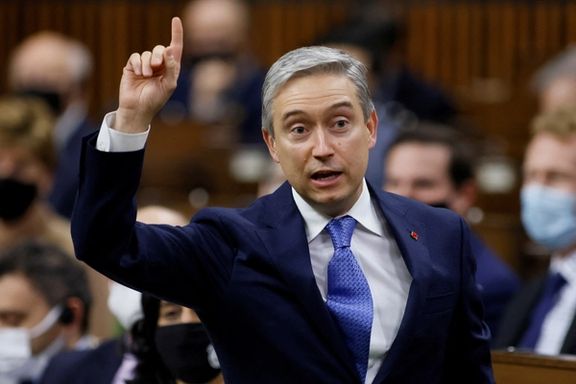
Canada's Minister of Innovation, Science and Industry Francois-Philippe Champagne in the House of Commons on Parliament Hill in Ottawa, Ontario, Canada December 14, 2021
Canada on Tuesday restricted researchers linked to universities based in China, Russia and Iran from working on subjects critical to Canadian national security.
Ottawa introduced the measures to withhold government grants from researchers having ties to universities associated with the defense and security entities of countries posing potential security threats. While the majority of the listed universities are based in China, a handful from Iran and Russia are also included.
"While Canadian-led research is defined by its excellence and collaborative nature, its openness can make it a target for foreign influence," the ministers of innovation, health, and public safety said in a joint statement.
An official clarified that the current policy directly impacts federal funding but said they hope that it would serve as guidance for provincial governments and institutions across Canada.
In 2022, Canada made headlines by arresting and charging a researcher with espionage, alleging an attempt to steal trade secrets for the benefit of China.
As a member of the "Five Eyes" alliance, alongside Britain, the United States, New Zealand, and Australia, Canada has actively participated in the intelligence community's accusations against China for intellectual property theft. Last year, the alliance's intelligence chiefs accused China of utilizing artificial intelligence for hacking and spying against member nations.
The longstanding issue of intellectual property theft continues to be a significant point of contention in US-China relations.
USS LEWIS B. PULLER (ESB 3) intercepted this dhow and conducted a nighttime boarding on January 11, 2024.
The Office of the US Special Envoy for Iran has condemned Tehran’s backing of Houthi rebels, with a commitment from Washington to ensure freedom of navigation.
Abram Paley, the US Deputy Special Envoy to Iran, made the statements following the interception by US Navy of a small vessel transporting advanced lethal aid from Iran to resupply Houthi forces in Yemen on Tuesday.
Despite Iran's official denial of supporting the Houthis, Paley underscored their attempt to provide resupplies, a direct violation of UNSCR 2216 and international law.
Quoting CENTCOM General Kurilla, Paley characterized the incident as another example of Iran actively fostering instability in the region. He expressed the United States' dedication to working with allies and partners to expose and thwart Iran's activities, ensuring freedom of navigation in the affected regions.
Since mid-November, Houthi rebels have made dozens of attacks on commercial vessels in a bid to force Israel into a ceasefire amidst its war on Hamas in Gaza.
This has resulted in the closure of a vital maritime route, causing disruptions to the global flow of goods. The initiation of the attacks coincided with a call from Iran's Supreme Leader, Ali Khamenei, urging the blockade of Israel.
File photo of several Iranian missiles being fired during war games
Following Iran’s airstrikes in Iraq, Syria and Pakistan, the Arab League is set to hold an emergency meeting while Islamabad and Baghdad have recalled ambassadors.
The Iraqi state news agency announced that the meeting will focus on Iran's Revolutionary Guards Monday missile strike on Erbil in Iraqi Kurdistan. The date of the session is not announced yet. The country has also lodged a complaint at the United Nations Security Council and recalled its ambassador from Tehran.
Also on Wednesday, a Pakistani foreign ministry spokeswoman said the country has recalled its ambassador over the Islamic Republic’s violation of its airspace, calling it a 'blatant breach' of its sovereignty. Pakistan will not allow Iran's ambassador, who was visiting his home country, to return, the ministry said in a statement. Latest reports Wednesday evening local time spoke of Pakistan closing its border with Iran.
In less than one day, the IRGC launched missile and drone strikes on three neighboring countries, claiming ‘revenge’ for civilians and troops killed in the past few weeks. Having hit several locations in Syria and Iraqi Kurdistan Monday, IRGC missiles and drones targeted Pakistan Tuesday, in an operation that Iran said was against two bases of the Sunni militant group Jaish al-Adl. Provincial officials in Pakistan said two children were killed and several others injured by missile strikes near the Iran border, while another toddler was killed in the IRGC’s strikes in Erbil.
A view of a damaged building following missile attacks, in Erbil, Iraq, January 16, 2024.
Iran's Foreign Minister Amir-Abdollahian said Tehran hit militants in "missile and drone" strikes, claiming that no Pakistani national was targeted. Only "terrorists" were hit, the Iranian diplomat said at Davos, Switzerland, where he was participating in the World Economic Forum, alleging that those targeted were linked to Israel.
According to the Pakistan foreign ministry spokeswoman, Mumtaz Zahra Baloch, the violation was "unprovoked and unacceptable," adding that the country reserved "the right to respond to this illegal act."
Iran and Pakistan have rocky but functioning ties. Clashes in border areas occur from time to time, mainly involving groups such as Jaish al-Adl, which has claimed responsibility for attacks on, and the killing of, several Iranian border patrols.
On Tuesday, hours before the airstrikes, Iran and Pakistan had a joint military exercise in the Persian Gulf, according to Iran’s official news agency IRNA, and Iran’s foreign minister met Pakistan’s caretaker prime minister on the sidelines of the World Economic Forum in Davos.
Officials in Pakistan's southwestern province of Baluchistan, which borders Iran, said that four missiles had hit the Panjgur district close to the Iranian border. "Four missiles were fired in the village of Koh-i-Sabaz which is around 50 km inside Pakistan soil," a senior official of the Panjgur administration told Reuters. "A mosque and three houses were damaged in the attack," another official said.
Iran’s muscle-flexing – using ballistic missiles on targets, some of which were well over 1,200 km away -- comes amid US and UK airstrikes on Iran-backed Houthis in Yemen, who, nonetheless, continue to target vessels in the Red Sea as a show of support for Palestinians in Gaza.
While the attacks on Syria and Pakistan do not seem directly related to Israel, with Tehran claiming the strikes were targeting anti-Iran terror groups, they signal bolder direct action from Iran, which funds and supplies forces opposing Israel like Hezbollah in Lebanon, Hamas in Gaza and the Houthis in Yemen.
Claiming that the Houthis "are not receiving any orders or instructions from Tehran," Amir-Abdollahian said in Davos that attacks against Israel and its interests by the "Axis of Resistance" will stop if the Gaza war ends. ‘Axis of Resistance’ is a term the Islamic Republic uses for its network of proxy militia across the region.
The Biden administration is set to re-designate the Houthis as a terrorist organization in light of the terror the group is waging on global trade and targets, three years after it lifted the designation upon assuming office.
IRGC Colonel Hossein-Ali Javdanfar has been killed after armed men opened fire on the car near the Pakistan border where tensions are rising since Iran launched an attack on Baluch outposts on Tuesday night.
The IRGC Ground Force’s Quds Base issued a statement identifying Javdanfar, saying he had been on a mission related to cultural activities and projects in Saravan County. Jaish al-Adl Sunni militant group has claimed responsibility for his killing, adding that two of his "bodyguards" were also killed by their forces.
In response, Pakistan denounced the attack as "illegal" and "completely unacceptable," claiming casualties, including the death of two children, and warning of "serious consequences."
Jaish al-Adl confirmed the strikes, stating that two of its members' homes were hit, killing two children and injuring two women and a teenage girl.
Founded in 2012, the group operates primarily in Pakistan, and Iran has previously faced border clashes with them. Despite occasional difficulties, Iran and Pakistan maintain functional relations, but the missile-and-drone attack on Pakistan is unprecedented.
Iran's President Ebrahim Raisi (right) and Mohammad Mahdi Esmaeili, the minister of culture and Islamic guidance, during a meeting on January 16, 2024
President Ebrahim Raisi has a significant role in Internet censorship by blocking websites and apps, a recent report by Tehran E-commerce Association has alleged.
Although all three branches of government are directly involved in the process of censorship, by appointing half of the members of the committee that decides which sites should be filtered, the President should be held accountable for the problems Iranians face in free access to the Internet, the association’s report published Monday said.
“Iran's internet situation is very similar to poor and underdeveloped countries, internet access quality indices show, but the main difference [with those countries] is that in Iran's case these conditions are self-inflicted,” the report said.
Self-inflicted, the report says, means that a significant part of the country's internet access problems, from filtering to speed that affects loading times as well as widespread disruptions, arise from policies, management and laws rather than problems in infrastructure development such as fiber optic expansion which the government insists is the solution to the problem.
Restrictions on social networks in several countries in 2023
Tehran E-Commerce Association was founded in 2019 by several major ecommerce and online services companies including Digikala e-commerce platform, Snapp vehicle for hire, Cafe Bazar app store for the Android operating systems, and Divar classified ads and e-commerce platform and has so far published two detailed reports.
According to the recent report, there has been relative improvement in latency and bandwidth and access to restricted sites since July when the first report was released, but the improvement has made very little difference in ease of access to the internet because Iranians are still forced to use anti-filtering software (VPNs) which costs families lot of money amid an annual inflation rate of 50 percent and affects the quality of their access.
The report shows that filtering at IP level causes collateral damage and restricts access to many websites without reason and forces users to use anti-filtering software at all times.
Iran not only filters a vast array of websites including all major social media platforms and international platforms such as Google Play but has also employs a reverse filtering procedure called Iran Access to block the access of users outside the country to many Iranian websites including the websites of government organizations as well as banks and other financial entities. This is apparently to reduce the risk of foreign hacking, which has been occurring frequently, targeting government organizations.
The use of anti-filtering software makes users’ equipment more vulnerable to cyber threats and exposes online businesses to greater risks of user data leaks, the report added.
Hackers have targeted online businesses many times in recent years to steal personal information and sensitive data. Only last week Snapp Food, the largest online food delivery platform in Iran, was hacked by an Iranian hacking group that claimed it had accessed the personal details of over 20 million users.
A member of the Iranian parliament’s cultural commission announced a substantial fine of 240 million rials for the violation of the hijab in Iran, a record high.
Amir-Hossein Bankipour said, “a fine of 30 million rials for the first-time violation” will be in place, however, the gravity of the penalty is amplified for the second offense, as people “must now face court proceedings, with a penalty of 240 million rials.”
Bankipour's statements have drawn attention to the significant sum, equivalent to over two months' wages, nearly 500 US dollars, in Iran. The controversial proposal has ignited discussions about the severity of the penalties and their potential economic implications on women.
The legislator revealed that there were differing opinions during the bill's formulation, with some suggesting the immediate referral of individuals without a hijab to court, a proposal rejected by the Judiciary Commission. Bankipour emphasized that, “for minor offenses such as a woman not observing the hijab in public, the approved provision stipulates a fine instead of a direct court appearance.”
The bill, officially titled "Protection of Family Through Promotion of Hijab and Chastity Culture," initially secured parliamentary approval in September. However, it encountered an unexpected setback when the Guardian Council, holding ultimate legislative authority, rejected it. The rejection cited formal deficiencies and called for revisions to clarify ambiguous terms.
The development occurs against the backdrop of protests triggered by the tragic death of Mahsa Amini in 2022. Mass hijab rebellion has swept the country with increasing surveillance and crackdowns failing to stem the tide.